Guarneri Fabrizio, Custurone Paolo, Papaianni Valeria, Gangemi Sebastiano
Department of Clinical and Experimental Medicine, Dermatology, University of Messina, Via Consolare Valeria-Gazzi, 98125 Messina, Italy.
School and Operative Unit of Allergy and Clinical Immunology, Department of Clinical and Experimental Medicine, University of Messina, Via Consolare Valeria-Gazzi, 98125 Messina, Italy.
Antioxidants (Basel). 2021 Jan 9;10(1):82. doi: 10.3390/antiox10010082.
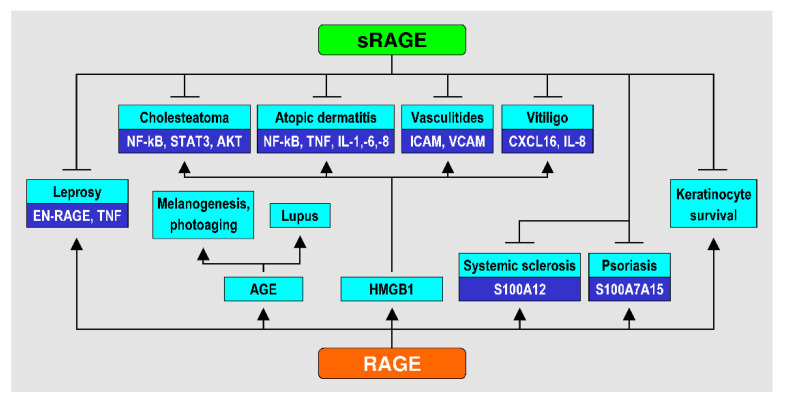
The surface receptor for advanced glycosylation end-products (RAGE) and its soluble (sRAGE) and endogenous secretory (EN-RAGE) forms belong to the superfamily of toll-like receptors and play important roles in inflammation and autoimmunity, directly or through binding with advanced glycosylation end-products (AGE) and advanced oxidation protein products (AOPP). We reviewed the literature on the role of RAGE in skin diseases. Research in this field is still rather limited (28 articles) but suggests the involvement of RAGE and RAGE-related pathways in chronic inflammatory diseases (lupus, psoriasis, atopic dermatitis, and lichen planus), infectious diseases (leprosy, -induced skin lesions), alterations of the repairing processes in diabetic skin, systemic sclerosis, and ulcers. These data prompt further research in this field, which not only will be useful to better understand the pathogenetic mechanisms of diseases, but is also likely to have intriguing clinical implications. Indeed, when their role in the complex and multifactorial inflammatory balance will be adequately defined, RAGE and related molecules could be used as markers of disease severity and/or response to treatment. Moreover, future promising therapeutic perspectives could be topical administration of some of these molecules (e.g., sRAGE) to modulate local inflammatory response and/or the development of anti-RAGE antibodies for systemic treatment.
晚期糖基化终末产物表面受体(RAGE)及其可溶性形式(sRAGE)和内源性分泌形式(EN-RAGE)属于Toll样受体超家族,在炎症和自身免疫中直接或通过与晚期糖基化终末产物(AGE)和晚期氧化蛋白产物(AOPP)结合发挥重要作用。我们回顾了关于RAGE在皮肤疾病中作用的文献。该领域的研究仍然相当有限(28篇文章),但提示RAGE及RAGE相关途径参与慢性炎症性疾病(狼疮、银屑病、特应性皮炎和扁平苔藓)、传染病(麻风、诱导的皮肤病变)、糖尿病皮肤修复过程的改变、系统性硬化症和溃疡。这些数据促使该领域开展进一步研究,这不仅有助于更好地理解疾病的发病机制,而且可能具有引人关注的临床意义。事实上,当RAGE及其相关分子在复杂的多因素炎症平衡中的作用得到充分界定时,它们可作为疾病严重程度和/或治疗反应的标志物。此外,未来有前景的治疗方法可能是局部应用其中一些分子(如sRAGE)来调节局部炎症反应和/或开发用于全身治疗的抗RAGE抗体。