Ferreira Carolina, Viana Sofia D, Reis Flávio
Institute of Pharmacology & Experimental Therapeutics, Coimbra Institute for Clinical and Biomedical Research (iCBR), Faculty of Medicine, University of Coimbra, 3000-548 Coimbra, Portugal.
Center for Innovative Biomedicine and Biotechnology (CIBB), University of Coimbra, 3004-504 Coimbra, Portugal.
Microorganisms. 2020 Oct 1;8(10):1514. doi: 10.3390/microorganisms8101514.
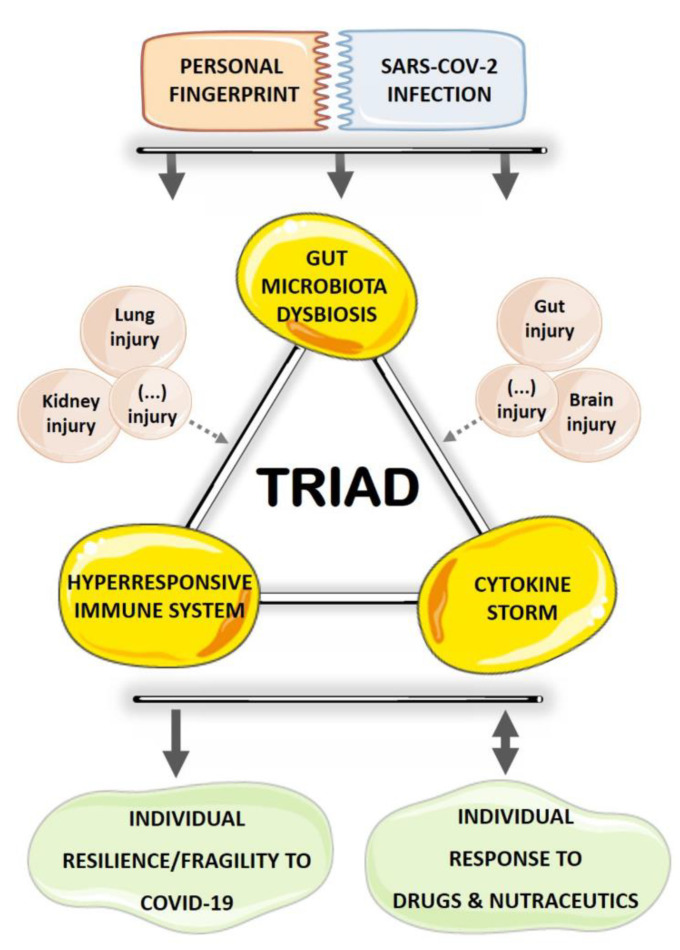
Coronavirus Disease 2019 (COVID-19) is a pandemic infection caused by a novel coronavirus named severe acute respiratory syndrome coronavirus 2 (SARS-CoV-2). Patients present a complex clinical picture that, in severe cases, evolves to respiratory, hepatic, gastrointestinal, and neurological complications, and eventually death. The underlying pathophysiological mechanisms are complex and multifactorial and have been summarized as a hyperresponse of the immune system that originates an inflammatory/cytokine storm. In elderly patients, particularly in those with pre-existing cardiovascular, metabolic, renal, and pulmonary disorders, the disease is particularly severe, causing prolonged hospitalization at intensive care units (ICU) and an increased mortality rate. Curiously, the same populations have been described as more prone to a gut microbiota (GM) dysbiosis profile. Intestinal microflora plays a major role in many metabolic and immune functions of the host, including to educate and strengthen the immune system to fight infections, namely of viral origin. Notably, recent studies suggest the existence of GM dysbiosis in COVID-19 patients. This review article highlights the interplay between the triad GM dysbiosis-immune hyperresponse-inflammation in the individual resilience/fragility to SARS-CoV-2 infection and presents the putative impact of pharmacological and nutraceutical approaches on the triumvirate, with focus on GM.
2019冠状病毒病(COVID-19)是由一种名为严重急性呼吸综合征冠状病毒2(SARS-CoV-2)的新型冠状病毒引起的大流行性感染。患者呈现出复杂的临床症状,在严重情况下,会发展为呼吸、肝脏、胃肠道和神经并发症,最终导致死亡。潜在的病理生理机制复杂且多因素,已被总结为免疫系统的过度反应,引发炎症/细胞因子风暴。在老年患者中,尤其是那些患有心血管、代谢、肾脏和肺部疾病的患者,病情尤为严重,导致在重症监护病房(ICU)住院时间延长,死亡率增加。奇怪的是,同一人群被描述为更容易出现肠道微生物群(GM)失调。肠道微生物群在宿主的许多代谢和免疫功能中发挥着重要作用,包括培养和增强免疫系统以对抗感染,尤其是病毒感染。值得注意的是,最近的研究表明COVID-19患者存在GM失调。这篇综述文章强调了GM失调-免疫过度反应-炎症三联征在个体对SARS-CoV-2感染的恢复力/脆弱性中的相互作用,并介绍了药理学和营养保健品方法对这三者的假定影响,重点是GM。