Wulff Nelson A, Daniel Bruno, Sassi Rodrigo S, Moreira Alécio S, Bassanezi Renato B, Sala Ivaldo, Coletti Daniela A B, Rodrigues Júlio C
Fundo de Defesa da Citricultura-FUNDECITRUS-Araraquara, São Paulo 14807-040, Brazil.
Professional Master Program on Citrus Diseases and Pest Control (MasterCitrus)/FUNDECITRUS-Araraquara, São Paulo 14807-040, Brazil.
Insects. 2020 Oct 3;11(10):672. doi: 10.3390/insects11100672.
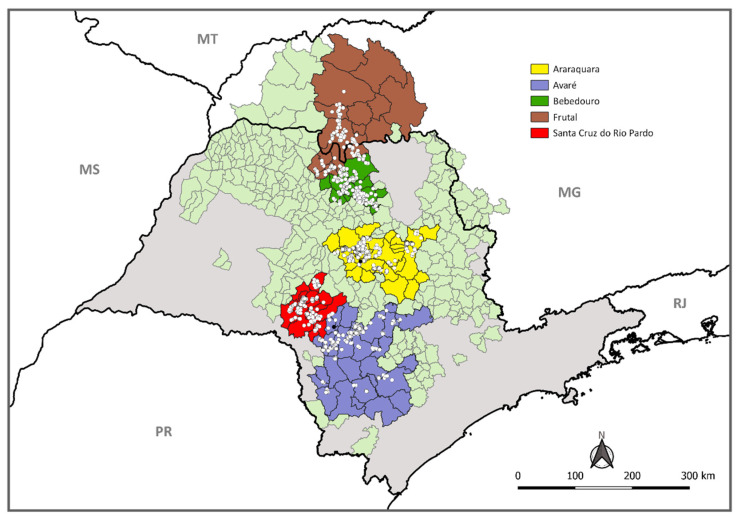
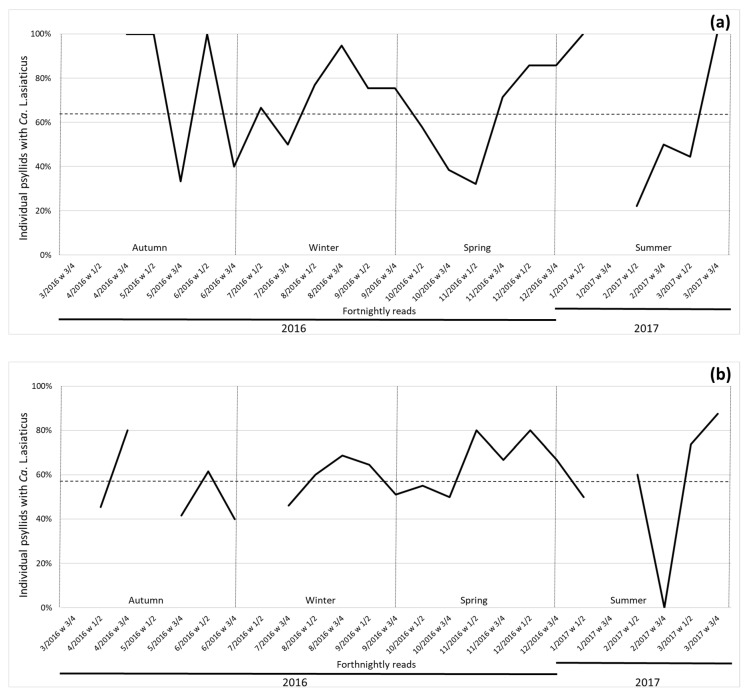
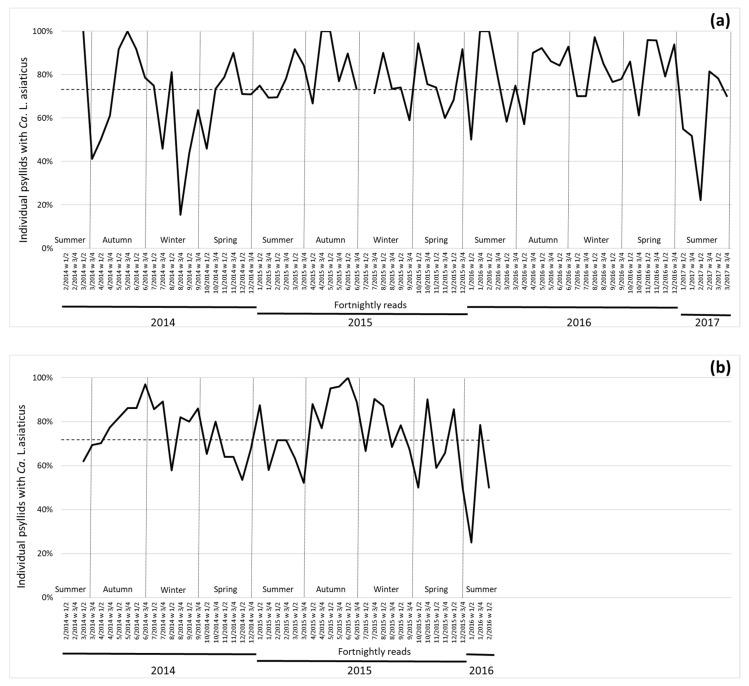
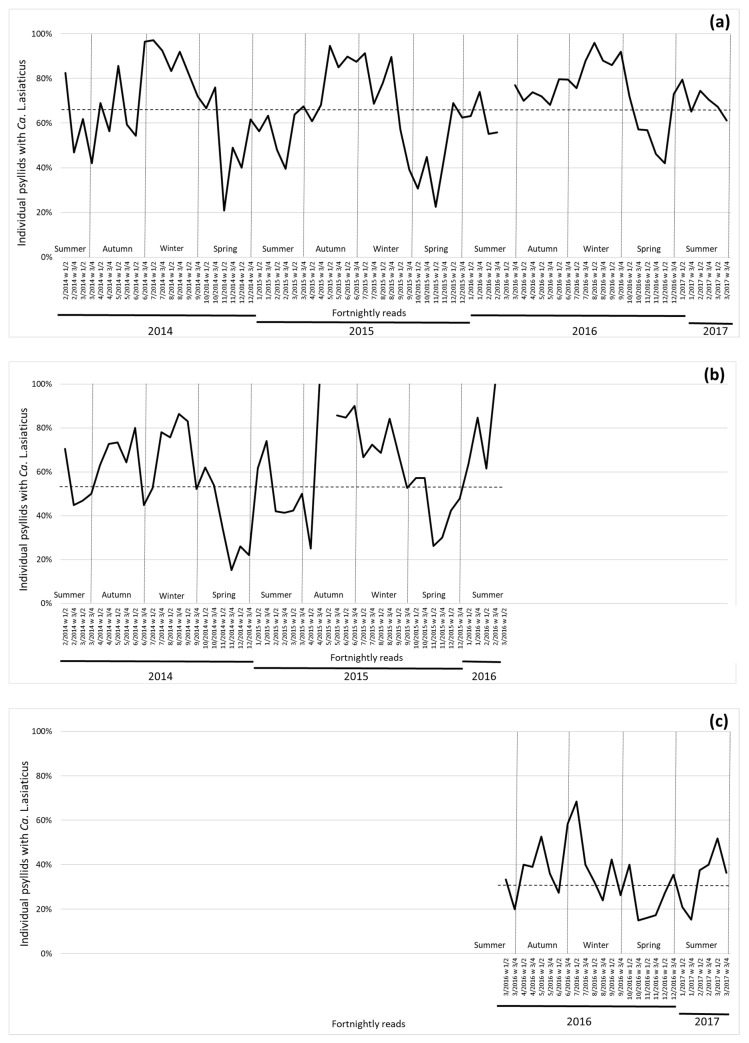
Huanglongbing (HLB) is a citrus disease of worldwide importance, associated with the presence of Liberibacter asiaticus (Las) and vectored by the psyllid in Asia and the Americas. To properly manage HLB, removal of inoculum sources and control of the psyllid are undertaken. We evaluated the percentage of the psyllid population with Las, sampled from yellow sticky traps over a three-year period and its relationship with insect population, regions, season of the year, and HLB management in citrus areas in the southwestern, central, and northern regions of São Paulo (SP) and southwestern region of Minas Gerais states, Brazil. In each reading, up to 50 psyllids per region were collected and detection of Las in individual psyllids were made by quantitative polymerase chain reaction. The percentage of psyllids with Las-an average of 65.3%-was constant throughout the year in the southwestern region of SP state, while showing an increase from spring to autumn when sampled from central to northern regions. The proportion of psyllids carrying Las from each region and year period were compared by a proportion test and spectral density analysis. The proportion of psyllids carrying Las evaluated in the same region in different seasons presented statistical differences in central (Araraquara) and southwestern (Santa Cruz do Rio Pardo) regions in 2015, with higher values in the first semester (summer and autumn) than in the second semester (winter and spring). Orchards with poor HLB management had higher incidence of psyllids with Las. Spectral density analysis indicated that good management areas had 50% less relevant peaks of psyllids with Las than in areas with poor HLB management practices. The relationship between the percentage of psyllids carrying Las and the number of captured psyllids in the region in a given time denotes the most critical intake time for HLB spread in citrus orchards. The reduction in the population of psyllids carrying Las is a direct benefit from the use of good management practices.
黄龙病(HLB)是一种具有全球重要性的柑橘病害,与亚洲韧皮杆菌(Las)的存在有关,并由木虱在亚洲和美洲传播。为了妥善管理黄龙病,需清除接种源并控制木虱。我们评估了在三年时间里从黄色粘虫板上采集的携带Las的木虱种群百分比,以及它与昆虫种群、地区、年份季节和巴西圣保罗州(SP)西南部、中部和北部以及米纳斯吉拉斯州西南部柑橘产区黄龙病管理之间的关系。每次读数时,每个地区最多收集50只木虱,并通过定量聚合酶链反应检测单个木虱体内的Las。在SP州西南部地区,携带Las的木虱百分比——平均为65.3%——全年保持恒定,而从中部到北部地区采样时,该百分比从春季到秋季呈上升趋势。通过比例检验和谱密度分析比较了不同地区和年份时段携带Las的木虱比例。2015年,在中部(阿拉拉夸拉)和西南部(里奥帕尔多河畔圣克鲁斯)地区,同一地区不同季节评估的携带Las的木虱比例存在统计学差异,第一学期(夏季和秋季)的值高于第二学期(冬季和春季)。黄龙病管理不善的果园中携带Las的木虱发生率更高。谱密度分析表明,管理良好的地区携带Las的木虱相关峰值比黄龙病管理措施不佳的地区少50%。在给定时间内,某地区携带Las的木虱百分比与捕获的木虱数量之间的关系表明了黄龙病在柑橘果园传播的最关键传入时间。减少携带Las的木虱数量是采用良好管理措施的直接益处。