Fentie Kelemu, Wakayo Tolassa, Gizaw Getu
Jimma University Medical Center, Jimma, Ethiopia.
Department of Human Nutrition and Dietetics, Faculty of Public Health, Institute of Health, Jimma University, Jimma, Ethiopia.
Anemia. 2020 Sep 22;2020:5043646. doi: 10.1155/2020/5043646. eCollection 2020.
Anemia defined as a low blood hemoglobin concentration is public health importance. The adolescence age group is the most neglected in public health and nutrition research as priorities are usually given to pregnant women, lactating mothers, and their children less than 2 years. Current Ethiopian Food and Nutrition policy included adolescent girls in the most at-risk group for nutritional demands; however, only a few published studies have assessed a deficiency of anemia and associated factors to tackle the intergenerational cycle of malnutrition.
To assess the prevalence of anemia and associated factors among high school adolescent girls in Jimma town.
Data were collected from 528 secondary school adolescent girls by a school-based cross-sectional study design in Jimma town from 1/1/2019 to 1/2/2019, southwest Ethiopia. A multistage sampling technique was used to select the study participants. A portable battery-operated HemoCue Hb 301+ analyzer was used to measure the hemoglobin level, and then reading was classified as normal Hb ≥ 12 g\dl and anemic if the hemoglobin value <12 g/dl based on the WHO 2011 recommended cutoff points after adjustments to altitude was made. Bivariate analysis at value ≤0.25 was considered as a candidate for multivariable logistic regression. Multivariable logistic regression was done to control for confounders and to identify factors independently associated with anemia. Level of statistical significance was declared at < 0.05.
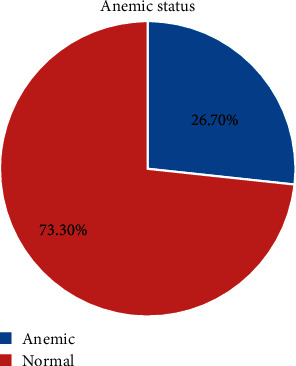
A total of 528 adolescent girls were included in the study yielding a response rate of 95.8%. The prevalence of anemia was found to be 26.7%, 95% CI (22.7, 30.50). In multivariate logistic regression analysis, those living separately from their family (AOR = 4.430, 95% CI (2.20, 8.90)), low dietary diversity score (AOR = 3.57, 95% CI (1.88, 6.75)), menstrual bleeding more than 5 days (AOR = 2.25, 95% CI (1.17, 4.33)), and low economic status (AOR = 2.16, 95% CI (1.17, 4.33)) were positively associated factors with anemia and only having at least a secondary school in mother's educational status AOR = 0.43, 95% CI (0.18, 0.97) was negatively associated with anemia in the study area.
Prevalence of anemia among school adolescent girls was moderate public health importance according to the World Health Organization prevalence estimation of anemia. The living condition of the adolescent girls, dietary diversity score, duration of menses, and low economic status were positive predictor variables, whereas mothers who are being secondary school and above was a protective factor for anemia. Therefore, iron-rich and diversified food consumption should be given attention.
贫血定义为血液血红蛋白浓度低,具有公共卫生重要性。青少年年龄组在公共卫生和营养研究中最被忽视,因为优先关注的通常是孕妇、哺乳期母亲及其2岁以下的孩子。当前埃塞俄比亚的食品和营养政策将少女列为营养需求风险最高的群体;然而,仅有少数已发表的研究评估了贫血的缺乏情况及相关因素,以应对营养不良的代际循环。
评估吉姆马镇高中少女贫血的患病率及相关因素。
2019年1月1日至2019年2月1日在埃塞俄比亚西南部的吉姆马镇,采用基于学校的横断面研究设计,从528名中学少女中收集数据。采用多阶段抽样技术选择研究参与者。使用便携式电池供电的HemoCue Hb 301 +分析仪测量血红蛋白水平,然后根据世界卫生组织2011年推荐的海拔调整后的临界值,将血红蛋白值≥12 g/dl分类为正常血红蛋白,<12 g/dl则为贫血。双变量分析中p值≤0.25的被视为多变量逻辑回归的候选因素。进行多变量逻辑回归以控制混杂因素并确定与贫血独立相关的因素。统计学显著性水平设定为p < 0.05。
共有528名少女纳入研究,应答率为95.8%。贫血患病率为26.7%,95%可信区间(22.7, 30.50)。在多变量逻辑回归分析中,与家人分开居住者(比值比 = 4.430,95%可信区间(2.20, 8.90))、饮食多样性得分低(比值比 = 3.57,95%可信区间(1.88, 6.75))、月经出血超过5天(比值比 = 2.25,95%可信区间(1.17, 4.33))以及经济状况差(比值比 = 2.16,95%可信区间(1.17, 4.33))是与贫血呈正相关的因素,而母亲教育程度至少为中学在研究区域内与贫血呈负相关(比值比 = 0.43,95%可信区间(0.18, 0.97))。
根据世界卫生组织对贫血患病率的估计,学校少女中的贫血患病率具有中等公共卫生重要性。少女的生活状况、饮食多样性得分、月经持续时间以及经济状况差是阳性预测变量,而母亲为中学及以上学历是贫血的保护因素。因此,应关注富含铁和多样化的食物消费。