Pennington Biomedical Research Center, Baton Rouge, LA, USA.
Int J Obes (Lond). 2020 Dec;44(12):2358-2371. doi: 10.1038/s41366-020-00693-2. Epub 2020 Oct 8.
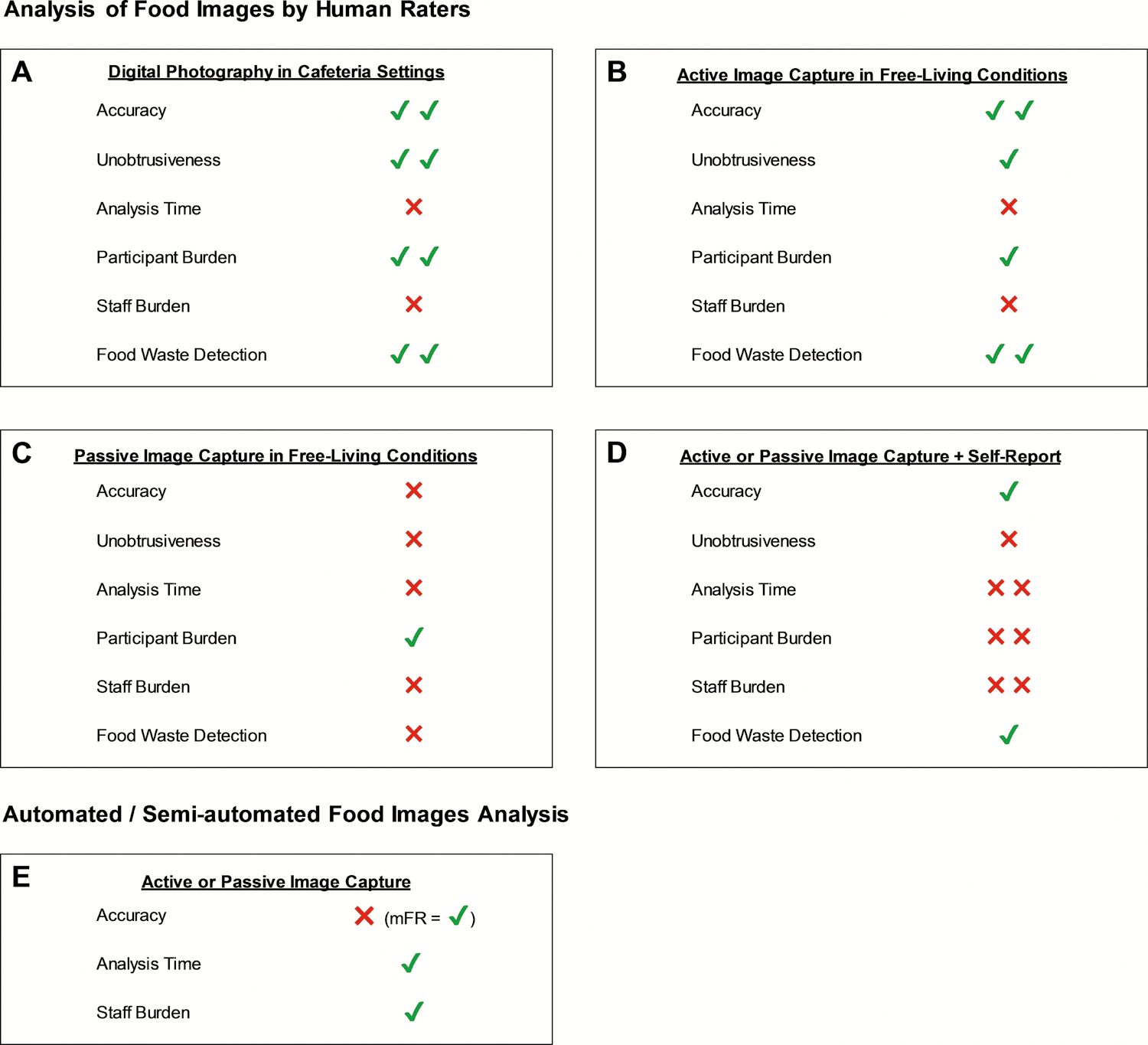
Accurately quantifying dietary intake is essential to understanding the effect of diet on health and evaluating the efficacy of dietary interventions. Self-report methods (e.g., food records) are frequently utilized despite evident inaccuracy of these methods at assessing energy and nutrient intake. Methods that assess food intake via images of foods have overcome many of the limitations of traditional self-report. In cafeteria settings, digital photography has proven to be unobtrusive and accurate and is the method of choice for assessing food provision, plate waste, and food intake. In free-living conditions, image capture of food selection and plate waste via the user's smartphone, is promising and can produce accurate energy intake estimates, though accuracy is not guaranteed. These methods foster (near) real-time transfer of data and eliminate the need for portion size estimation by the user since the food images are analyzed by trained raters. A limitation that remains, similar to self-report methods where participants must truthfully record all consumed foods, is intentional and/or unintentional underreporting of foods due to social desirability or forgetfulness. Methods that rely on passive image capture via wearable cameras are promising and aim to reduce user burden; however, only pilot data with limited validity are currently available and these methods remain obtrusive and cumbersome. To reduce analysis-related staff burden and to allow real-time feedback to the user, recent approaches have aimed to automate the analysis of food images. The technology to support automatic food recognition and portion size estimation is, however, still in its infancy and fully automated food intake assessment with acceptable precision not yet a reality. This review further evaluates the benefits and challenges of current image-assisted methods of food intake assessment and concludes that less burdensome methods are less accurate and that no current method is adequate in all settings.
准确量化饮食摄入对于理解饮食对健康的影响和评估饮食干预的效果至关重要。尽管这些方法在评估能量和营养素摄入方面明显不准确,但自我报告方法(例如,食物记录)仍然经常被使用。通过食物图像评估食物摄入量的方法克服了传统自我报告方法的许多局限性。在自助餐厅环境中,数码摄影已被证明是不引人注目的且准确的,并且是评估食物供应、餐盘浪费和食物摄入量的首选方法。在自由生活条件下,通过用户的智能手机拍摄食物选择和餐盘浪费的图像具有很大的前景,可以产生准确的能量摄入估计值,尽管准确性无法保证。这些方法促进了(近乎)实时数据传输,并且由于食物图像由经过培训的评估员进行分析,因此无需用户进行食物份量估计,从而消除了这一需求。与要求参与者真实记录所有食用食物的自我报告方法一样,仍然存在一个限制,即由于社会期望或健忘,可能会有意或无意地少报食物。依赖于通过可穿戴相机进行被动图像采集的方法很有前景,旨在减轻用户负担;但是,目前仅提供有限有效性的试点数据,这些方法仍然很繁琐。为了减少与分析相关的员工负担,并允许用户实时反馈,最近的方法旨在实现食物图像的自动分析。但是,支持自动食物识别和份量估计的技术仍处于起步阶段,尚未实现具有可接受精度的全自动食物摄入评估。这篇综述进一步评估了当前图像辅助食物摄入评估方法的优势和挑战,并得出结论,负担较小的方法准确性较低,并且没有一种当前的方法在所有情况下都足够完善。