College of Dental Medicine, Roseman University of Health Sciences, South Jordan, UT 84095, USA.
Department of Orthopaedic Surgery Operations, University of Utah, Salt Lake City, UT 84108, USA.
Int J Environ Res Public Health. 2020 Oct 6;17(19):7286. doi: 10.3390/ijerph17197286.
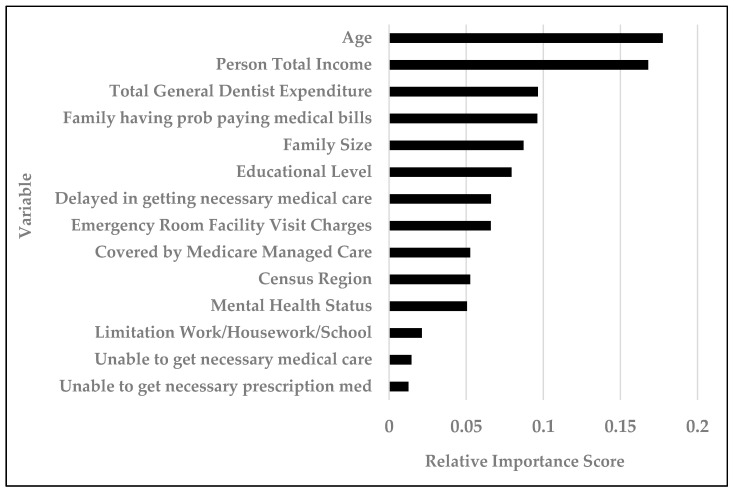
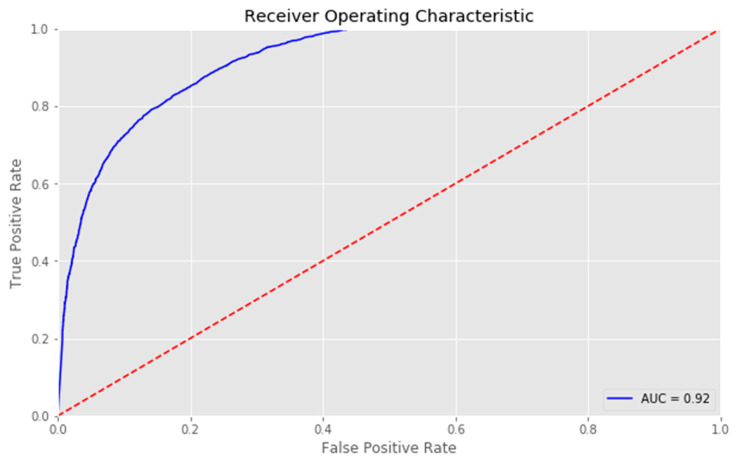
The goals of this study were to develop a risk prediction model in unmet dental care needs and to explore the intersection between social determinants of health and unmet dental care needs in the United States. Data from the 2016 Medical Expenditure Panel Survey were used for this study. A chi-squared test was used to examine the difference in social determinants of health between those with and without unmet dental needs. Machine learning was used to determine top predictors of unmet dental care needs and to build a risk prediction model to identify those with unmet dental care needs. Age was the most important predictor of unmet dental care needs. Other important predictors included income, family size, educational level, unmet medical needs, and emergency room visit charges. The risk prediction model of unmet dental care needs attained an accuracy of 82.6%, sensitivity of 77.8%, specificity of 87.4%, precision of 82.9%, and area under the curve of 0.918. Social determinants of health have a strong relationship with unmet dental care needs. The application of deep learning in artificial intelligence represents a significant innovation in dentistry and enables a major advancement in our understanding of unmet dental care needs on an individual level that has never been done before. This study presents promising findings and the results are expected to be useful in risk assessment of unmet dental care needs and can guide targeted intervention in the general population of the United States.
本研究旨在开发一个未满足的牙科护理需求风险预测模型,并探索美国健康社会决定因素与未满足的牙科护理需求之间的交集。本研究使用了 2016 年医疗支出面板调查的数据。卡方检验用于检验有和无未满足的牙科需求者之间健康社会决定因素的差异。机器学习用于确定未满足的牙科护理需求的主要预测因素,并建立风险预测模型以识别未满足的牙科护理需求者。年龄是未满足的牙科护理需求的最重要预测因素。其他重要的预测因素包括收入、家庭规模、教育水平、未满足的医疗需求和急诊室就诊费用。未满足的牙科护理需求风险预测模型的准确性为 82.6%,敏感性为 77.8%,特异性为 87.4%,精度为 82.9%,曲线下面积为 0.918。健康社会决定因素与未满足的牙科护理需求密切相关。深度学习在人工智能中的应用代表了牙科领域的重大创新,使我们能够以前所未有的方式深入了解个人层面上未满足的牙科护理需求。本研究提出了有前景的发现,研究结果有望有助于评估未满足的牙科护理需求的风险,并可以指导美国普通人群的有针对性干预。