Division of Hematology/Oncology, Department of Internal Medicine, University of Michigan, Ann Arbor, Michigan, USA.
Internal Medicine, Onkologikum Frankfurt, Frankfurt, Germany.
ESMO Open. 2020 Oct;5(5):e000858. doi: 10.1136/esmoopen-2020-000858.
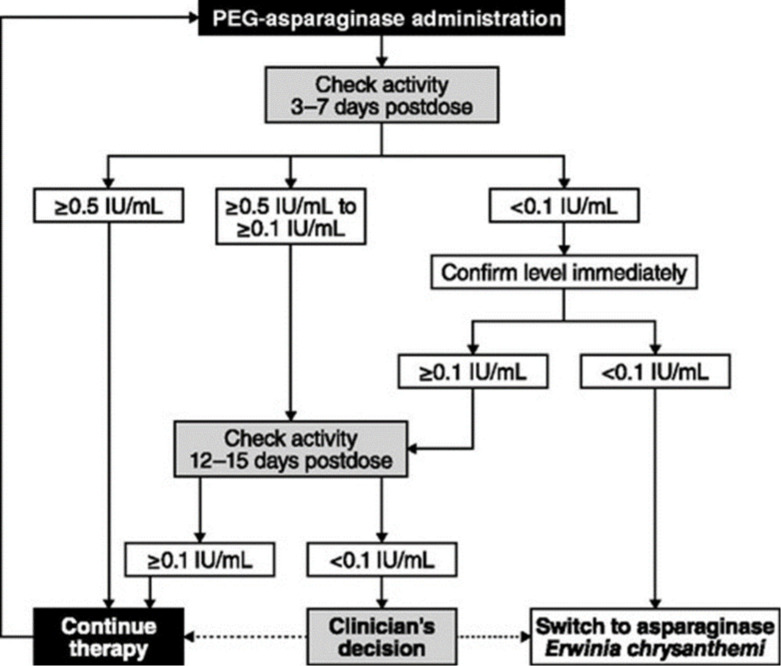
With recent prospective clinical trials that used paediatric regimens with multiple doses of pegylated form of asparaginase (PEG asparaginase) in adults reporting significantly improved survival compared with historical data with regimens that used less asparaginase, PEG asparaginase is increasingly being used in the treatment of adult acute lymphoblastic leukaemia (ALL). However, administering asparaginase still comes with its challenges, especially in adult patients. Therefore, it is important to understand how to manage its toxicities properly. An expert group met in November 2019 in London to discuss recent data of paediatric as well as adult studies using paediatric regimens with regard to the best management of several key toxicities that can occur in adults treated with asparaginase including hepatotoxicity, pancreatitis, hypertriglyceridaemia, thrombosis and hypersensitivity. Several recommendations were made for each one of these toxicities, with the goal of safe administration of the drug and to educate clinicians when the drug can be continued despite side effects.
随着最近的前瞻性临床试验报告显示,与使用较少剂量聚乙二醇化门冬酰胺酶(PEG 门冬酰胺酶)的方案相比,使用包含多剂 PEG 门冬酰胺酶的儿科方案治疗成人急性淋巴细胞白血病(ALL)可显著提高生存率,PEG 门冬酰胺酶在成人 ALL 的治疗中越来越多地被应用。然而,使用门冬酰胺酶仍然存在挑战,尤其是在成人患者中。因此,正确处理其毒性非常重要。一个专家组于 2019 年 11 月在伦敦开会,讨论了最近的儿科和成人研究数据,这些研究使用儿科方案来治疗几种关键毒性,包括在接受门冬酰胺酶治疗的成人中可能发生的肝毒性、胰腺炎、高甘油三酯血症、血栓形成和过敏反应。针对每一种毒性都提出了一些建议,目的是安全地使用该药物,并在药物出现副作用时教育临床医生应继续使用药物。