• 文献检索
  • 文档翻译
  • 深度研究
  • 学术资讯
  • Suppr Zotero 插件Zotero 插件
  • 邀请有礼
  • 套餐&价格
  • 历史记录
应用&插件
Suppr Zotero 插件Zotero 插件浏览器插件Mac 客户端Windows 客户端微信小程序
定价
高级版会员购买积分包购买API积分包
服务
文献检索文档翻译深度研究API 文档MCP 服务
关于我们
关于 Suppr公司介绍联系我们用户协议隐私条款
关注我们

Suppr 超能文献

核心技术专利:CN118964589B侵权必究
粤ICP备2023148730 号-1Suppr @ 2026

文献检索

告别复杂PubMed语法,用中文像聊天一样搜索,搜遍4000万医学文献。AI智能推荐,让科研检索更轻松。

立即免费搜索

文件翻译

保留排版,准确专业,支持PDF/Word/PPT等文件格式,支持 12+语言互译。

免费翻译文档

深度研究

AI帮你快速写综述,25分钟生成高质量综述,智能提取关键信息,辅助科研写作。

立即免费体验

体内 mRNA 展示通过下一代测序实现大规模蛋白质组学。

In vivo mRNA display enables large-scale proteomics by next generation sequencing.

机构信息

Department of Biological Sciences, Columbia University, New York, NY 10027;

Department of Systems Biology, Columbia University, New York, NY 10032.

出版信息

Proc Natl Acad Sci U S A. 2020 Oct 27;117(43):26710-26718. doi: 10.1073/pnas.2002650117. Epub 2020 Oct 9.

DOI:10.1073/pnas.2002650117
PMID:33037152
原文链接:https://pmc.ncbi.nlm.nih.gov/articles/PMC7604504/
Abstract

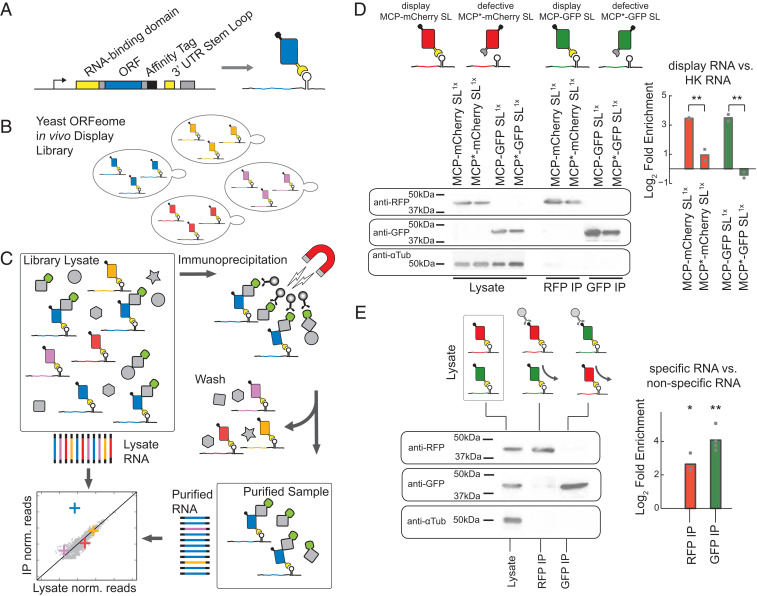
Large-scale proteomic methods are essential for the functional characterization of proteins in their native cellular context. However, proteomics has lagged far behind genomic approaches in scalability, standardization, and cost. Here, we introduce in vivo mRNA display, a technology that converts a variety of proteomics applications into a DNA sequencing problem. In vivo-expressed proteins are coupled with their encoding messenger RNAs (mRNAs) via a high-affinity stem-loop RNA binding domain interaction, enabling high-throughput identification of proteins with high sensitivity and specificity by next generation DNA sequencing. We have generated a high-coverage in vivo mRNA display library of the proteome and demonstrated its potential for characterizing subcellular localization and interactions of proteins expressed in their native cellular context. In vivo mRNA display libraries promise to circumvent the limitations of mass spectrometry-based proteomics and leverage the exponentially improving cost and throughput of DNA sequencing to systematically characterize native functional proteomes.

摘要

大规模的蛋白质组学方法对于在天然细胞环境下对蛋白质的功能进行特征描述是必不可少的。然而,蛋白质组学在可扩展性、标准化和成本方面远远落后于基因组学方法。在这里,我们介绍了体内 mRNA 展示技术,它将各种蛋白质组学应用转化为 DNA 测序问题。通过高亲和力的茎环 RNA 结合域相互作用,将体内表达的蛋白质与其编码的信使 RNA(mRNA)连接起来,通过下一代 DNA 测序以高灵敏度和特异性高通量鉴定蛋白质。我们已经生成了一个高覆盖率的体内 mRNA 展示文库,展示了其在描述天然细胞环境中表达的蛋白质的亚细胞定位和相互作用方面的潜力。体内 mRNA 展示文库有望克服基于质谱的蛋白质组学的局限性,并利用 DNA 测序成本和通量呈指数级提高的优势,系统地描述天然功能蛋白质组。
https://cdn.ncbi.nlm.nih.gov/pmc/blobs/4b9b/7604504/bd9b2ed6c31b/pnas.2002650117fig04.jpg
https://cdn.ncbi.nlm.nih.gov/pmc/blobs/4b9b/7604504/486763582463/pnas.2002650117fig01.jpg
https://cdn.ncbi.nlm.nih.gov/pmc/blobs/4b9b/7604504/cc5807fbe96a/pnas.2002650117fig02.jpg
https://cdn.ncbi.nlm.nih.gov/pmc/blobs/4b9b/7604504/e706b7eb2ebe/pnas.2002650117fig03.jpg
https://cdn.ncbi.nlm.nih.gov/pmc/blobs/4b9b/7604504/bd9b2ed6c31b/pnas.2002650117fig04.jpg
https://cdn.ncbi.nlm.nih.gov/pmc/blobs/4b9b/7604504/486763582463/pnas.2002650117fig01.jpg
https://cdn.ncbi.nlm.nih.gov/pmc/blobs/4b9b/7604504/cc5807fbe96a/pnas.2002650117fig02.jpg
https://cdn.ncbi.nlm.nih.gov/pmc/blobs/4b9b/7604504/e706b7eb2ebe/pnas.2002650117fig03.jpg
https://cdn.ncbi.nlm.nih.gov/pmc/blobs/4b9b/7604504/bd9b2ed6c31b/pnas.2002650117fig04.jpg

相似文献

1
In vivo mRNA display enables large-scale proteomics by next generation sequencing.体内 mRNA 展示通过下一代测序实现大规模蛋白质组学。
Proc Natl Acad Sci U S A. 2020 Oct 27;117(43):26710-26718. doi: 10.1073/pnas.2002650117. Epub 2020 Oct 9.
2
Large-Scale Interaction Profiling of Protein Domains Through Proteomic Peptide-Phage Display Using Custom Peptidomes.通过使用定制肽组的蛋白质组学肽-噬菌体展示对蛋白质结构域进行大规模相互作用分析。
Methods Mol Biol. 2017;1518:213-226. doi: 10.1007/978-1-4939-6584-7_14.
3
Genome-wide C-SWAT library for high-throughput yeast genome tagging.高通量酵母基因组标签的全基因组 C-SWAT 文库。
Nat Methods. 2018 Aug;15(8):598-600. doi: 10.1038/s41592-018-0045-8. Epub 2018 Jul 9.
4
Next-generation sequencing coupled with a cell-free display technology for reliable interactome of translational factors.下一代测序与无细胞展示技术相结合用于翻译因子的可靠相互作用组研究。
Methods Mol Biol. 2014;1164:23-32. doi: 10.1007/978-1-4939-0805-9_3.
5
Mapping the Saccharomyces cerevisiae Spatial Proteome with High Resolution Using hyperLOPIT.使用超LOPIT高分辨率绘制酿酒酵母空间蛋白质组图谱。
Methods Mol Biol. 2019;2049:165-190. doi: 10.1007/978-1-4939-9736-7_10.
6
Compartmentalized linkage of genes encoding interacting protein pairs.基因编码相互作用蛋白对的分隔连接。
Proteomics. 2011 Apr;11(7):1335-9. doi: 10.1002/pmic.201000643. Epub 2011 Feb 14.
7
Next-generation sequencing coupled with a cell-free display technology for high-throughput production of reliable interactome data.下一代测序技术与无细胞展示技术相结合,用于高通量生产可靠的互作组学数据。
Sci Rep. 2012;2:691. doi: 10.1038/srep00691. Epub 2012 Oct 9.
8
Protein interaction networks by proteome peptide scanning.通过蛋白质组肽扫描构建的蛋白质相互作用网络
PLoS Biol. 2004 Jan;2(1):E14. doi: 10.1371/journal.pbio.0020014. Epub 2004 Jan 20.
9
A complete mass-spectrometric map of the yeast proteome applied to quantitative trait analysis.酵母蛋白质组的全质谱图谱应用于数量性状分析。
Nature. 2013 Feb 14;494(7436):266-70. doi: 10.1038/nature11835. Epub 2013 Jan 20.
10
Proteomics.蛋白质组学
Annu Rev Biochem. 2003;72:783-812. doi: 10.1146/annurev.biochem.72.121801.161511.

引用本文的文献

1
Multimodal Omics Approaches to Aging and Age-Related Diseases.衰老及年龄相关疾病的多组学研究方法
Phenomics. 2024 Feb 24;4(1):56-71. doi: 10.1007/s43657-023-00125-x. eCollection 2024 Feb.
2
Single-Stranded RNA-Binding Peptides Discovered by Codon-Restricted mRNA Display.基于密码子限制的 mRNA 展示技术发现的单链 RNA 结合肽
Biomacromolecules. 2024 Jan 8;25(1):355-365. doi: 10.1021/acs.biomac.3c01024. Epub 2023 Dec 5.
3
Assembly of Long-Adapter Single-Strand Oligonucleotide (LASSO) Probes for Massively Parallel Capture of Kilobase Size DNA Targets.

本文引用的文献

1
Network-based prediction of protein interactions.基于网络的蛋白质相互作用预测。
Nat Commun. 2019 Mar 18;10(1):1240. doi: 10.1038/s41467-019-09177-y.
2
Large-Scale, Quantitative Protein Assays on a High-Throughput DNA Sequencing Chip.高通量 DNA 测序芯片上的大规模定量蛋白质分析。
Mol Cell. 2019 Mar 7;73(5):1075-1082.e4. doi: 10.1016/j.molcel.2019.02.019.
3
Connecting Proteomics to Next-Generation Sequencing: Proteogenomics and Its Current Applications in Biology.将蛋白质组学与下一代测序技术相连接:蛋白质基因组学及其在生物学中的当前应用。
长接头单链寡核苷酸 (LASSO) 探针的组装,用于大规模平行捕获千碱基大小的 DNA 靶标。
Curr Protoc. 2021 Nov;1(11):e278. doi: 10.1002/cpz1.278.
4
Applications of single-cell genomics and computational strategies to study common disease and population-level variation.单细胞基因组学和计算策略在研究常见疾病和人群水平变异中的应用。
Genome Res. 2021 Oct;31(10):1728-1741. doi: 10.1101/gr.275430.121.
5
Multiscale plant modeling: from genome to phenome and beyond.多尺度植物建模:从基因组到表型再到超越。
Emerg Top Life Sci. 2021 May 21;5(2):231-237. doi: 10.1042/ETLS20200276.
6
Nucleic-acid sequencing of proteomes.蛋白质组的核酸测序
Nat Rev Genet. 2021 Jan;22(1):2. doi: 10.1038/s41576-020-00301-z.
Proteomics. 2019 May;19(10):e1800235. doi: 10.1002/pmic.201800235. Epub 2018 Dec 11.
4
The Gene Ontology Resource: 20 years and still GOing strong.《基因本体论资源:20 年,持续强大》
Nucleic Acids Res. 2019 Jan 8;47(D1):D330-D338. doi: 10.1093/nar/gky1055.
5
Affinity capture of polyribosomes followed by RNAseq (ACAPseq), a discovery platform for protein-protein interactions.多核糖体亲和捕获结合 RNA 测序(ACAPseq),一种用于蛋白质-蛋白质相互作用的发现平台。
Elife. 2018 Oct 22;7:e40982. doi: 10.7554/eLife.40982.
6
Efficient proximity labeling in living cells and organisms with TurboID.TurboID 实现活细胞和生物体内高效的邻近标记。
Nat Biotechnol. 2018 Oct;36(9):880-887. doi: 10.1038/nbt.4201. Epub 2018 Aug 20.
7
Genome-wide SWAp-Tag yeast libraries for proteome exploration.用于蛋白质组探索的全基因组 SWAp-Tag 酵母文库。
Nat Methods. 2018 Aug;15(8):617-622. doi: 10.1038/s41592-018-0044-9. Epub 2018 Jul 9.
8
Isolation of mitochondria from Saccharomyces cerevisiae using magnetic bead affinity purification.使用磁珠亲和纯化法从酿酒酵母中分离线粒体。
PLoS One. 2018 Apr 26;13(4):e0196632. doi: 10.1371/journal.pone.0196632. eCollection 2018.
9
High-throughput characterization of protein-protein interactions by reprogramming yeast mating.通过重新编程酵母交配实现蛋白质-蛋白质相互作用的高通量表征。
Proc Natl Acad Sci U S A. 2017 Nov 14;114(46):12166-12171. doi: 10.1073/pnas.1705867114. Epub 2017 Oct 31.
10
Definition of a High-Confidence Mitochondrial Proteome at Quantitative Scale.定量规模下高可信度线粒体蛋白质组的定义
Cell Rep. 2017 Jun 27;19(13):2836-2852. doi: 10.1016/j.celrep.2017.06.014.