Institute of Psychiatry, Psychology and Neuroscience, Kings College London, London, United Kingdom.
JMIR Mhealth Uhealth. 2020 Oct 10;8(10):e18140. doi: 10.2196/18140.
Mobile health apps are increasingly available and used in a clinical context to monitor young people's mood and mental health. Despite the benefits of accessibility and cost-effectiveness, consumer engagement remains a hurdle for uptake and continued use. Hundreds of mood-monitoring apps are publicly available to young people on app stores; however, few studies have examined consumer perspectives. App store reviews held on Google and Apple platforms provide a large, rich source of naturally generated, publicly available user reviews. Although commercial developers use these data to modify and improve their apps, to date, there has been very little in-depth evaluation of app store user reviews within scientific research, and our current understanding of what makes apps engaging and valuable to young people is limited.
This study aims to gain a better understanding of what app users consider useful to encourage frequent and prolonged use of mood-monitoring apps appropriate for young people.
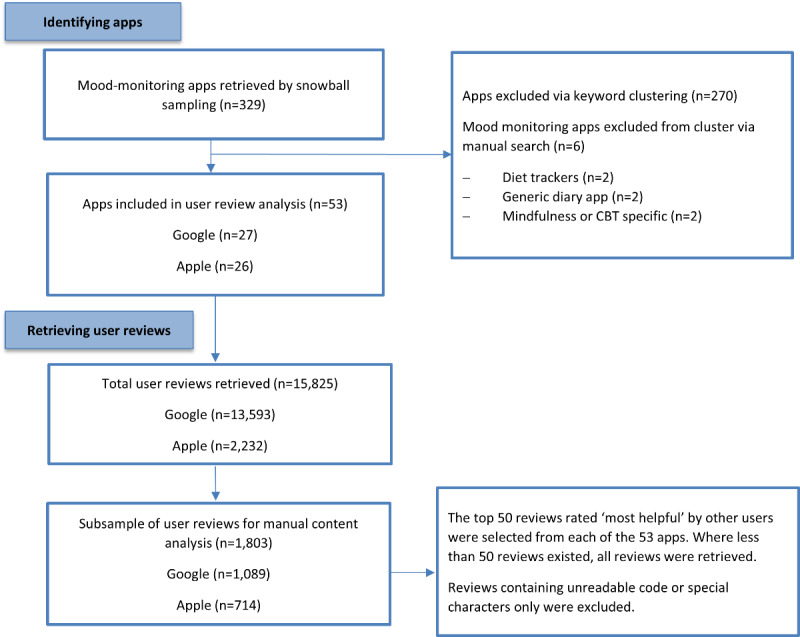
A systematic approach was applied to the selection of apps and reviews. We identified mood-monitoring apps (n=53) by a combination of automated application programming interface (API) methods. We only included apps appropriate for young people based on app store age categories (apps available to those younger than 18 years). We subsequently downloaded all available user reviews via API data scraping methods and selected a representative subsample of reviews (n=1803) for manual qualitative content analysis.
The qualitative content analysis revealed 8 main themes: accessibility (34%), flexibility (21%), recording and representation of mood (18%), user requests (17%), reflecting on mood (16%), technical features (16%), design (13%), and health promotion (11%). A total of 6 minor themes were also identified: notification and reminders; recommendation; privacy, security, and transparency; developer; adverts; and social/community.
Users value mood-monitoring apps that can be personalized to their needs, have a simple and intuitive design, and allow accurate representation and review of complex and fluctuating moods. App store reviews are a valuable repository of user engagement feedback and provide a wealth of information about what users value in an app and what user needs are not being met. Users perceive mood-monitoring apps positively, but over 20% of reviews identified the need for improvement.
移动健康应用程序在临床环境中越来越多地被用于监测年轻人的情绪和心理健康,具有便捷和经济有效的优势。尽管如此,消费者的参与度仍然是提高使用率和持续使用的一个障碍。数以百计的情绪监测应用程序在应用商店中向年轻人公开提供;然而,很少有研究检查消费者的观点。在谷歌和苹果平台上的应用商店评论提供了大量自然生成的、公开可用的用户评论。尽管商业开发者使用这些数据来修改和改进他们的应用程序,但迄今为止,在科学研究中,对应用商店用户评论的深入评估还很少,我们目前对哪些因素使应用程序对年轻人有吸引力和有价值的了解也很有限。
本研究旨在更好地了解用户认为哪些功能对鼓励年轻人频繁和长时间使用情绪监测应用程序有用。
我们采用系统的方法选择应用程序和评论。我们通过结合自动应用程序编程接口 (API) 方法来识别情绪监测应用程序(n=53)。我们仅根据应用程序商店的年龄类别(适用于 18 岁以下人群的应用程序)确定适合年轻人的应用程序。随后,我们通过 API 数据抓取方法下载所有可用的用户评论,并选择有代表性的评论子样本(n=1803)进行手动定性内容分析。
定性内容分析揭示了 8 个主要主题:可访问性(34%)、灵活性(21%)、情绪的记录和表达(18%)、用户请求(17%)、情绪反思(16%)、技术特征(16%)、设计(13%)和健康促进(11%)。还确定了 6 个次要主题:通知和提醒;推荐;隐私、安全和透明度;开发者;广告;以及社交/社区。
用户重视能够根据自己的需求进行个性化设置、具有简单直观设计、并允许准确表达和回顾复杂多变情绪的情绪监测应用程序。应用商店评论是用户参与反馈的宝贵资源,提供了大量关于用户在应用程序中看重什么以及用户需求未得到满足的信息。用户对情绪监测应用程序的评价是积极的,但超过 20%的评论指出需要改进。