The Center for Modern Chinese City Studies, East China Normal University, Shanghai, China.
School of Urban and Regional Science, East China Normal University, Shanghai, China.
Front Public Health. 2020 Sep 17;8:450. doi: 10.3389/fpubh.2020.00450. eCollection 2020.
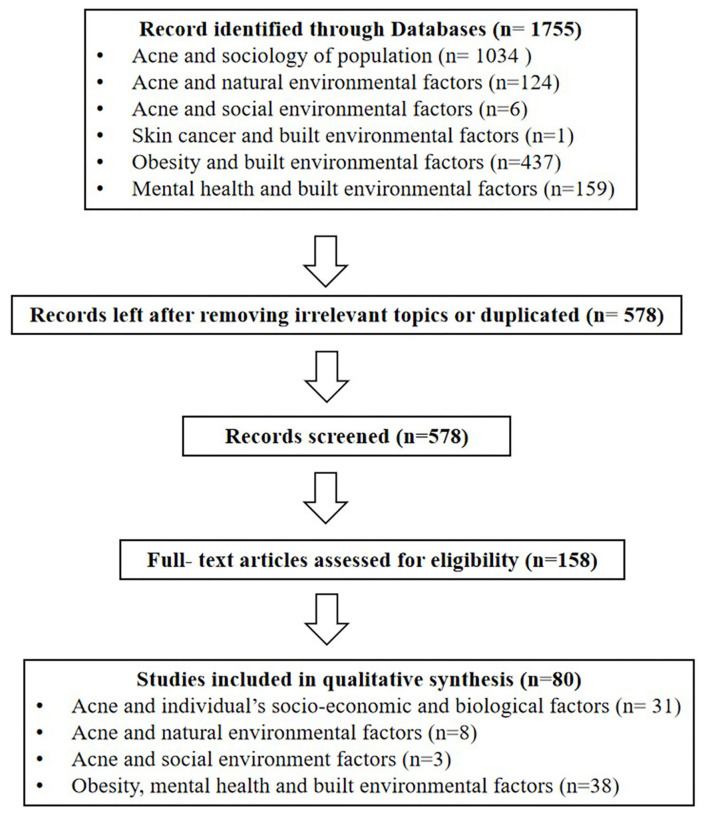
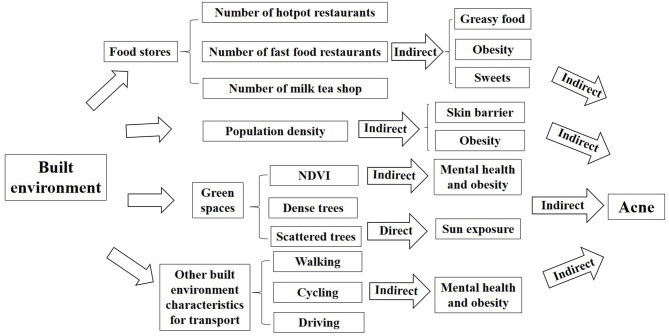
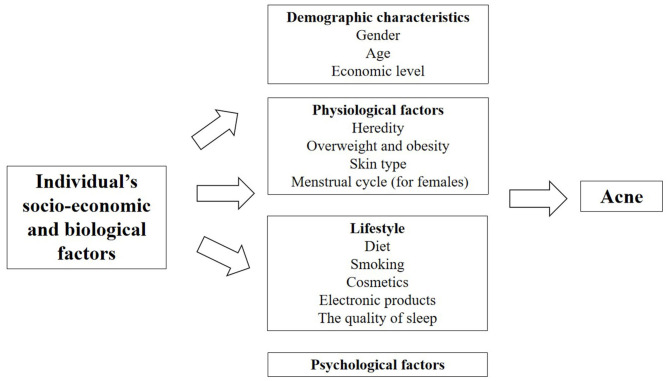
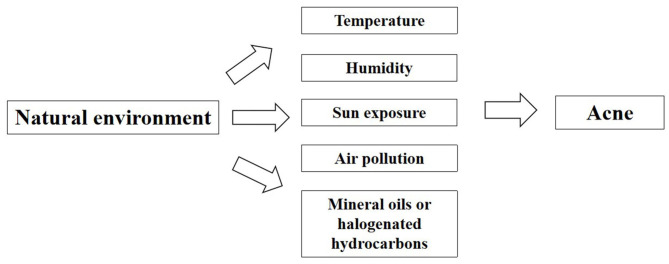
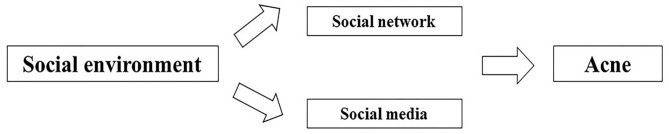
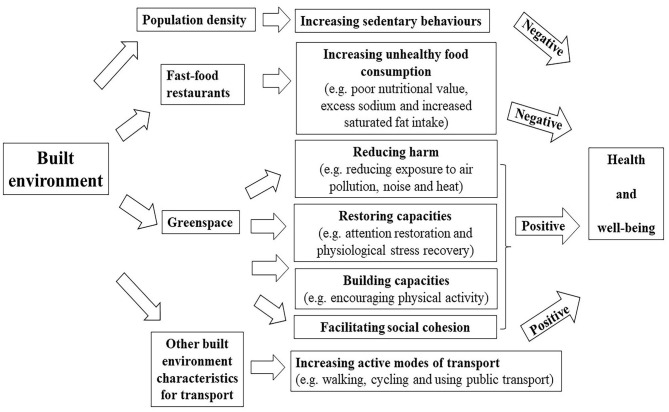
Acne vulgaris is known as a commonly-seen skin disease with a considerable impact on the quality of life. At present, there have been a growing number of epidemiological, medical, demographic and sociological researches focusing on various influencing factors in the occurrence of acne. Nevertheless, the correlation between environmental factors and acne has yet to be fully investigated. To assess the impacts of individual, natural and social environmental factors on acne and to construct a framework for the potential impact of built environment on acne. A thorough review was conducted into the published social demographical, epidemiological, and environmental studies on acne through PubMed, Google Scholar and Web of Science, with reference made to the relevant literature. The influencing factors in acne are classed into four major categories. The first one includes individual socio-economic and biological factors, for example, gender, age, economic level, heredity, obesity, skin type, menstrual cycle (for females), diet, smoking, cosmetics products, electronic products, sleep quality and psychological factors. The second one includes such natural environmental factors as temperature, humidity, sun exposure, air pollution and chloracne. The third one relates to social environment, including social network and social media. The last one includes built environmental factors, for example, population density, food stores, green spaces, as well as other built environment characteristics for transport. Acne can be affected negatively by family history, overweight, obesity, oily or mixed skin, irregular menstrual cycles, sugary food, greasy food, dairy products, smoking, the improper use of cosmetics, the long-term use of electronics, the poor quality of sleep, stress, high temperature, sun exposure, air pollution, mineral oils and halogenated hydrocarbons. Apart from that, there are also potential links between built environment and acne. It is necessary to determine the correlation between the built environment and acne based on the understanding of the impact of traditional factors (sociology of population and environment) on acne gained by multidisciplinary research teams. Moreover, more empirical studies are required to reveal the specific relationship between built environment and acne.
寻常痤疮是一种常见的皮肤病,对生活质量有相当大的影响。目前,越来越多的流行病学、医学、人口学和社会学研究集中在痤疮发生的各种影响因素上。然而,环境因素与痤疮之间的相关性尚未得到充分研究。评估个体、自然和社会环境因素对痤疮的影响,并构建一个潜在的痤疮与建筑环境影响的框架。通过PubMed、Google Scholar 和 Web of Science 对已发表的关于痤疮的社会人口学、流行病学和环境研究进行了全面综述,并参考了相关文献。痤疮的影响因素分为四大类。第一类包括个体社会经济和生物学因素,如性别、年龄、经济水平、遗传、肥胖、皮肤类型、月经周期(女性)、饮食、吸烟、化妆品、电子产品、睡眠质量和心理因素。第二类包括温度、湿度、阳光照射、空气污染和氯痤疮等自然环境因素。第三类与社会环境有关,包括社交网络和社交媒体。最后一类包括建筑环境因素,例如人口密度、食品店、绿地以及其他与交通有关的建筑环境特征。痤疮可受家族史、超重、肥胖、油性或混合性皮肤、不规则月经周期、含糖食物、油腻食物、乳制品、吸烟、化妆品使用不当、电子产品使用时间过长、睡眠质量差、压力、高温、阳光照射、空气污染、矿物油和卤代烃的负面影响。此外,建筑环境与痤疮之间也存在潜在联系。有必要在多学科研究团队对人口与环境社会学对痤疮影响的理解的基础上,确定建筑环境与痤疮之间的相关性。此外,还需要更多的实证研究来揭示建筑环境与痤疮之间的具体关系。