MOE-LCSM, School of Mathematics and Statistics, Hunan Normal University, Changsha, PR China; Key Laboratory of Applied Statistics and Data Science, Hunan Normal University, College of Hunan Province, Changsha, PR China.
Hunan Provincial People's Hospital, Hunan Normal University, Changsha, PR China; Changsha Clinical Research Center for Kidney Disease, Changsha, PR China; Hunan Clinical Research Center for Chronic Kidney Disease, Changsha, PR China.
Am J Emerg Med. 2021 Jul;45:345-351. doi: 10.1016/j.ajem.2020.08.090. Epub 2020 Sep 3.
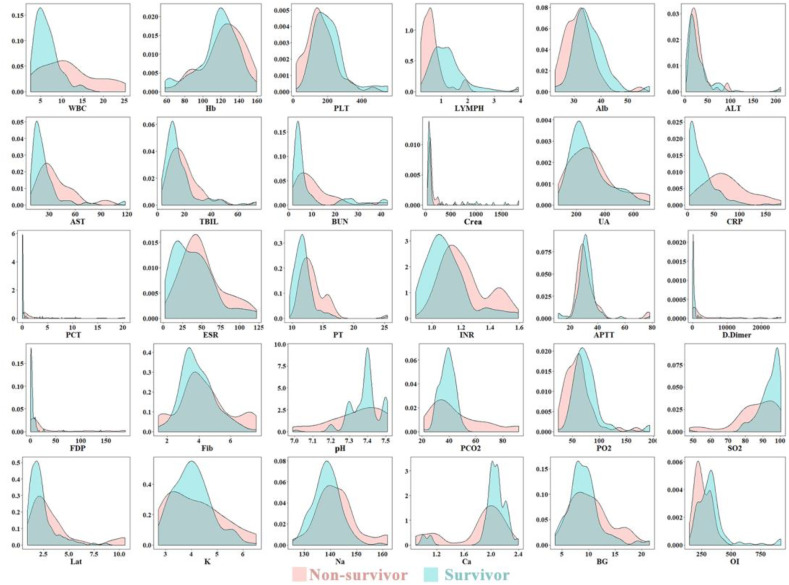
Many laboratory indicators form a skewed distribution with outliers in critically ill patients with COVID-19, for which robust methods are needed to precisely determine and quantify fatality risk factors.
A total of 192 critically ill patients (142 were discharged and 50 died in the hospital) with COVID-19 were included in the sample. Quantile regression was used to determine discrepant laboratory indexes between survivors and non-survivors and quantile shift (QS) was used to quantify the difference. Logistic regression was then used to calculate the odds ratio (OR) and the predictive power of death for each risk indicator.
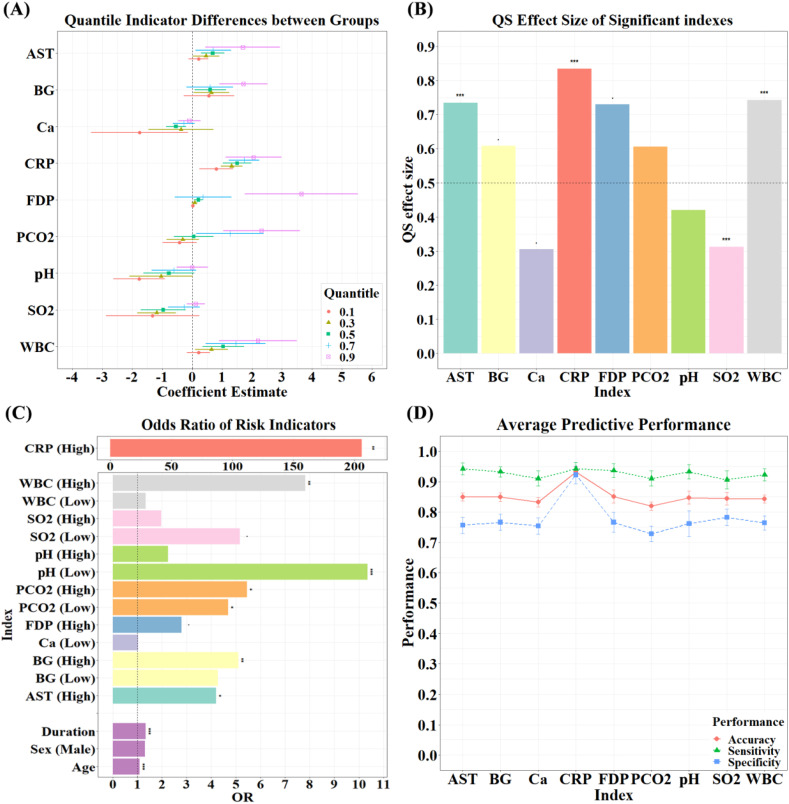
After adjusting for multiple comparisons and controlling numerous confounders, quantile regression revealed that the laboratory indexes of non-survivors were significantly higher in C-reactive protein (CRP; QS = 0.835, p < .001), white blood cell counts (WBC; QS = 0.743, p < .001), glutamic oxaloacetic transaminase (AST; QS = 0.735, p < .001), blood glucose (BG; QS = 0.608, p = .059), fibrin degradation product (FDP; QS = 0.730, p = .080), and partial pressure of carbon dioxide (PCO), and lower in oxygen saturation (SO; QS = 0.312, p < .001), calcium (Ca; QS = 0.306, p = .073), and pH. Most of these indexes were associated with an increased fatality risk, and predictive for the probability of death. Especially, CRP is the most prominent index with and odds ratio of 205.97 and predictive accuracy of 93.2%.
Laboratory indexes provided reliable information on mortality in critically ill patients with COVID-19, which might help improve clinical prediction and treatment at an early stage.
在患有 COVID-19 的危重症患者中,许多实验室指标呈偏态分布且存在异常值,因此需要稳健的方法来准确确定和量化病死率的危险因素。
本研究共纳入 192 例患有 COVID-19 的危重症患者(出院 142 例,住院死亡 50 例)。采用分位数回归确定存活者和非存活者之间存在差异的实验室指标,并采用分位数偏移(QS)来量化差异。然后采用 logistic 回归计算每个风险指标的死亡比值比(OR)和死亡预测能力。
经过多次比较调整和多种混杂因素控制后,分位数回归显示,非存活者的实验室指标中 C 反应蛋白(CRP;QS=0.835,p<.001)、白细胞计数(WBC;QS=0.743,p<.001)、谷草转氨酶(AST;QS=0.735,p<.001)、血糖(BG;QS=0.608,p=0.059)、纤维蛋白降解产物(FDP;QS=0.730,p=0.080)和二氧化碳分压(PCO)显著升高,而血氧饱和度(SO;QS=0.312,p<.001)、钙(Ca;QS=0.306,p=0.073)和 pH 值显著降低。其中大多数指标与病死率增加相关,且能预测死亡概率。尤其是 CRP 是最显著的指标,其比值比为 205.97,预测准确率为 93.2%。
实验室指标为 COVID-19 危重症患者的病死率提供了可靠的信息,这可能有助于在早期改善临床预测和治疗。