Department of Veterinary Clinical Sciences, Purdue University College of Veterinary Medicine, West Lafayette, Indiana, 47907, USA.
Department of Comparative Pathobiology, Purdue University College of Veterinary Medicine, West Lafayette, Indiana, 47907, USA.
J Vet Intern Med. 2020 Nov;34(6):2357-2364. doi: 10.1111/jvim.15926. Epub 2020 Oct 13.
Red blood cells (RBC) are uniquely susceptible to oxidative injury. Oxidative stress is both a cause for, and effect, of anemia in people but this has been minimally documented in dogs.
To describe direct and indirect markers of oxidative stress in anemic dogs.
Anemic dogs will have oxidative stress when compared to healthy dogs.
Forty-seven dogs with anemia (10 with hemolytic anemia) and 70 healthy control dogs.
Prospective, cross-sectional study. Anemic dogs were identified from the patient population, and medical records were reviewed to classify the anemia as hemolytic or nonhemolytic. Flow cytometry was used to detect reactive oxygen species (ROS) in erythrocyte isolates. Reduced glutathione (GSH) concentrations were measured in both plasma and hemolysate samples, and vitamin E was measured in serum.
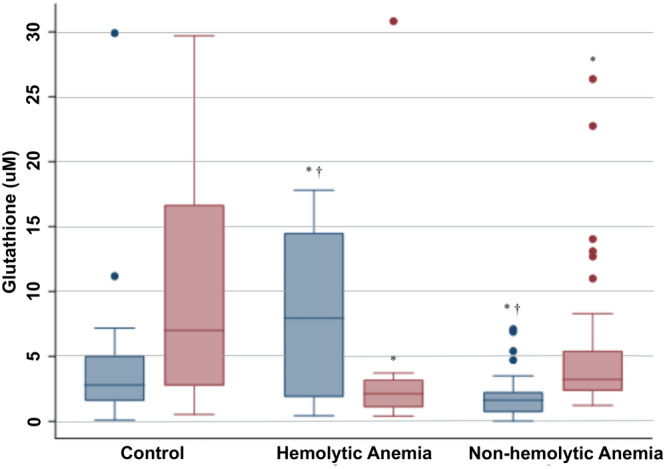
Anemic dogs (both hemolytic and nonhemolytic) had significantly lower median RBC hemolysate GSH concentrations (3.1 μM [0.4-30.8]) when compared to healthy dogs (7.0 μM [0.5-29.7]; P = .03). Dogs with hemolytic anemia had significantly higher median plasma GSH (7.6 μM [0.4-17.8]) when compared to dogs with nonhemolytic anemia (1.6 μM [0.01-7.1]; P = .04) and healthy dogs (2.8 μM [0.1-29.9]; P < .0001). Reactive oxygen species were detectable in all samples, but there was no difference in ROS or vitamin E between groups.
Oxidative stress is present in anemic dogs. Derangements in biomarkers of oxidative stress are different in dogs with hemolytic anemia and nonhemolytic anemia.
红细胞(RBC)特别容易受到氧化损伤。氧化应激既是贫血的原因,也是贫血的结果,但在犬中这方面的记录很少。
描述贫血犬的直接和间接氧化应激标志物。
与健康犬相比,贫血犬会出现氧化应激。
47 只贫血犬(10 只为溶血性贫血)和 70 只健康对照犬。
前瞻性、横断面研究。从患者人群中确定贫血犬,并回顾病历记录将贫血分为溶血性或非溶血性。使用流式细胞术检测红细胞分离物中的活性氧(ROS)。测量血浆和红细胞溶血样本中的还原型谷胱甘肽(GSH)浓度,并测量血清中的维生素 E。
与健康犬(7.0 μM [0.5-29.7])相比,贫血犬(溶血性和非溶血性)的 RBC 溶血 GSH 浓度中位数明显更低(3.1 μM [0.4-30.8];P =.03)。与非溶血性贫血犬(1.6 μM [0.01-7.1])和健康犬(2.8 μM [0.1-29.9])相比,溶血性贫血犬的血浆 GSH 中位数明显更高(7.6 μM [0.4-17.8];P =.04)。所有样本均检测到活性氧,但各组之间的 ROS 或维生素 E 无差异。
氧化应激存在于贫血犬中。溶血性贫血和非溶血性贫血犬的氧化应激生物标志物的改变不同。