Swansea University Medical School, Swansea University, Swansea, UK.
Swansea University Medical School, Swansea University, Swansea, UK.
Lancet Psychiatry. 2022 Jan;9(1):23-34. doi: 10.1016/S2215-0366(21)00367-9. Epub 2021 Nov 23.
Poor attendance at school, whether due to absenteeism or exclusion, leads to multiple social, educational, and lifelong socioeconomic disadvantages. We aimed to measure the association between a broad range of diagnosed neurodevelopmental and mental disorders and recorded self-harm by the age of 24 years and school attendance and exclusion.
In this nationwide, retrospective, electronic cohort study, we drew a cohort from the Welsh Demographic Service Dataset, which included individuals aged 7-16 years (16 years being the school leaving age in the UK) enrolled in state-funded schools in Wales in the academic years 2012/13-2015/16 (between Sept 1, 2012, and Aug 31, 2016). Using the Adolescent Mental Health Data Platform, we linked attendance and exclusion data to national demographic and primary and secondary health-care datasets. We identified all pupils with a recorded diagnosis of neurodevelopmental disorders (ADHD and autism spectrum disorder [ASD]), learning difficulties, conduct disorder, depression, anxiety, eating disorders, alcohol or drugs misuse, bipolar disorder, schizophrenia, other psychotic disorders, or recorded self-harm (our explanatory variables) before the age of 24 years. Outcomes were school absence and exclusion. Generalised estimating equations with exchangeable correlation structures using binomial distribution with the logit link function were used to calculate odds ratios (OR) for absenteeism and exclusion, adjusting for sex, age, and deprivation.
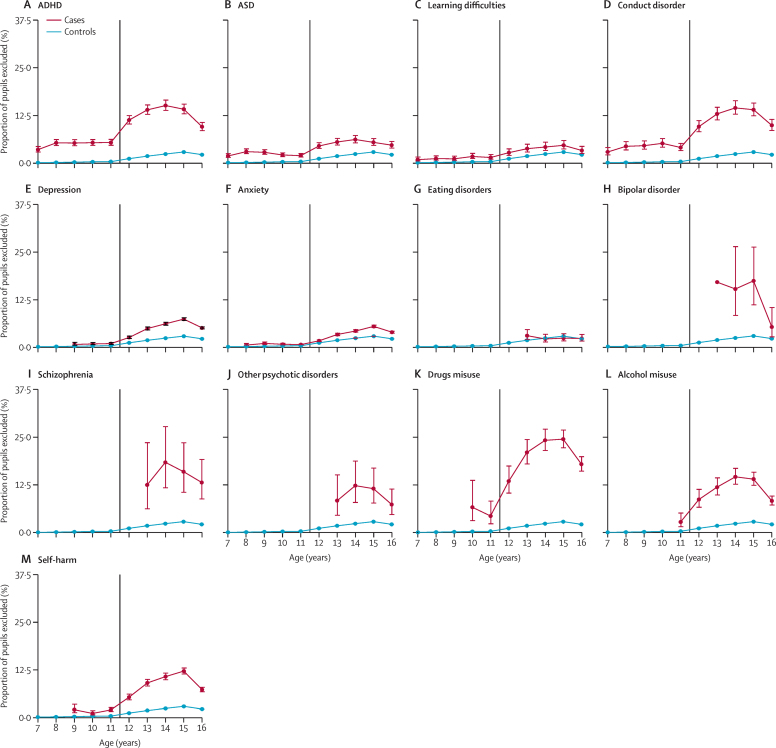
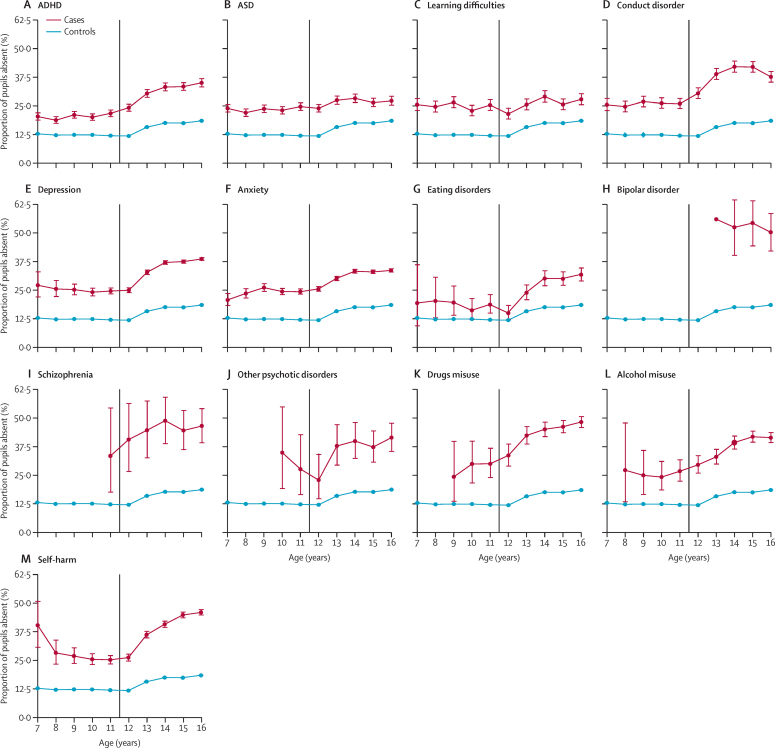
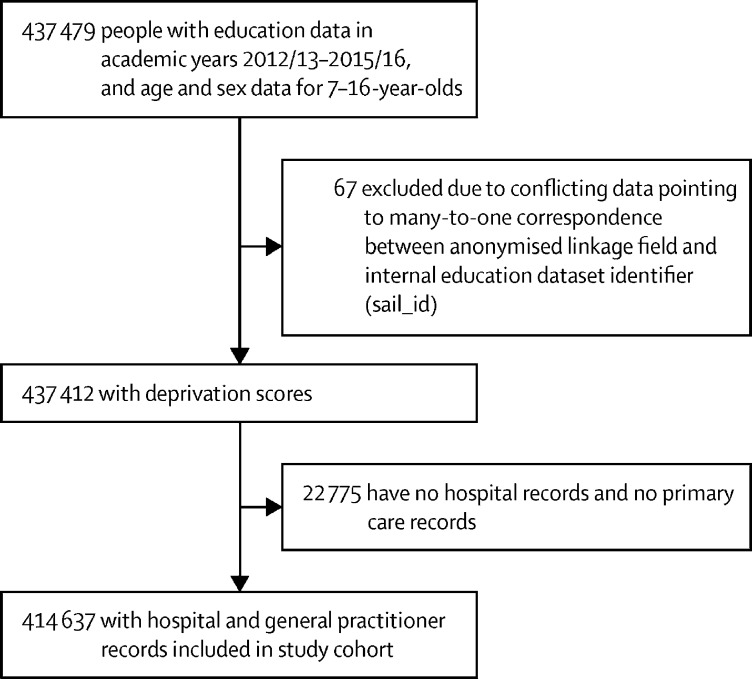
School attendance, school exclusion, and health-care data were available for 414 637 pupils (201 789 [48·7%] girls and 212 848 [51·3%] boys; mean age 10·5 years [SD 3·8] on Sept 1, 2012; ethnicity data were not available). Individuals with a record of a neurodevelopmental disorder, mental disorder, or self-harm were more likely to be absent or excluded in any school year than were those without a record. Unadjusted ORs for absences ranged from 2·1 (95% CI 2·0-2·2) for those with neurodevelopmental disorders to 6·6 (4·9-8·3) for those with bipolar disorder. Adjusted ORs (aORs) for absences ranged from 2·0 (1·9-2·1) for those with neurodevelopmental disorders to 5·5 (4·2-7·2) for those with bipolar disorder. Unadjusted ORs for exclusion ranged from 1·7 (1·3-2·2) for those with eating disorders to 22·7 (20·8-24·7) for those with a record of drugs misuse. aORs for exclusion ranged from 1·8 (1·5-2·0) for those with learning difficulties to 11·0 (10·0-12·1) for those with a record of drugs misuse.
Children and young people up to the age of 24 years with a record of a neurodevelopmental or mental disorder or self-harm before the age of 24 years were more likely to miss school than those without a record. Exclusion or persistent absence are potential indicators of current or future poor mental health that are routinely collected and could be used to target assessment and early intervention. Integrated school-based and health-care strategies to support young peoples' engagement with school life are required.
The Medical Research Council, MQ Mental Health Research, and the Economic and Social Research Council.
For the Welsh translation of the abstract see Supplementary Materials section.
无论是逃学还是被开除,学业不良都导致了一系列社会、教育和终身社会经济劣势。我们旨在衡量广泛的诊断性神经发育和精神障碍与 24 岁之前的自我伤害以及学业出勤和缺勤之间的关联。
在这项全国性的回顾性电子队列研究中,我们从威尔士人口服务数据集(包括 2012/13 学年至 2015/16 学年期间在威尔士的国立学校就读的 7-16 岁儿童[英国的离校年龄为 16 岁])中抽取了一个队列。利用青少年心理健康数据平台,我们将出勤和缺勤数据与国家人口统计学以及初级和二级医疗保健数据集联系起来。我们在 24 岁之前确定了所有有记录的神经发育障碍(ADHD 和自闭症谱系障碍[ASD])、学习困难、品行障碍、抑郁、焦虑、饮食障碍、酒精或药物滥用、双相情感障碍、精神分裂症、其他精神病障碍或记录的自我伤害(我们的解释变量)的学生。结果是缺课和缺勤。使用具有可交换相关结构的广义估计方程,采用二项式分布和对数链接函数,根据性别、年龄和贫困程度调整了缺勤和缺勤的优势比(OR)。
有 414637 名学生(201789 名女生[48.7%]和 212848 名男生[51.3%];2012 年 9 月 1 日的平均年龄为 10.5 岁[SD 3.8];种族数据不可用)的出勤、缺勤和医疗数据可用。与无记录者相比,有神经发育障碍、精神障碍或自我伤害记录的个体在任何学年缺勤或被开除的可能性更大。未调整的缺勤比值比(OR)范围从神经发育障碍者的 2.1(95%CI 2.0-2.2)到双相情感障碍者的 6.6(4.9-8.3)。调整后的缺勤比值比(aOR)范围从神经发育障碍者的 2.0(1.9-2.1)到双相情感障碍者的 5.5(4.2-7.2)。未调整的辍学 OR 范围从饮食障碍者的 1.7(1.3-2.2)到药物滥用者的 22.7(20.8-24.7)。辍学的 aOR 范围从学习困难者的 1.8(1.5-2.0)到药物滥用者的 11.0(10.0-12.1)。
在 24 岁之前有神经发育或精神障碍或自我伤害记录的儿童和青少年比没有记录的儿童和青少年更有可能缺课。被开除或持续缺勤可能是当前或未来心理健康不良的潜在指标,这些指标是常规收集的,可以用来确定评估和早期干预的对象。需要制定综合的以学校和卫生保健为基础的战略,以支持年轻人参与学校生活。
医学研究委员会、MQ 心理健康研究和经济和社会研究委员会。