Al-Rawi Ahmed, Siddiqi Maliha, Morgan Rosemary, Vandan Nimisha, Smith Julia, Wenham Clare
Simon Fraser University, Burnaby, BC, Canada.
John Hopkins University, Baltimore, MD, United States.
J Med Internet Res. 2020 Nov 5;22(11):e21646. doi: 10.2196/21646.
The online discussion around the COVID-19 pandemic is multifaceted, and it is important to examine the different ways by which online users express themselves. Since emojis are used as effective vehicles to convey ideas and sentiments, they can offer important insight into the public's gendered discourses about the pandemic.
This study aims at exploring how people of different genders (eg, men, women, and sex and gender minorities) are discussed in relation to COVID-19 through the study of Twitter emojis.
We collected over 50 million tweets referencing the hashtags #Covid-19 and #Covid19 for a period of more than 2 months in early 2020. Using a mixed method, we extracted three data sets containing tweets that reference men, women, and sexual and gender minorities, and we then analyzed emoji use along each gender category. We identified five major themes in our analysis including morbidity fears, health concerns, employment and financial issues, praise for frontline workers, and unique gendered emoji use. The top 600 emojis were manually classified based on their sentiment, indicating how positive, negative, or neutral each emoji is and studying their use frequencies.
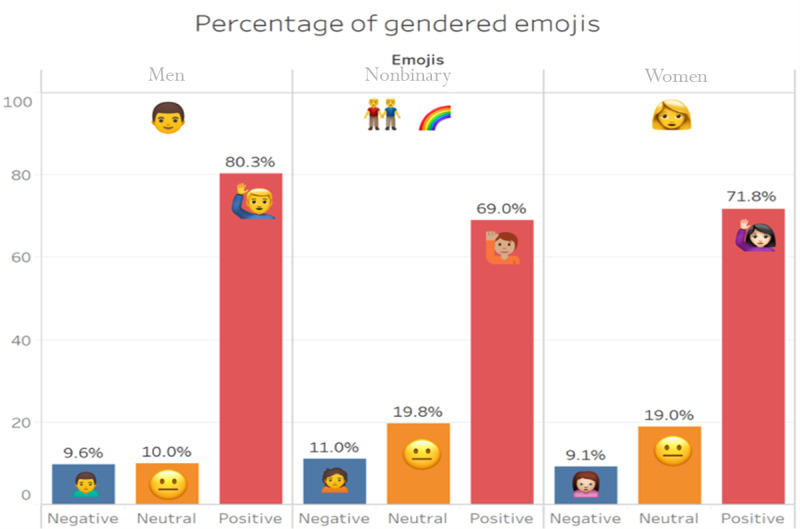
The findings indicate that the majority of emojis are overwhelmingly positive in nature along the different genders, but sexual and gender minorities, and to a lesser extent women, are discussed more negatively than men. There were also many differences alongside discourses of men, women, and gender minorities when certain topics were discussed, such as death, financial and employment matters, gratitude, and health care, and several unique gendered emojis were used to express specific issues like community support.
Emoji research can shed light on the gendered impacts of COVID-19, offering researchers an important source of information on health crises as they happen in real time.
围绕新冠疫情的在线讨论是多方面的,研究在线用户表达自身的不同方式很重要。由于表情符号是传达想法和情感的有效工具,它们可以为公众关于疫情的性别化话语提供重要见解。
本研究旨在通过对推特表情符号的研究,探索不同性别(如男性、女性以及性与性别少数群体)在新冠疫情相关讨论中的情况。
我们在2020年初的两个多月时间里收集了超过5000万条提及#Covid-19和#Covid19标签的推文。采用混合方法,我们提取了三个数据集,分别包含提及男性、女性以及性与性别少数群体的推文,然后分析了每个性别类别中表情符号的使用情况。我们在分析中确定了五个主要主题,包括对发病的恐惧、健康担忧、就业和财务问题、对一线工作者的赞扬以及独特的性别化表情符号使用。根据表情符号的情感倾向对前600个表情符号进行了人工分类,确定每个表情符号的积极、消极或中性程度,并研究它们的使用频率。
研究结果表明,不同性别使用的大多数表情符号在本质上都是非常积极的,但性与性别少数群体,以及在较小程度上的女性,在讨论中比男性受到更多负面评价。在讨论某些话题时,如死亡、财务和就业问题、感恩以及医疗保健,男性、女性和性别少数群体的话语也存在许多差异,并且使用了一些独特的性别化表情符号来表达社区支持等特定问题。
表情符号研究可以揭示新冠疫情的性别化影响,为研究人员提供有关实时发生的健康危机的重要信息来源。