Montreal Heart Institute, Université de Montréal, Montréal, Quebec, Canada.
Department of Microbiology, Infectious Diseases and Immunology, Faculty of Medicine, Université de Montréal, Montréal, Quebec, Canada.
mSphere. 2020 Oct 14;5(5):e00646-20. doi: 10.1128/mSphere.00646-20.
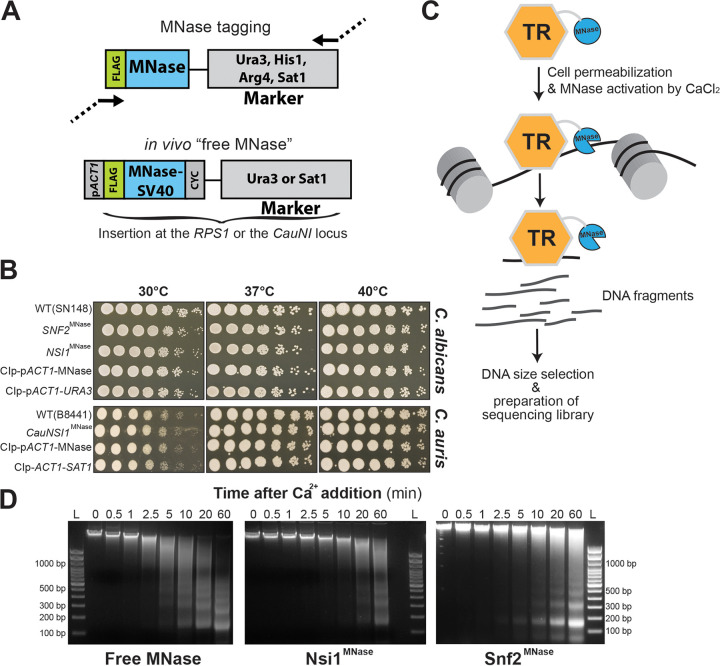
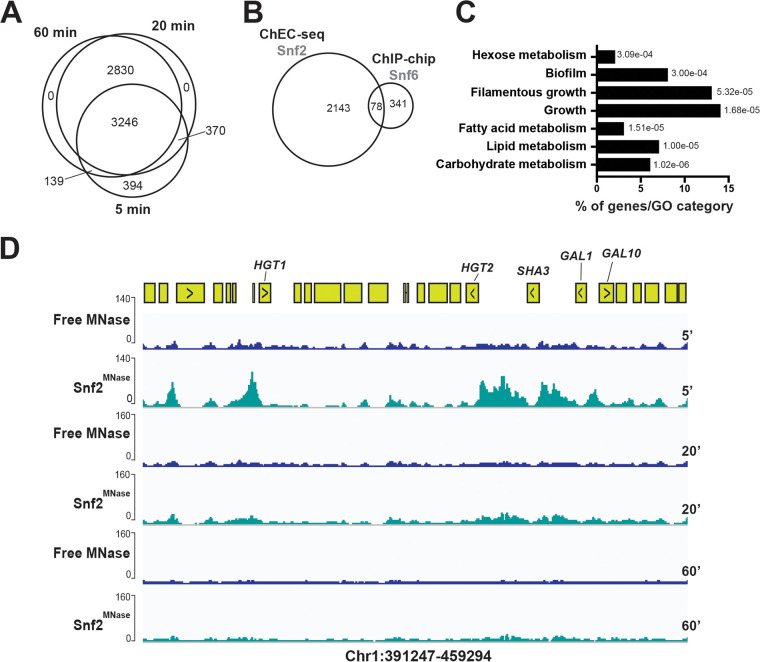
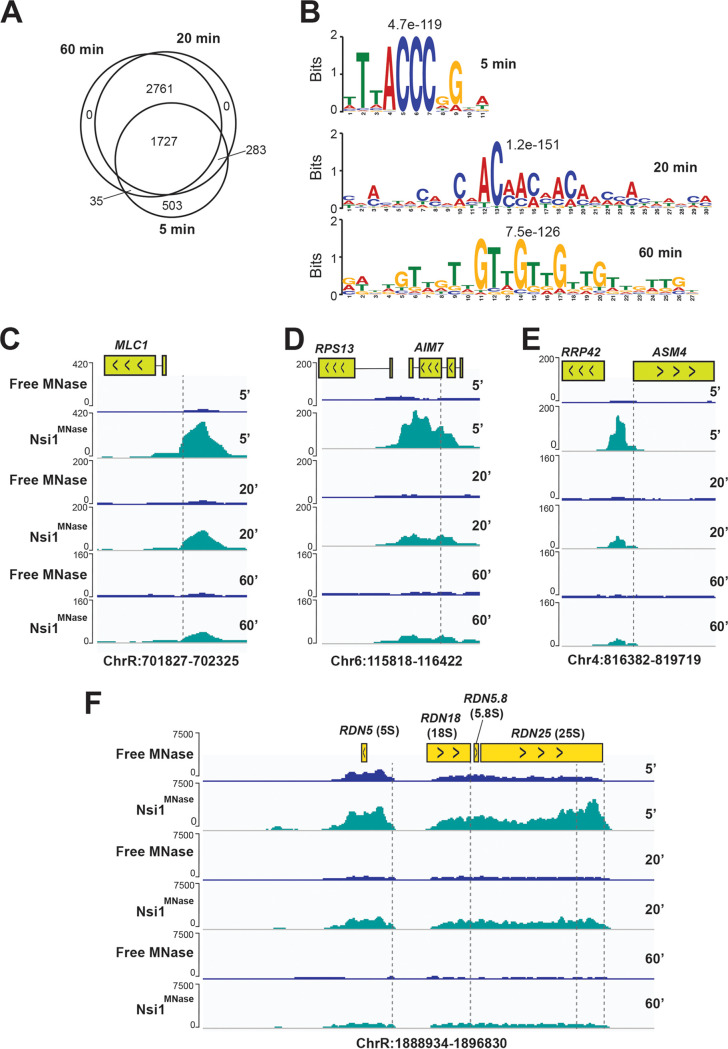
To persist in their dynamic human host environments, fungal pathogens must sense and adapt by modulating their gene expression to fulfill their cellular needs. Understanding transcriptional regulation on a global scale would uncover cellular processes linked to persistence and virulence mechanisms that could be targeted for antifungal therapeutics. Infections associated with the yeast , a highly prevalent fungal pathogen, and the multiresistant related species are becoming a serious public health threat. To define the set of a gene regulated by a transcriptional regulator in , chromatin immunoprecipitation (ChIP)-based techniques, including ChIP with microarray technology (ChIP-chip) or ChIP-DNA sequencing (ChIP-seq), have been widely used. Here, we describe a new set of PCR-based micrococcal nuclease (MNase)-tagging plasmids for and other spp. to determine the genome-wide location of any transcriptional regulator of interest using chromatin endogenous cleavage (ChEC) coupled to high-throughput sequencing (ChEC-seq). The ChEC procedure does not require protein-DNA cross-linking or sonication, thus avoiding artifacts related to epitope masking or the hyper-ChIPable euchromatic phenomenon. In a proof-of-concept application of ChEC-seq, we provided a high-resolution binding map of the SWI/SNF chromatin remodeling complex, a master regulator of fungal fitness in , in addition to the transcription factor Nsi1 that is an ortholog of the DNA-binding protein Reb1 for which genome-wide occupancy was previously established in The ChEC-seq procedure described here will allow a high-resolution genomic location definition which will enable a better understanding of transcriptional regulatory circuits that govern fungal fitness and drug resistance in these medically important fungi. Systemic fungal infections caused by and the "superbug" are becoming a serious public health threat. The ability of these yeasts to cause disease is linked to their faculty to modulate the expression of genes that mediate their escape from the immune surveillance and their persistence in the different unfavorable niches within the host. Comprehensive knowledge on gene expression control of fungal fitness is consequently an interesting framework for the identification of essential infection processes that could be hindered by chemicals as potential therapeutics. Here, we expanded the use of ChEC-seq, a technique that was initially developed in the yeast model to identify genes that are modulated by a transcriptional regulator, in pathogenic yeasts from the genus This robust technique will allow a better characterization of key gene expression regulators and their contribution to virulence and antifungal resistance in these pathogenic yeasts.
为了在动态的人类宿主环境中持续存在,真菌病原体必须通过调节基因表达来感知和适应,以满足其细胞需求。从全球范围理解转录调控将揭示与持久性和毒力机制相关的细胞过程,这些过程可能成为抗真菌治疗的靶点。与酵母(一种高度流行的真菌病原体)相关的感染以及多药耐药相关物种正成为严重的公共卫生威胁。为了确定受转录调节剂调控的一组基因,已广泛使用基于染色质免疫沉淀(ChIP)的技术,包括 ChIP 与微阵列技术(ChIP-chip)或 ChIP-DNA 测序(ChIP-seq)。在这里,我们描述了一组新的基于微球菌核酸酶(MNase)标记的质粒,用于 和其他 spp.,以使用染色质内切割(ChEC)结合高通量测序(ChEC-seq)来确定任何感兴趣的转录调节剂的全基因组位置。ChEC 程序不需要蛋白质-DNA 交联或超声处理,因此避免了与表位掩蔽或超 ChIP 常染色质现象相关的假象。在 ChEC-seq 的概念验证应用中,我们提供了 SWI/SNF 染色质重塑复合物的高分辨率结合图谱,该复合物是 中真菌适应性的主要调节剂,以及转录因子 Nsi1 的图谱,Nsi1 是 DNA 结合蛋白 Reb1 的同源物,之前在 中已建立了全基因组占有率。这里描述的 ChEC-seq 程序将允许进行高分辨率的基因组位置定义,从而更好地理解控制这些医学上重要真菌中真菌适应性和抗药性的转录调控回路。由 和“超级细菌”引起的系统性真菌感染正成为严重的公共卫生威胁。这些酵母引起疾病的能力与其调节基因表达的能力有关,这些基因介导它们逃避免疫监视并在宿主内的不同不利小生境中持续存在。因此,全面了解真菌适应性的基因表达控制是识别可能被化学物质阻碍的潜在治疗药物的重要感染过程的有趣框架。在这里,我们扩展了 ChEC-seq 的用途,ChEC-seq 是一种最初在酵母模型 中开发的技术,用于识别受转录调节剂调节的基因,用于来自 属的致病性酵母。这种强大的技术将允许更好地描述关键基因表达调节剂及其对这些致病性酵母的毒力和抗真菌耐药性的贡献。