MMWR Morb Mortal Wkly Rep. 2020 Oct 16;69(41):1497-1502. doi: 10.15585/mmwr.mm6941e2.
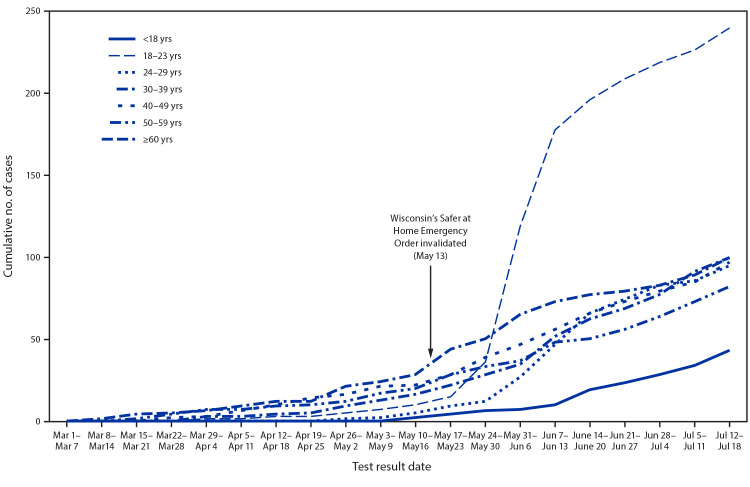
On May 13, 2020, the Wisconsin Supreme Court declared the state's Safer at Home Emergency Order (https://evers.wi.gov/Documents/COVID19/EMO28-SaferAtHome.pdf) "unlawful, invalid, and unenforceable,"* thereby increasing opportunities for social and business interactions. By mid-June, Winnebago County, Wisconsin experienced an increase in the number of infections with SARS-CoV-2, the virus that causes coronavirus disease 2019 (COVID-19), with the largest increase among persons aged 18-23 years (young adults) (1). This age group accounts for 12.5% of the population in the county. To identify factors that influence exposure to COVID-19 among young adults in Winnebago County, characteristics of COVID-19 cases and drivers of behaviors in this age group were examined. During March 1-July 18, 2020, 240 young adults received positive SARS-CoV-2 test results, accounting for 32% of all Winnebago County cases. In 30 key informant interviews, most interviewees reported exposure to misinformation, conflicting messages, or opposing views about the need for and effectiveness of masks. Thirteen young adults described social or peer pressure to not wear a mask and perceived severity of disease outcome for themselves as low but high for loved ones at risk. Having low perceived severity of disease outcome might partly explain why, when not in physical contact with loved ones at risk, young adults might attend social gatherings or not wear a mask (2). Exposure to misinformation and unclear messages has been identified as a driver of behavior during an outbreak (3,4), underscoring the importance of providing clear and consistent messages about the need for and effectiveness of masks. In addition, framing communication messages that amplify young adults' responsibility to protect others and target perceived social or peer pressure to not adhere to public health guidance might persuade young adults to adhere to public health guidelines that prevent the spread of COVID-19.
2020 年 5 月 13 日,威斯康星州最高法院宣布该州的《居家更安全紧急命令》(https://evers.wi.gov/Documents/COVID19/EMO28-SaferAtHome.pdf)“非法、无效且不可执行”*,从而增加了社交和商业互动的机会。到 6 月中旬,威斯康星州温尼贝戈县因 SARS-CoV-2 感染人数增加而经历了冠状病毒病 2019(COVID-19)的爆发,其中 18-23 岁人群(年轻人)感染人数增幅最大(1)。这一年龄组占该县人口的 12.5%。为了确定温尼贝戈县年轻人感染 COVID-19 的影响因素,研究了该年龄组的 COVID-19 病例特征和行为驱动因素。在 2020 年 3 月 1 日至 7 月 18 日期间,有 240 名年轻人的 SARS-CoV-2 检测结果呈阳性,占温尼贝戈县所有病例的 32%。在 30 次关键知情人访谈中,大多数受访者报告接触到错误信息、相互矛盾的信息或对口罩的必要性和有效性持不同看法。13 名年轻人描述了因社交或同伴压力而不戴口罩的情况,并认为自己患该病的严重程度较低,但对有患病风险的亲人的严重程度较高。年轻人对疾病结果的严重程度认识不足,这可能部分解释了为什么在与有患病风险的亲人没有身体接触时,年轻人可能会参加社交聚会或不戴口罩(2)。在疫情爆发期间,接触错误信息和不明确信息被确定为行为的驱动因素(3,4),这突显了提供有关口罩必要性和有效性的清晰一致信息的重要性。此外,将沟通信息框架化,放大年轻人保护他人的责任,并针对不遵守公共卫生指导的社会或同伴压力,可能会促使年轻人遵守防止 COVID-19 传播的公共卫生准则。