Surgery of the Alimentary Tract, Department of Medical and Surgical Sciences, Sant'Orsola- Malpighi Hospital, Alma Mater Studiorum University of Bologna, Via Albertoni 15, 40138, Bologna, Italy.
Operative Unit of clinical Microbiology, Department of Diagnostic Medicine and Prevention, Sant'Orsola Hospital, Alma Mater Studiorum University of Bologna, Via Albertoni 15, 40138, Bologna, Italy.
Int J Colorectal Dis. 2021 Mar;36(3):437-444. doi: 10.1007/s00384-020-03785-7. Epub 2020 Oct 14.
The objective was to collect the data available regarding the presence of laboratory-confirmed severe acute respiratory syndrome coronavirus 2 (SARS-CoV-2) in gastrointestinal system and to evaluate whether the digestive system could contribute to viral transmission.
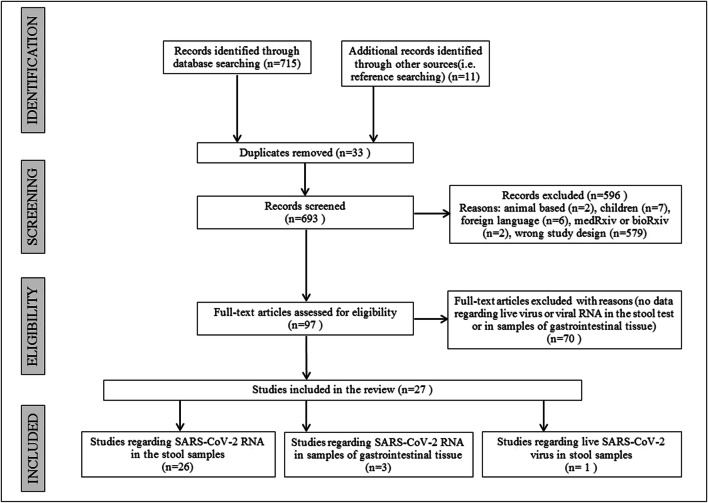
Bibliographic databases were searched to identify all studies documenting, in adult patients with a confirmed diagnosis of coronavirus disease 2019 (COVID-19): (1) the presence of SARS-CoV-2 ribonucleic acid in the feces; (2) the presence of SARS-CoV-2 ribonucleic acid in the intestinal cells; (3) live SARS-CoV-2 in the feces.
Twenty seven met the inclusion criteria. In 26 studies, the presence or absence of SARS-CoV-2 ribonucleic acid in the feces of COVID-19 patients had been reported. Out of the 671 patients, 312 (46.5%) had a positive stool sample for viral nucleic acid. Of these patients, 63.9% remained positive for viral nucleic acid in the feces after pharyngeal swabs became negative; Three studies also evaluated the viral ribonucleic acid in the gastrointestinal tissues and the presence of SARS-CoV-2 nucleic acid was found in samples of 3 patients out of 8 examined (37.5%). The presence of the live virus in stool samples was confirmed in two studies but no in in a recent study from Germany. These results suggested that SARS-CoV-2 could infect gastrointestinal epithelial cells and it may be transmitted through the digestive tract.
In order to control the pandemic, every effort should be made to understand all the possible routes of transmission of the infections, even the less important ones.
收集有关严重急性呼吸综合征冠状病毒 2(SARS-CoV-2)在胃肠道中存在的实验室确诊数据,并评估消化系统是否有助于病毒传播。
检索文献数据库,以确定所有记录有以下内容的研究:(1)在确诊为 2019 年冠状病毒病(COVID-19)的成年患者中,粪便中 SARS-CoV-2 核糖核酸的存在;(2)肠道细胞中 SARS-CoV-2 核糖核酸的存在;(3)粪便中活的 SARS-CoV-2。
符合纳入标准的有 27 项研究。在 26 项研究中,报告了 COVID-19 患者粪便中 SARS-CoV-2 核糖核酸的存在或不存在。在 671 名患者中,312 名(46.5%)粪便样本中病毒核酸呈阳性。在这些患者中,咽拭子转为阴性后,仍有 63.9%的患者粪便中病毒核酸持续阳性;三项研究还评估了胃肠道组织中的病毒核糖核酸,在 8 例检查患者中有 3 例(37.5%)样本中发现了 SARS-CoV-2 核酸。两项研究证实了粪便样本中活病毒的存在,但德国最近的一项研究未发现。这些结果表明,SARS-CoV-2 可感染胃肠道上皮细胞,可能通过消化道传播。
为了控制大流行,应尽一切努力了解感染的所有可能传播途径,即使是不太重要的途径。