Amegadzie Joseph Emil, Gamble John-Michael, Farrell Jamie, Gao Zhiwei
Faculty of Medicine, Memorial University of Newfoundland, Newfoundland, Canada.
Faculty of Science, School of Pharmacy, University of Waterloo, Waterloo, Ontario, Canada.
Int J Chron Obstruct Pulmon Dis. 2020 Sep 30;15:2355-2366. doi: 10.2147/COPD.S264580. eCollection 2020.
Gender differences in the incidence, susceptibility and severity of many obstructive airway diseases (OADs) have been well recognized. However, gender differences in the inhaled pharmacotherapy profile are not well characterized.
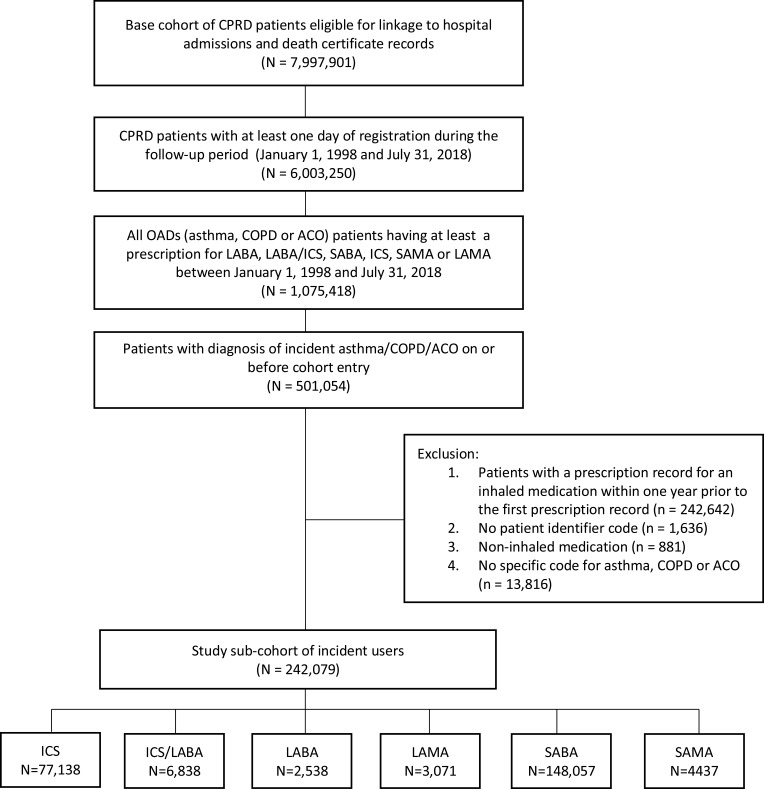
We conducted a retrospective cohort study to investigate gender differences in new-users of inhaled corticosteroids (ICS), short-or long-acting beta-agonist (SABA or LABA), ICS/LABA, short-or long-acting muscarinic antagonist (SAMA or LAMA) among patients with asthma, COPD or asthma-COPD overlap (ACO). We used Clinical Practice Research Datalink to identify OAD patients, 18 years and older, who were new-users (1-year washout period) from 01-January-1998 to 31-July-2018. Multivariable logistic regression was used to examine gender differences in each of the inhaled pharmacotherapies after controlling for potential confounders.
A total of 242,079 new-users (asthma: 84.93%; COPD: 10.19%; ACO: 4.88%) of inhaled pharmacotherapies were identified. The multivariable analyses showed that males with COPD were more likely to be a new user of a LABA (odds ratio [OR] 1.29; 95% confidence interval [CI], 1.12-1.49), LAMA (OR 1.21; 95% CI 1.10-1.33), SAMA (OR 1.11; 95% CI 1.01-1.21) and less likely to be a new user of a SABA (OR 0.84; 95% CI, 0.80-0.89) compared to females. Similar patterns were also observed for patients with ACO; males were more likely to be prescribed with LABA (OR 1.26; 95% CI 1.03-1.55), LAMA (OR 1.28; 95% CI 1.11-1.48), SAMA (OR 1.28; 95% CI 1.11-1.48), and less likely to be a new user of a SABA (OR 0.89; 95% CI, 0.82-0.96). Also, males with asthma were more likely to be a new-user of ICS/LABA (OR 1.15; 95% CI, 1.08-1.23) and less likely to start an ICS (OR 0.97; 95% CI, 0.95-0.99) in comparison with females.
Our study showed significant gender differences in new-users of inhaled pharmacotherapies among OAD patients. Adjusting for proxies of disease severity, calendar year, smoking and socioeconomic status did not change the association by gender.
许多阻塞性气道疾病(OAD)在发病率、易感性和严重程度方面的性别差异已得到充分认识。然而,吸入药物治疗方面的性别差异尚未得到很好的描述。
我们进行了一项回顾性队列研究,以调查哮喘、慢性阻塞性肺疾病(COPD)或哮喘-COPD重叠综合征(ACO)患者中吸入皮质类固醇(ICS)、短效或长效β受体激动剂(SABA或LABA)、ICS/LABA、短效或长效毒蕈碱拮抗剂(SAMA或LAMA)新使用者的性别差异。我们使用临床实践研究数据链来识别1998年1月1日至2018年7月31日期间18岁及以上的OAD新使用者(1年洗脱期)。在控制潜在混杂因素后,使用多变量逻辑回归来检验每种吸入药物治疗中的性别差异。
共识别出242,079名吸入药物治疗的新使用者(哮喘:84.93%;COPD:10.19%;ACO:4.88%)。多变量分析显示,与女性相比,COPD男性更有可能是LABA的新使用者(比值比[OR]1.29;95%置信区间[CI],1.12-1.49)、LAMA(OR 1.21;95%CI 1.10-1.33)、SAMA(OR 1.11;95%CI 1.01-1.21),而成为SABA新使用者的可能性较小(OR 0.84;95%CI,0.80-0.89)。ACO患者也观察到类似模式;男性更有可能被处方LABA(OR 1.26;95%CI 1.03-1.55)、LAMA(OR 1.28;95%CI 1.11-1.48)、SAMA(OR 1.28;95%CI 1.11-1.48),而成为SABA新使用者的可能性较小(OR 0.89;95%CI,0.82-0.96)。此外,与女性相比,哮喘男性更有可能是ICS/LABA的新使用者(OR 1.15;95%CI,1.08-1.23),而开始使用ICS的可能性较小(OR 0.97;95%CI,0.95-0.99)。
我们的研究显示OAD患者中吸入药物治疗新使用者存在显著的性别差异。调整疾病严重程度、日历年、吸烟和社会经济地位的替代指标后,性别关联并未改变。