Jia Zhongming, Zhu Huamin, Sun Hongguang, Hua Yitong, Zhang Guoqiang, Jiang Jingru, Wang Xiaohong
Department of Thyroid and Breast Surgery, Affiliated Hospital of Binzhou Medical University, Binzhou 256603, Shandong, People's Republic of China.
Department of Medical Ultrasonics, Affiliated Hospital of Binzhou Medical University, Binzhou 256603, Shandong, People's Republic of China.
Cancer Manag Res. 2020 Sep 22;12:8733-8744. doi: 10.2147/CMAR.S270200. eCollection 2020.
Emerging evidence has noted the versatile functions of mesenchymal stem cell-derived exosomes (MSC-Exos) in cancer control. This work aims to probe to function of adipose MSC-Exos (adMSC-Exos) in drug-resistance of breast cancer (BC) cells to cisplatin (DDP) and the molecules involved.
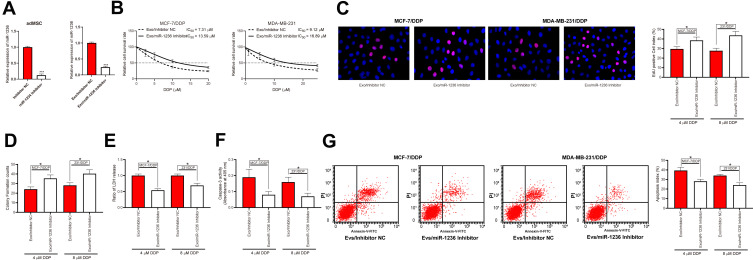
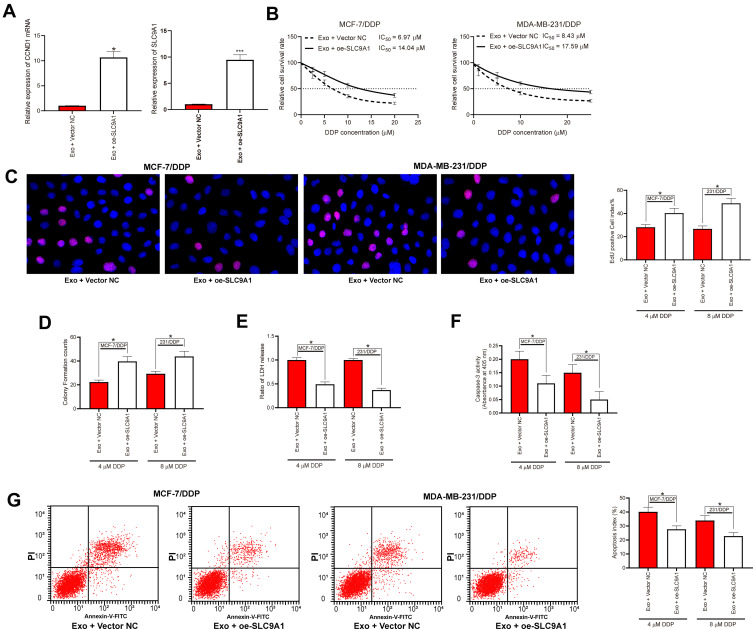
Parental and DDP-resistant BC cell lines MCF-7 and MDA-MB-231 were used. All cells were pre-treated with adMSC-Exos. Then, the viability and apoptosis of cells after DDP treatment were determined. Differentially expressed miRNAs after adMSC-exo treatment were screened out. Rescue experiments were conducted by pre-transfecting miR-1236 inhibitor into adMSCs, and the role of miR-1236 in DDP sensitivity was determined. Targeting mRNAs of miR-1236 were predicted by bioinformatics analysis. Altered SLC9A1 expression was administrated to evaluate its function in DDP resistance.
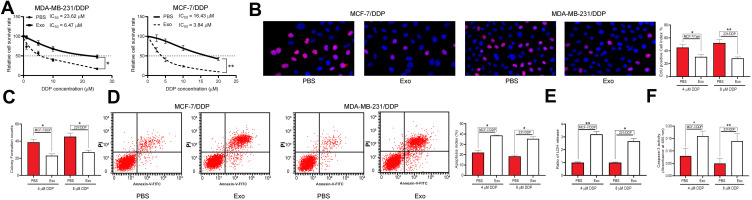
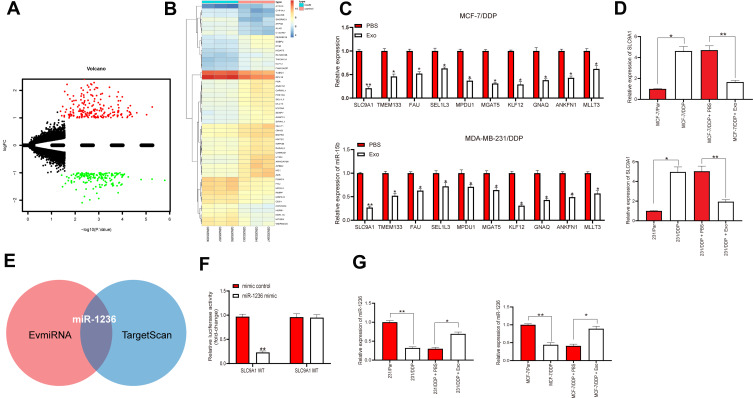
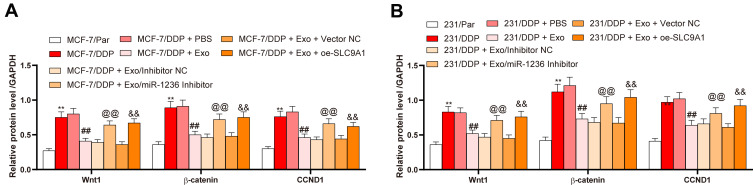
The adMSC-Exos notably increased the sensitivity of either parental or DDP-resistant BC cells to DDP. SLC9A1 was notably highly expressed in DDP-resistant cells but inhibited following adMSC-exo administration. Importantly, miR-1236, which could directly bind to SLC9A1 and suppress its expression, was confirmed as an enriched miRNA in adMSC-Exos. Either inhibition of miR-1236 or upregulation of SLC9A1 blocked the pro-sensitize roles of adMSC-Exos. In addition, the Wnt/β-catenin pathway activity was suppressed by adMSC-Exos but recovered by SLC9A1.
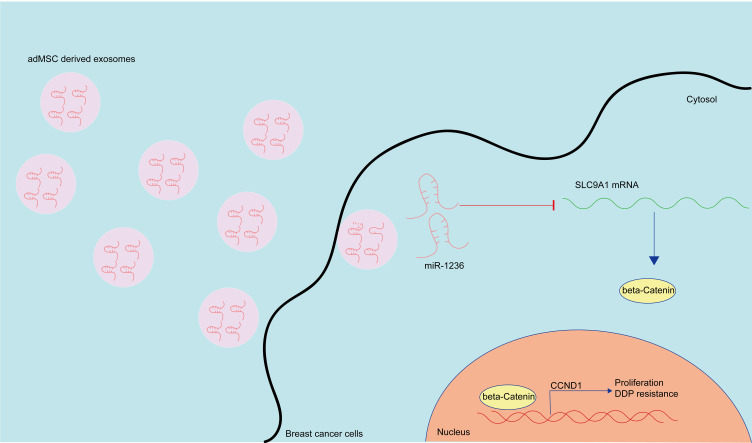
This study evidenced that adMSC-Exos carry miR-1236 to increase sensitivity of BC cells to DDP with the involvement of SLC9A1 downregulation and Wnt/β-catenin inactivation. This finding may offer novel insights into treatment for drug-resistant BC.
新出现的证据表明间充质干细胞衍生的外泌体(MSC-Exos)在癌症控制中具有多种功能。本研究旨在探讨脂肪间充质干细胞外泌体(adMSC-Exos)对乳腺癌(BC)细胞顺铂(DDP)耐药性的作用及相关分子机制。
采用亲代及顺铂耐药的BC细胞系MCF-7和MDA-MB-231。所有细胞均用adMSC-Exos预处理。然后,测定DDP处理后细胞的活力和凋亡情况。筛选出adMSC-Exos处理后差异表达的miRNA。通过将miR-1236抑制剂预先转染到adMSCs中进行挽救实验,确定miR-1236在DDP敏感性中的作用。通过生物信息学分析预测miR-1236的靶向mRNA。检测SLC9A1表达变化以评估其在DDP耐药中的作用。
adMSC-Exos显著提高了亲代或顺铂耐药BC细胞对DDP的敏感性。SLC9A1在顺铂耐药细胞中显著高表达,但在给予adMSC-Exos后受到抑制。重要的是,miR-1236可直接结合SLC9A1并抑制其表达,被确认为adMSC-Exos中富集的miRNA。抑制miR-1236或上调SLC9A1均阻断了adMSC-Exos的促敏感作用。此外,adMSC-Exos抑制了Wnt/β-连环蛋白通路活性,但SLC9A1使其恢复。
本研究证明adMSC-Exos携带miR-1236,通过下调SLC9A1和使Wnt/β-连环蛋白失活来增加BC细胞对DDP的敏感性。这一发现可能为耐药BC的治疗提供新的见解。