Al-Surimi Khaled, Al Omar Munirah, Alahmary Khalid, Salam Mahmoud
Department of Health System Management, College of Public Health and Health Informatics, King Saud bin Abdulaziz University for Health Sciences, Riyadh, Saudi Arabia.
King Abdullah International Medical Research Center, Riyadh, Saudi Arabia.
Risk Manag Healthc Policy. 2020 Oct 2;13:1905-1914. doi: 10.2147/RMHP.S265127. eCollection 2020.
Workplace bullying (WPB) refers to any form of repeated and unreasonable verbal, physical or sexual harassment that an employee endures by a person or a group. In healthcare settings, practitioners are occasionally victims of WPB incidents. The aim of this study was to survey victims of WPB and determine factors associated with being a victim of WPB at a multiregional health care facility in Saudi Arabia.
This cross-sectional study was conducted in 2018, by distributing a self-administered questionnaire via a private electronic mail to all fulltime healthcare practitioners within a multi-regional hospital in Saudi Arabia. Healthcare practitioners included physicians, nurses, allied healthcare professionals and pharmacists who reported being exposed to WPB in the past year. Study outcomes were the prevalence rate ratio of WPB and its associated factors, such as victim, perpetrator and incident characteristics.
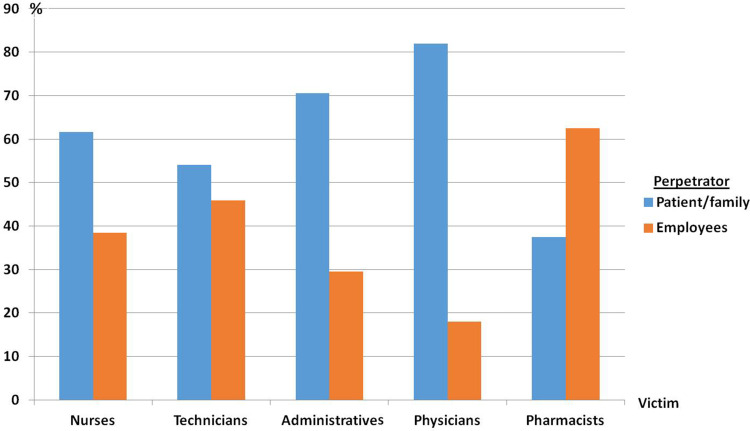
WPB has been reported by 684 participants. Perpetrators were mainly patients (36.1%), their families/relatives (29.5%), and hospital staff (27.2%) or managers/supervisors (7.2%). The type of WPB incident was mostly verbal abuse (98.1%) followed by physical harassment (11.8%) and sexual connotations (5.8%). WPB was 30% more prevalent among younger nurses and 24% less prevalent among higher educated nurses compared to their counter groups, P<0.001 each. Among technicians and administrative employees, WPB was 54% more prevalent among females, 36% more prevalent among the younger group, and 25% more prevalent among expatriate workers compared to their counter groups P<0.014, P<0.001 and P=0.017, respectively. WPB was 20% less prevalent among higher educated allied health professionals, P=0.002. Among physicians, WPB was 33% more prevalent among females, P=0.041 and was 47% more prevalent among higher educated physicians compared to their counter groups, P=0.018.
WPB might occur any time, anywhere and by any person within health care facilities. The prevalence of WPB varies within health occupational groups. Gender, age, educational level, and nationality were significantly associated factors with WPB.
职场霸凌(WPB)是指员工遭受个人或群体的任何形式的重复性且不合理的言语、身体或性骚扰。在医疗环境中,从业者偶尔会成为职场霸凌事件的受害者。本研究的目的是对职场霸凌的受害者进行调查,并确定沙特阿拉伯一家多地区医疗机构中成为职场霸凌受害者的相关因素。
这项横断面研究于2018年进行,通过私人电子邮件向沙特阿拉伯一家多地区医院内的所有全职医疗从业者发放一份自填式问卷。医疗从业者包括医生、护士、专职医疗人员和药剂师,他们报告在过去一年中遭受过职场霸凌。研究结果是职场霸凌的患病率比及其相关因素,如受害者、霸凌者和事件特征。
684名参与者报告遭受过职场霸凌。霸凌者主要是患者(36.1%)、其家人/亲属(29.5%)、医院工作人员(27.2%)或经理/主管(7.2%)。职场霸凌事件的类型主要是言语辱骂(98.1%),其次是身体骚扰(11.8%)和带有性暗示(5.8%)。与对照组相比,年轻护士中的职场霸凌患病率高30%,高学历护士中的患病率低24%,P值均<0.001。在技术人员和行政人员中,与对照组相比,女性中的职场霸凌患病率高54%,年轻群体中高36%,外籍员工中高25%,P值分别为<0.014、<0.001和=0.017。高学历专职医疗人员中的职场霸凌患病率低20%,P=0.002。在医生中,女性中的职场霸凌患病率高33%,P=0.041,高学历医生中的患病率比对照组高47%,P=0.018。
职场霸凌可能在医疗机构内的任何时间、任何地点由任何人发生。职场霸凌的患病率在不同健康职业群体中有所不同。性别、年龄、教育水平和国籍是与职场霸凌显著相关的因素。