Kamal Haziq, Tan Geok Chin, Ibrahim Siti Fatimah, Shaikh Mohd Farooq, Mohamed Isa Naina, Mohamed Rashidi M Pakri, Hamid Adila A, Ugusman Azizah, Kumar Jaya
Department of Physiology, Faculty of Medicine, Universiti Kebangsaan Malaysia, Kuala Lumpur, Malaysia.
Department of Pathology, Faculty of Medicine, Universiti Kebangsaan Malaysia, Kuala Lumpur, Malaysia.
Front Cell Neurosci. 2020 Aug 31;14:282. doi: 10.3389/fncel.2020.00282. eCollection 2020.
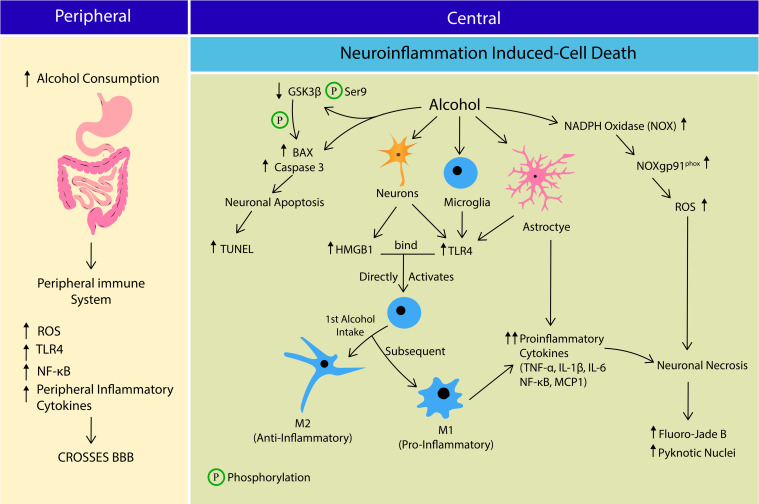
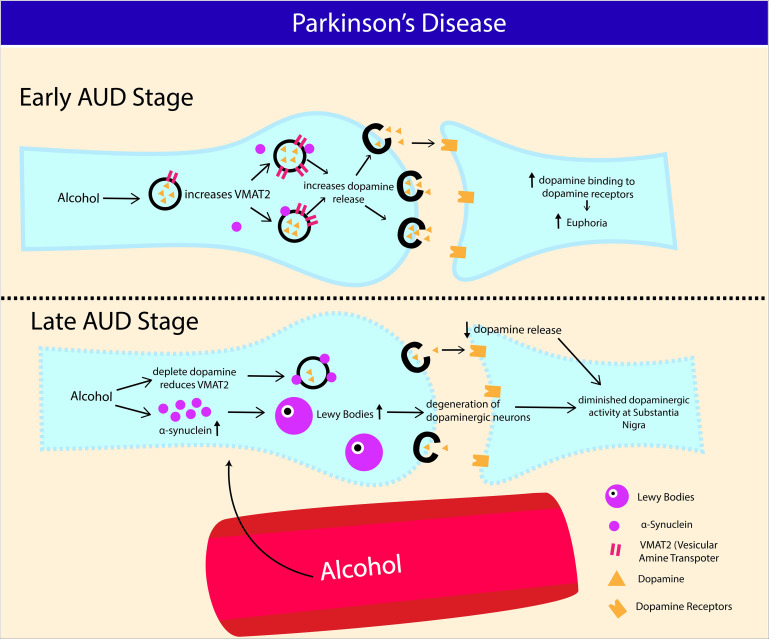
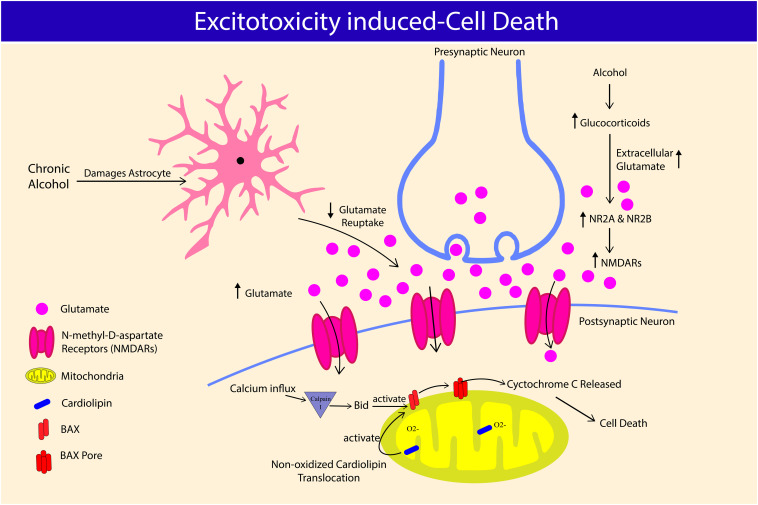
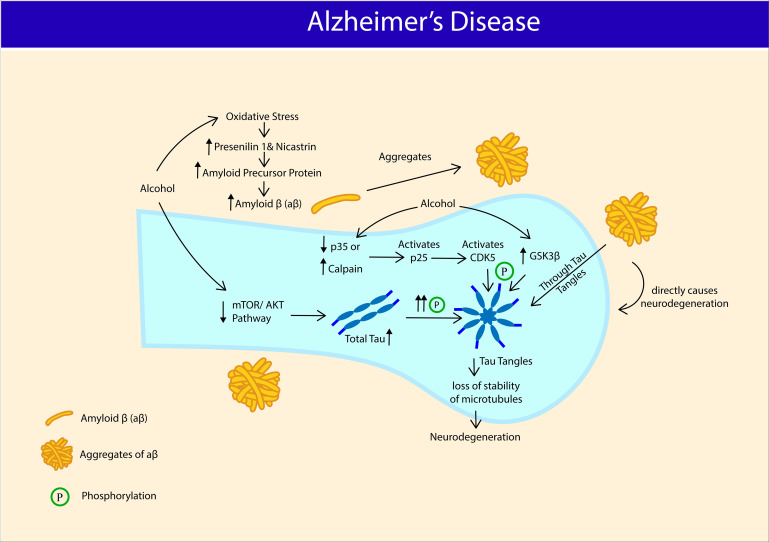
Alcohol use disorder (AUD) has been associated with neurodegenerative diseases such as Alzheimer's and Parkinson's disease. Prolonged excessive alcohol intake contributes to increased production of reactive oxygen species that triggers neuroimmune response and cellular apoptosis and necrosis via lipid peroxidation, mitochondrial, protein or DNA damage. Long term binge alcohol consumption also upregulates glutamate receptors, glucocorticoids and reduces reuptake of glutamate in the central nervous system, resulting in glutamate excitotoxicity, and eventually mitochondrial injury and cell death. In this review, we delineate the following principles in alcohol-induced neurodegeneration: (1) alcohol-induced oxidative stress, (2) neuroimmune response toward increased oxidants and lipopolysaccharide, (3) glutamate excitotoxicity and cell injury, and (4) interplay between oxidative stress, neuroimmune response and excitotoxicity leading to neurodegeneration and (5) potential chronic alcohol intake-induced development of neurodegenerative diseases, including Alzheimer's and Parkinson's disease.
酒精使用障碍(AUD)与神经退行性疾病如阿尔茨海默病和帕金森病有关。长期过量饮酒会导致活性氧的产生增加,活性氧通过脂质过氧化、线粒体、蛋白质或DNA损伤触发神经免疫反应以及细胞凋亡和坏死。长期暴饮酒精还会上调谷氨酸受体、糖皮质激素,并减少中枢神经系统中谷氨酸的再摄取,导致谷氨酸兴奋性毒性,最终造成线粒体损伤和细胞死亡。在本综述中,我们阐述了酒精诱导神经退行性变的以下原理:(1)酒精诱导的氧化应激,(2)对氧化剂和脂多糖增加的神经免疫反应,(3)谷氨酸兴奋性毒性和细胞损伤,(4)氧化应激、神经免疫反应和兴奋性毒性之间导致神经退行性变的相互作用,以及(5)长期饮酒可能导致神经退行性疾病(包括阿尔茨海默病和帕金森病)的发生。