Suprenant Mark P, Gopaluni Anuraag, Dyson Meredith K, Al-Dheeb Najwa, Shafique Fouzia, Zaman Muhammad H
Department of Biomedical Engineering, Boston University, Boston, MA USA.
UNICEF, Yemen Country Office, Aden, Jordan.
Confl Health. 2020 Aug 5;14:55. doi: 10.1186/s13031-020-00300-1. eCollection 2020.
The ongoing war in Yemen continues to pose challenges for healthcare coverage in the country especially with regards to critical gaps in information systems needed for planning and delivering health services. Restricted access to social services including safe drinking water and sanitation systems have likely led to an increase in the spread of diarrheal diseases which remains one of greatest sources of mortality in children under 5 years old. To overcome morbidity and mortality from diarrheal diseases among children in the context of severe information shortages, a predictive model is needed to determine the burden of diarrheal disease on Yemeni children and their ability to reach curative health services through an estimate of healthcare coverage. This will allow for national and local health authorities and humanitarian partners to make better informed decisions for planning and providing health care services.
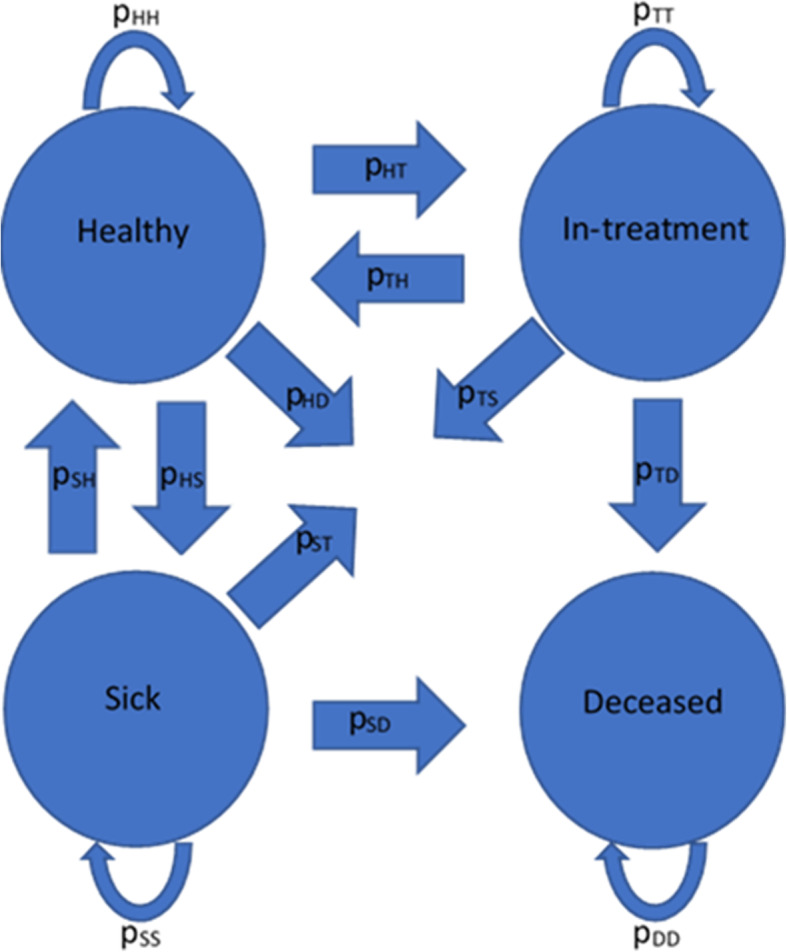
A probabilistic Markov model was developed based on an analysis of Yemen's health facilities' clinical register data provided by UNICEF. The model combines this health system data with environmental and conflict-related factors such as the destruction of infrastructure (roads and health facilities) to fill in gaps in population-level data on the burden of diarrheal diseases on children under five, and the coverage rate of the under-five sick population with treatment services at primary care facilities. The model also provides estimates of the incidence rate, and treatment outcomes including treatment efficacy and mortality rate.
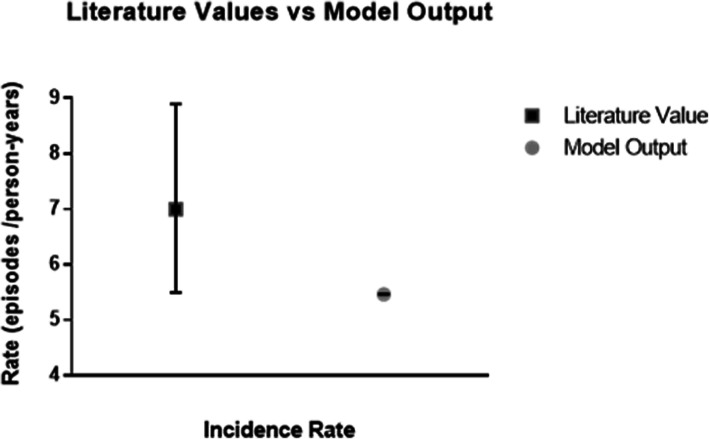
By using alternatives to traditional healthcare data, the model was able to recreate the observed trends in treatment with no significant difference compared to provided validation data. Once validated, the model was used to predict the percent of sick children with diarrhea who were able to reach, and thus receive, treatment services (coverage rate) for 2019 which ranged between an average weekly minimum of 1.73% around the 28th week of the year to a weekly maximum coverage of just over 5% around the new year. These predictions can be translated into policy decisions such as when increased efforts are needed to reach children and what type of service delivery modalities may be the most effective.
The model developed and presented in this manuscript shows a seasonal trend in the spread of diarrheal disease in children under five living in Yemen through a novel incorporation of weather, infrastructure and conflict parameters in the model. Our model also provides new information on the number of children seeking treatment and how this is influenced by the ongoing conflict. Despite the work of the national and local health authorities with the support of aid organizations, during the mid-year rains up to 98% of children with diarrhea are unable to receive treatment services. Thus, it is recommended that community outreach or other delivery modalities through which services are delivered in closer proximity to those in need should be scaled up prior to and during these periods. This would serve to increase number of children able to receive treatment by lessening the prohibitive travel burden, or access constraint, on families during these times.
也门持续的战争继续给该国的医疗保健覆盖带来挑战,特别是在规划和提供卫生服务所需的信息系统存在严重差距方面。包括安全饮用水和卫生系统在内的社会服务获取受限,可能导致腹泻疾病传播增加,腹泻疾病仍是5岁以下儿童最大的死亡原因之一。为了在严重信息短缺的情况下克服儿童腹泻疾病的发病率和死亡率,需要一个预测模型来确定腹泻疾病对也门儿童的负担,以及通过估计医疗保健覆盖率来确定他们获得治疗性卫生服务的能力。这将使国家和地方卫生当局以及人道主义伙伴能够在规划和提供医疗保健服务方面做出更明智的决策。
基于对联合国儿童基金会提供的也门卫生设施临床登记数据的分析,开发了一个概率马尔可夫模型。该模型将这些卫生系统数据与环境和冲突相关因素(如基础设施破坏(道路和卫生设施))相结合,以填补五岁以下儿童腹泻疾病负担以及初级保健设施中五岁以下患病人口治疗服务覆盖率的人群层面数据空白。该模型还提供发病率估计以及治疗结果,包括治疗效果和死亡率。
通过使用传统医疗保健数据的替代数据,该模型能够重现观察到的治疗趋势,与提供的验证数据相比无显著差异。一旦验证,该模型被用于预测2019年能够获得并因此接受治疗服务的腹泻患病儿童百分比(覆盖率),范围从一年中第28周左右的平均每周最低1.73%到新年前后的每周最高覆盖率略超过5%。这些预测可以转化为政策决策,例如何时需要加大力度接触儿童以及哪种服务提供方式可能最有效。
本手稿中开发和展示的模型通过在模型中新颖地纳入天气、基础设施和冲突参数,显示了也门五岁以下儿童腹泻疾病传播的季节性趋势。我们的模型还提供了关于寻求治疗的儿童数量以及这如何受到持续冲突影响的新信息。尽管国家和地方卫生当局在援助组织的支持下开展了工作,但在年中降雨期间,高达98%的腹泻儿童无法获得治疗服务。因此,建议在这些时期之前和期间扩大社区外展或其他更接近有需要人群提供服务的方式。这将通过减轻这些时期家庭面临的高昂旅行负担或获取限制,来增加能够接受治疗的儿童数量。