Liu Robin, Van Aarsen Kristine, Sedran Rob, Lim Rodrick
Schulich School of Medicine and Dentistry, Western University, Ontario, Canada.
Division of Emergency Medicine, Department of Medicine, Western University, Ontario, Canada.
Can Med Educ J. 2020 Sep 23;11(5):e56-e61. doi: 10.36834/cmej.68602. eCollection 2020 Sep.
In recent years, there has been growing interest in the field of physician wellness and burnout. The prevalence of burnout is non-uniform between medical specialties and is most prevalent amongst emergency medicine physicians. Importantly, burnout can be observed amongst individuals early in their medical careers, including medical students and residents. Despite ample studies in other populations, there is no national perspective of burnout amongst Canadian Royal College of Physicians and Surgeons of Canada (RCPSC)Emergency Medicine (EM) residents.
Our study surveyed Canadian residents undergoing EM training though the RCPSC via local program directors using an anonymous electronic form. Basic demographic characteristics and residents' contemplation of suicide were surveyed. The Maslach Burnout Inventory - Human Services Survey (MBI-HSS) for medical personnel was used to assess burnout on three dimensions (emotional exhaustion, depersonalization and personal accomplishment).
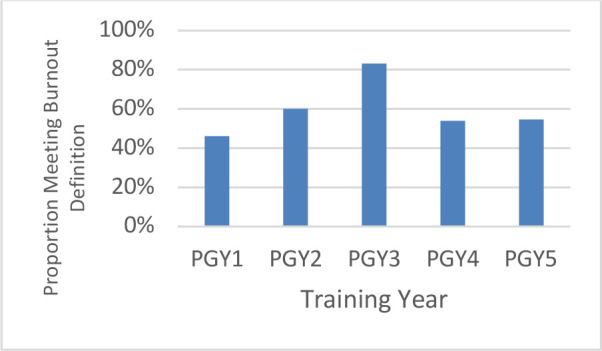
A total of 65 valid responses were collected from eight of 14 eligible institutions (response rate = 30%). Respondents are primarily male (58%) and in their postgraduate year (PGY) 1-3 (71%). Overall, 62% of residents met the threshold for burnout according to a widely cited definition of burnout using the MBI-HSS. Additionally, 14% contemplated suicide during their training. There was no statistical significance in burnout rates between male and female responders or between residents in different stages of training.
Our results suggest significant burnout amongst Canadian EM residents. These results point to an important opportunity to better support EM residents during their training to improve wellness and reduce burnout.
近年来,医师健康与职业倦怠领域受到越来越多的关注。职业倦怠的患病率在各医学专业之间并不统一,在急诊医学医师中最为普遍。重要的是,在医学职业生涯早期的个体中也能观察到职业倦怠,包括医学生和住院医师。尽管对其他人群进行了大量研究,但加拿大皇家内科医师与外科医师学院(RCPSC)急诊医学(EM)住院医师的职业倦怠情况尚无全国性的视角。
我们的研究通过当地项目主任,使用匿名电子表格对通过RCPSC接受EM培训的加拿大住院医师进行了调查。调查了基本人口统计学特征以及住院医师的自杀念头。使用针对医务人员的马氏职业倦怠量表 - 人类服务调查(MBI - HSS)从三个维度(情感耗竭、去个性化和个人成就感)评估职业倦怠。
从14个符合条件的机构中的8个共收集到65份有效回复(回复率 = 30%)。受访者主要为男性(58%),处于研究生第1 - 3年(PGY)(71%)。总体而言,根据使用MBI - HSS广泛引用的职业倦怠定义,62%的住院医师达到职业倦怠阈值。此外,14%的人在培训期间有过自杀念头。男性和女性受访者之间或不同培训阶段的住院医师之间的职业倦怠率无统计学意义。
我们的结果表明加拿大EM住院医师存在显著的职业倦怠。这些结果指出了一个重要机会,即在培训期间更好地支持EM住院医师,以改善健康状况并减少职业倦怠。