Kejela Gemechu, Wakgari Aga, Tesfaye Tariku, Turi Ebisa, Adugna Moa, Alemu Netsanet, Jebessa Latera
Department of Public Health, Institute of Health Sciences, Wollega University, Nekemte, Ethiopia.
School of Medicine, Institute of Health Sciences, Wollega University, Nekemte, Ethiopia.
Contracept Reprod Med. 2020 Oct 9;5:26. doi: 10.1186/s40834-020-00130-9. eCollection 2020.
Even if anemia is a worldwide public health problem affecting numerous people in all age groups, particularly the burden of the problem is higher among pregnant women. Anemia is estimated to contribute to more than 115,000 maternal deaths and 591,000 prenatal deaths globally per year. Maternal mortality is the prime health indicator in any society. Therefore, determining the prevalence of anemia and assessing its associated factors among pregnant women might help for the intervention of the problem.
The objective of this study was to determine the prevalence of anemia and its associated factors among pregnant women attending Antenatal Care (ANC) at Wollega University Referral Hospital, Western Ethiopia.
Institution based cross-sectional study was conducted at antenatal care (ANC) departments of Gynecology and Obstetrics, and MCH at Wollega University Referral Hospital from July 15-22, 2019. A systematic random sampling technique was used to select the study unit. The data were collected using questionnaires, physical examination, and laboratory investigation. After collection, the data were entered using Epi Data version 3.1 and analyzed using SPSS version 20 statistical software. Bivariate and multivariate logistic regression analysis was performed to identify predictors of anemia. Finally, the result was presented using text, tables, and charts.
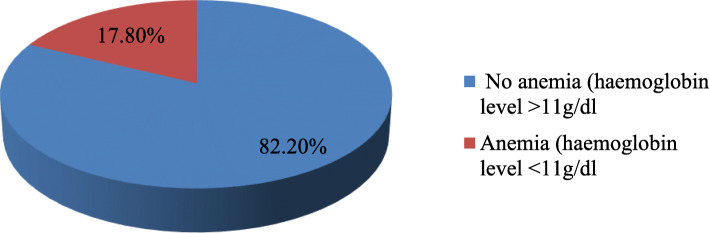
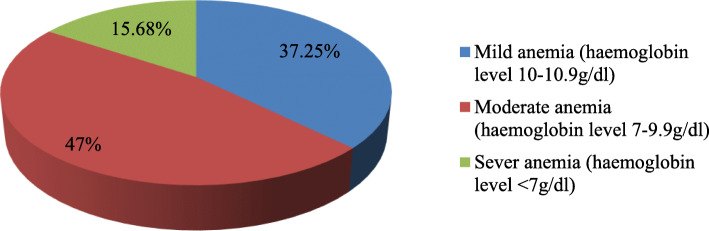
The overall prevalence of anemia using a cut off level of hemoglobin < 11 g/dl (< 33% Haematocrit) was 51 (17.8%). Out of all anemic pregnant women, 19 (37.25%) were mildly anemic, 24 (47%) were moderately anemic and 8 (15.68%) were severely anemic. Multivariable logistic regression analysis revealed that Birth interval of less than 2 years (AOR = 2.56 CI [2.84-4.52]), history of malarial attack in the past 12 months (AOR = 2.585 CI [1.181-5.656]) and engaging into daily laborer occupation (AOR = 8.33 CI [2.724-25.497]) showed significant association with maternal anemia.
The prevalence of anemia among pregnant women in this study is high. Having a birth interval of < 2 years, having a history of malarial attack in the past 12 months, and being engaged in daily laborer occupation were factors associated with anemia among pregnant women. Thus, contraceptive methods and information to space children, information, and services to prevent malaria and economically empowering women is needed to prevent anemia among pregnant women in the study area.
即使贫血是一个影响所有年龄组众多人群的全球性公共卫生问题,尤其是该问题在孕妇中的负担更高。据估计,全球每年贫血导致超过11.5万例孕产妇死亡和59.1万例产前死亡。孕产妇死亡率是任何社会的主要健康指标。因此,确定贫血的患病率并评估孕妇中其相关因素可能有助于对该问题进行干预。
本研究的目的是确定埃塞俄比亚西部沃莱加大学转诊医院接受产前护理(ANC)的孕妇中贫血的患病率及其相关因素。
2019年7月15日至22日,在沃莱加大学转诊医院妇产科和妇幼保健的产前护理(ANC)部门进行了基于机构的横断面研究。采用系统随机抽样技术选择研究单位。通过问卷调查、体格检查和实验室检查收集数据。收集后,使用Epi Data 3.1版本录入数据,并使用SPSS 20版本统计软件进行分析。进行二元和多变量逻辑回归分析以确定贫血的预测因素。最后,使用文本、表格和图表展示结果。
以血红蛋白<11 g/dl(血细胞比容<33%)为临界值,贫血的总体患病率为51例(17.8%)。在所有贫血孕妇中,19例(37.25%)为轻度贫血,24例(47%)为中度贫血,8例(15.68%)为重度贫血。多变量逻辑回归分析显示,生育间隔小于2年(调整后比值比[AOR]=2.56,置信区间[CI][2.8~4.52])、过去12个月有疟疾发作史(AOR=2.585,CI[1.181~5.656])以及从事体力劳动者职业(AOR=8.33,CI[2.7~25.497])与孕产妇贫血显著相关。
本研究中孕妇贫血的患病率较高。生育间隔<2年、过去12个月有疟疾发作史以及从事体力劳动者职业是孕妇贫血的相关因素。因此,需要采取避孕方法和提供生育间隔信息、预防疟疾的信息和服务以及增强妇女经济能力,以预防研究地区孕妇贫血。