Uchida Kenichiro, Miyashita Masahiro, Kaga Shinichiro, Noda Tomohiro, Nishimura Tetsuro, Yamamoto Hiromasa, Mizobata Yasumitsu
Department of Traumatology and Critical Care Medicine, Osaka City University Graduate School of Medicine, Osaka, Japan.
Trauma Surg Acute Care Open. 2020 Sep 25;5(1):e000546. doi: 10.1136/tsaco-2020-000546. eCollection 2020.
Recently, interest has increased in surgical fixation for severe thoracic wall injury with good short-term outcomes. However, few reports have evaluated long-term outcomes or complications. This study aimed to assess long-term quality of life and implant-related complications after rib fixation for flail chest and multiple rib fractures.
We interviewed patients who had undergone rib fixation from January 2014 to December 2019 about their current ability to work and their usual life.
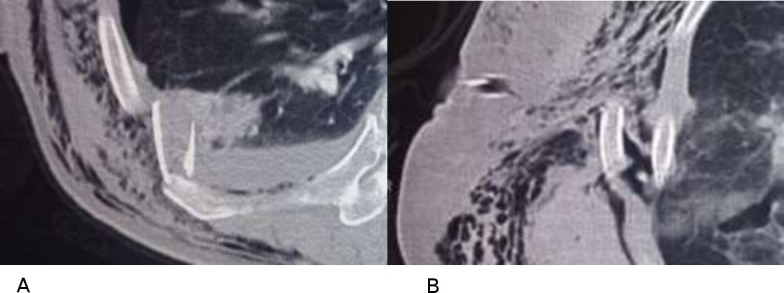
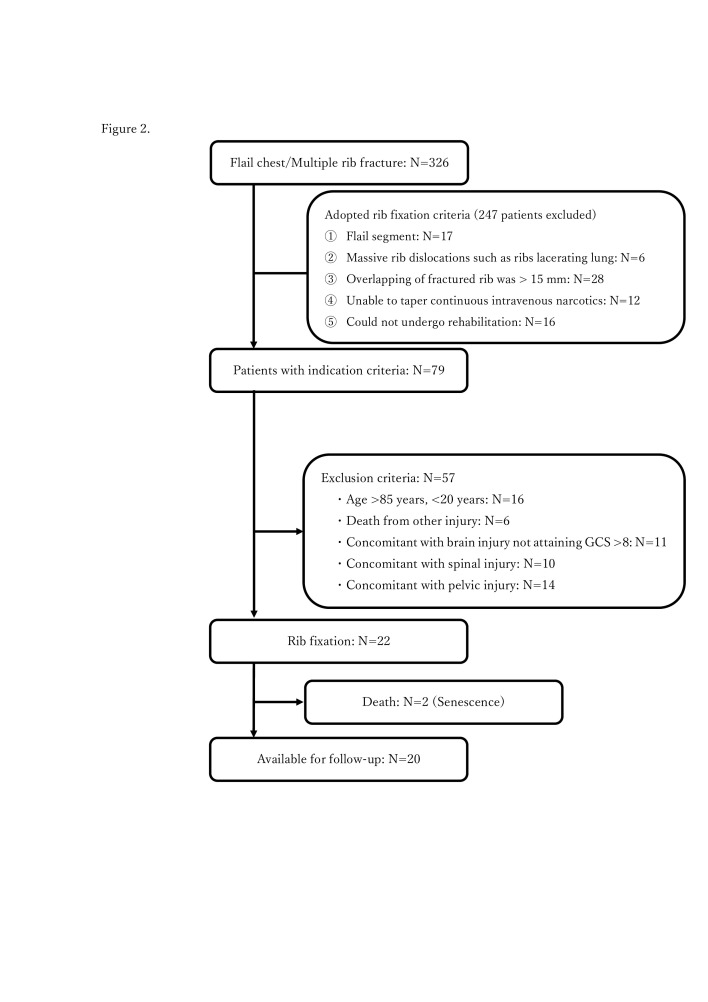
Twenty-two patients underwent rib fixation during the study period. Two patients with flail chest had already died after the surgery due to senescence; thus, follow-up information was obtained from 20 patients (91%), with a follow-up duration of 47.5 (IQR 22-58) months. The most undesirable event occurring during the study period was irritation caused by a palpable plate (n=2, 10%), probably due to the thin skin of patients over 70 years old. Eighteen patients were able to return to their usual life or same work as in the premorbid state with no complaints. Two patients are still undergoing rehabilitation due to concomitant extremities fractures. The median EQ-5D-5L index score was 0.89 (IQR 0.84-0.93). There were no implant-related complications requiring plate explantation.
We concluded that rib fixation offers good long-term benefits, with the ability of the patient with flail chest or multiple rib fractures to return to activity in the premorbid state. Elderly patients especially with thin, soft tissue may complain of irritation caused by the plate and should be informed of this prior to surgery.
Level IV therapeutic care/management.
最近,对于严重胸壁损伤的手术固定术的关注度有所增加,其短期效果良好。然而,很少有报告评估其长期效果或并发症。本研究旨在评估连枷胸和多根肋骨骨折行肋骨固定术后的长期生活质量及植入物相关并发症。
我们对2014年1月至2019年12月期间接受肋骨固定术的患者进行了访谈,了解他们目前的工作能力和日常生活情况。
在研究期间,22例患者接受了肋骨固定术。2例连枷胸患者术后因衰老已死亡;因此,从20例患者(91%)获得了随访信息,随访时间为47.5(四分位间距22 - 58)个月。研究期间发生的最不良事件是可触及钢板引起的刺激(n = 2,10%),可能是由于70岁以上患者皮肤较薄。18例患者能够恢复到术前的日常生活或工作,且无不适主诉。2例患者因合并四肢骨折仍在接受康复治疗。EQ - 5D - 5L指数评分中位数为0.89(四分位间距0.84 - 0.93)。没有需要取出钢板的植入物相关并发症。
我们得出结论,肋骨固定术具有良好的长期益处,连枷胸或多根肋骨骨折患者能够恢复到病前状态的活动水平。老年患者尤其是软组织较薄者可能会抱怨钢板引起的刺激,术前应告知他们这一点。
四级治疗护理/管理。