Mayer Kirby P, Boustany Heba, Cassity Evan P, Soper Melissa K, Kalema Anna G, Hatton Kolpek Jimmi, Montgomery-Yates Ashley A
Department of Physical Therapy, College of Health Sciences, University of Kentucky, Lexington, KY.
College of Arts and Sciences, Biology, University of Kentucky, Lexington, KY.
Crit Care Explor. 2020 Sep 28;2(10):e0206. doi: 10.1097/CCE.0000000000000206. eCollection 2020 Oct.
The primary purpose is to characterize patients attending ICU recovery clinic and then describe their trajectory of cognitive and emotional health in 1 year.
Retrospective observational study to assess attendance, attrition, and patient outcomes.
ICU Recovery Clinic.
Adult patients recently admitted to ICU for sepsis or acute respiratory failure and who were referred to clinic.
None.
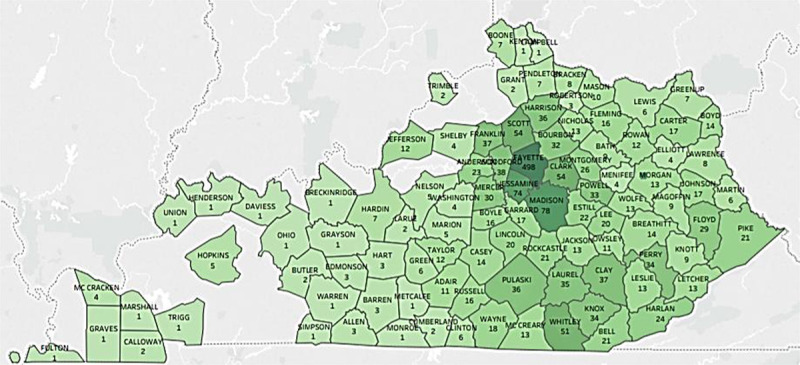
Thirty-eight patients (63%) attended ICU recovery clinic with a mean age of 53.2 ± 16 years (range, 20-82 yr), 42% female and mean Sequential Organ Failure Assessment scores at an ICU admission of 9.4 ± 2.9 participated in outcomes. Twelve patients (32%) were lost to follow up and 12 patients (32%) were transferred to different providers before the end of 1 year. Sequential Organ Failure Assessment scores were negatively associated with health-related quality of life at baseline ( = -0.41; = 0.033; = 28) and short term ( = -0.40; = 0.037; = 27). Male patients had higher Sequential Organ Failure Assessment scores (mean difference = 2.4; = 2.779; = 0.008) and longer hospital length of stay (mean difference = 9.3; = 2.27; = 0.029). Female patients had higher scores on Hospital Anxiety and Depression Scale (mean difference = 7.2; = 2.74; = 0.01) and Impact of Events Scale-Revised (mean difference = 18.9; = 2.74; = 0.011) at the initial follow-up visit. Patients never attending clinic were more likely to live further away, have a tracheotomy, and spent longer time in the ICU.
Attendance and attrition in ICU recovery clinic are related to patient factors (living in rural area) and ICU factors. Data suggest different recovery trajectories exist based on gender, severity of illness, and self-reported outcomes.
主要目的是对入住重症监护病房康复诊所的患者进行特征描述,然后描述他们在1年内认知和情绪健康的变化轨迹。
回顾性观察研究,以评估就诊情况、失访情况和患者预后。
重症监护病房康复诊所。
近期因脓毒症或急性呼吸衰竭入住重症监护病房并被转诊至该诊所的成年患者。
无。
38名患者(63%)就诊于重症监护病房康复诊所,平均年龄为53.2±16岁(范围20 - 82岁),42%为女性,入住重症监护病房时序贯器官衰竭评估(SOFA)平均得分9.4±2.9分并参与了预后评估。12名患者(32%)失访,12名患者(32%)在1年结束前转至其他医疗机构。SOFA评分与基线时(r = -0.41;p = 0.033;n = 28)和短期(r = -0.40;p = 0.037;n = 27)的健康相关生活质量呈负相关。男性患者SOFA评分更高(平均差值 = 2.4;t = 2.779;p = 0.008)且住院时间更长(平均差值 = 9.3;t = 2.27;p = 0.029)。女性患者在初次随访时医院焦虑抑郁量表得分更高(平均差值 = 7.2;t = 2.74;p = 0.01)以及事件影响量表修订版得分更高(平均差值 = 18.9;t = 2.74;p = 0.011)。从未就诊的患者更有可能住得更远、行气管切开术且在重症监护病房停留时间更长。
重症监护病房康复诊所的就诊率和失访率与患者因素(居住在农村地区)和重症监护病房因素有关。数据表明,基于性别、疾病严重程度和自我报告的结果存在不同的康复轨迹。