Castelli Vanessa, d'Angelo Michele, Quintiliani Massimiliano, Benedetti Elisabetta, Cifone Maria Grazia, Cimini Annamaria
Department of Life, Health and Environmental Sciences, University of L'Aquila, Italy.
Department of Life, Health and Environmental Sciences, University of L'Aquila; SIRE Srl, Naples, Italy.
Neural Regen Res. 2021 Apr;16(4):628-634. doi: 10.4103/1673-5374.295270.
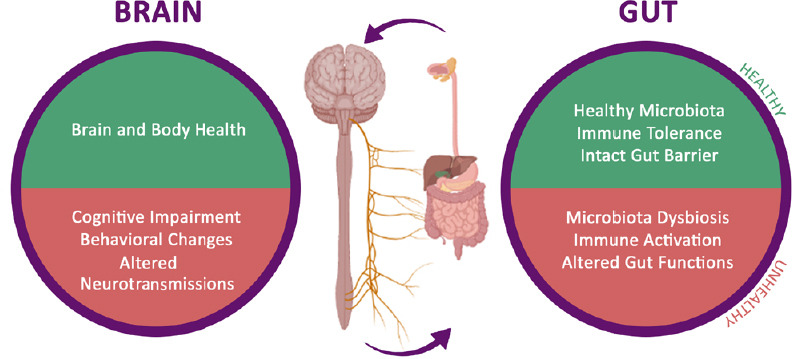
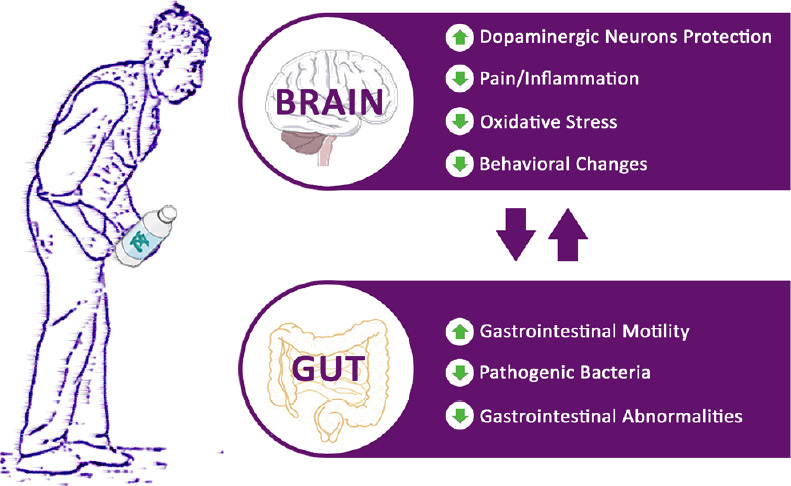
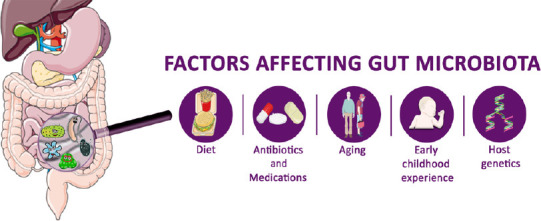
Neurodegenerative disease etiology is still unclear, but different contributing factors, such as lifestyle and genetic factors are involved. Altered components of the gut could play a key role in the gut-brain axis, which is a bidirectional system between the central nervous system and the enteric nervous system. Variations in the composition of the gut microbiota and its function between healthy people and patients have been reported for a variety of human disorders comprising metabolic, autoimmune, cancer, and, notably, neurodegenerative disorders. Diet can alter the microbiota composition, affecting the gut-brain axis function. Different nutraceutical interventions have been devoted to normalizing gut microbiome dysbiosis and to improving biological outcomes in neurological conditions, including the use of probiotics. Preclinical and clinical investigations discussed in this review strengthen the correlation between intestinal microbiota and brain and the concept that modifying the microbiome composition may improve brain neurochemistry, modulating different pathways. This review will discuss the potential use of probiotics for Parkinson's disease prevention or treatment or as adjuvant therapy, confirming that gut microbiota modulation influences different pro-survival pathways. Future investigations in Parkinson's disease should consider the role of the gut-brain axis and additional comprehension of the underlying mechanisms is extremely necessary.
神经退行性疾病的病因仍不明确,但涉及不同的促成因素,如生活方式和遗传因素。肠道成分的改变可能在肠脑轴中起关键作用,肠脑轴是中枢神经系统和肠神经系统之间的双向系统。据报道,在包括代谢、自身免疫、癌症,尤其是神经退行性疾病在内的多种人类疾病中,健康人与患者之间肠道微生物群的组成及其功能存在差异。饮食可以改变微生物群组成,影响肠脑轴功能。不同的营养干预措施致力于使肠道微生物群失调正常化,并改善神经疾病的生物学结果,包括使用益生菌。本综述中讨论的临床前和临床研究加强了肠道微生物群与大脑之间的相关性,以及改变微生物群组成可能改善脑内神经化学、调节不同途径的概念。本综述将讨论益生菌在帕金森病预防或治疗中的潜在用途,或作为辅助治疗,证实肠道微生物群调节会影响不同的促生存途径。未来对帕金森病的研究应考虑肠脑轴的作用,并进一步深入了解其潜在机制是极其必要的。