Zidovska Alexandra
Center for Soft Matter Research, Department of Physics, New York University, New York, NY, USA.
Biophys Rev. 2020 Oct;12(5):1093-1106. doi: 10.1007/s12551-020-00761-x. Epub 2020 Oct 16.
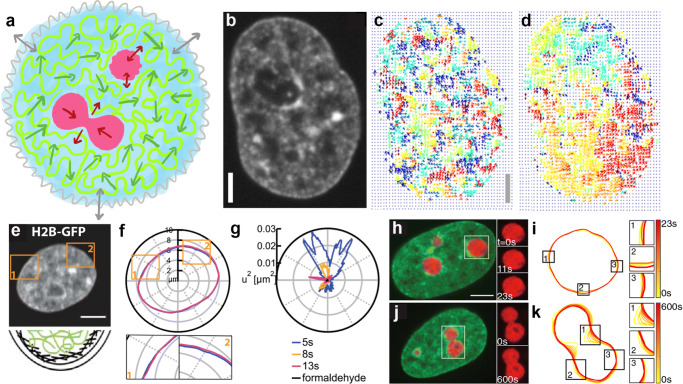
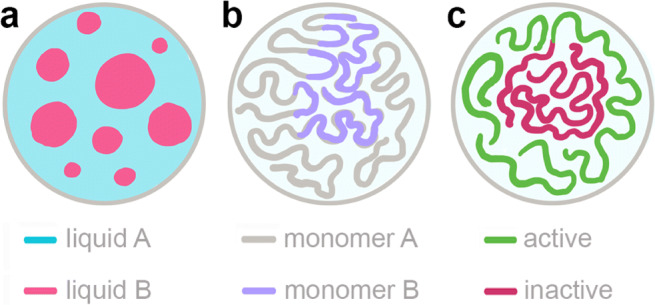
The cell nucleus stores the genetic material essential for life, and provides the environment for transcription, maintenance, and replication of the genome. Moreover, the nucleoplasm is filled with subnuclear bodies such as nucleoli that are responsible for other vital functions. Overall, the nucleus presents a highly heterogeneous and dynamic environment with diverse functionality. Here, we propose that its biophysical complexity can be organized around three inter-related and interactive facets: heterogeneity, activity, and rheology. Most nuclear constituents are sites of active, ATP-dependent processes and are thus inherently dynamic: The genome undergoes constant rearrangement, the nuclear envelope flickers and fluctuates, nucleoli migrate and coalesce, and many of these events are mediated by nucleoplasmic flows and interactions. And yet there is spatiotemporal organization in terms of hierarchical structure of the genome, its coherently moving regions and membrane-less compartmentalization via phase-separated nucleoplasmic constituents. Moreover, the non-equilibrium or activity-driven nature of the nucleus gives rise to emergent rheology and material properties that impact all cellular processes via the central dogma of molecular biology. New biophysical insights into the cell nucleus can come from appreciating this rich inner life.
细胞核储存着生命所必需的遗传物质,并为基因组的转录、维持和复制提供环境。此外,核质中充满了负责其他重要功能的亚核体,如核仁。总体而言,细胞核呈现出一个高度异质且动态的环境,具有多种功能。在此,我们提出其生物物理复杂性可围绕三个相互关联且相互作用的方面进行组织:异质性、活性和流变学。大多数核成分是活跃的、依赖ATP的过程发生的场所,因此本质上是动态的:基因组不断重排,核膜闪烁波动,核仁迁移并融合,许多这些事件由核质流动和相互作用介导。然而,在基因组的层次结构、其连贯移动的区域以及通过相分离的核质成分进行的无膜区室化方面存在时空组织。此外,细胞核的非平衡或活性驱动性质产生了新兴的流变学和材料特性,这些特性通过分子生物学的中心法则影响所有细胞过程。对细胞核的新生物物理见解可源于对这种丰富的内在生命的认识。