Redmond Sean M
Department of Communication Sciences and Disorders, University of Utah, Salt Lake City.
J Speech Lang Hear Res. 2020 Oct 16;63(10):3263-3276. doi: 10.1044/2020_JSLHR-20-00050.
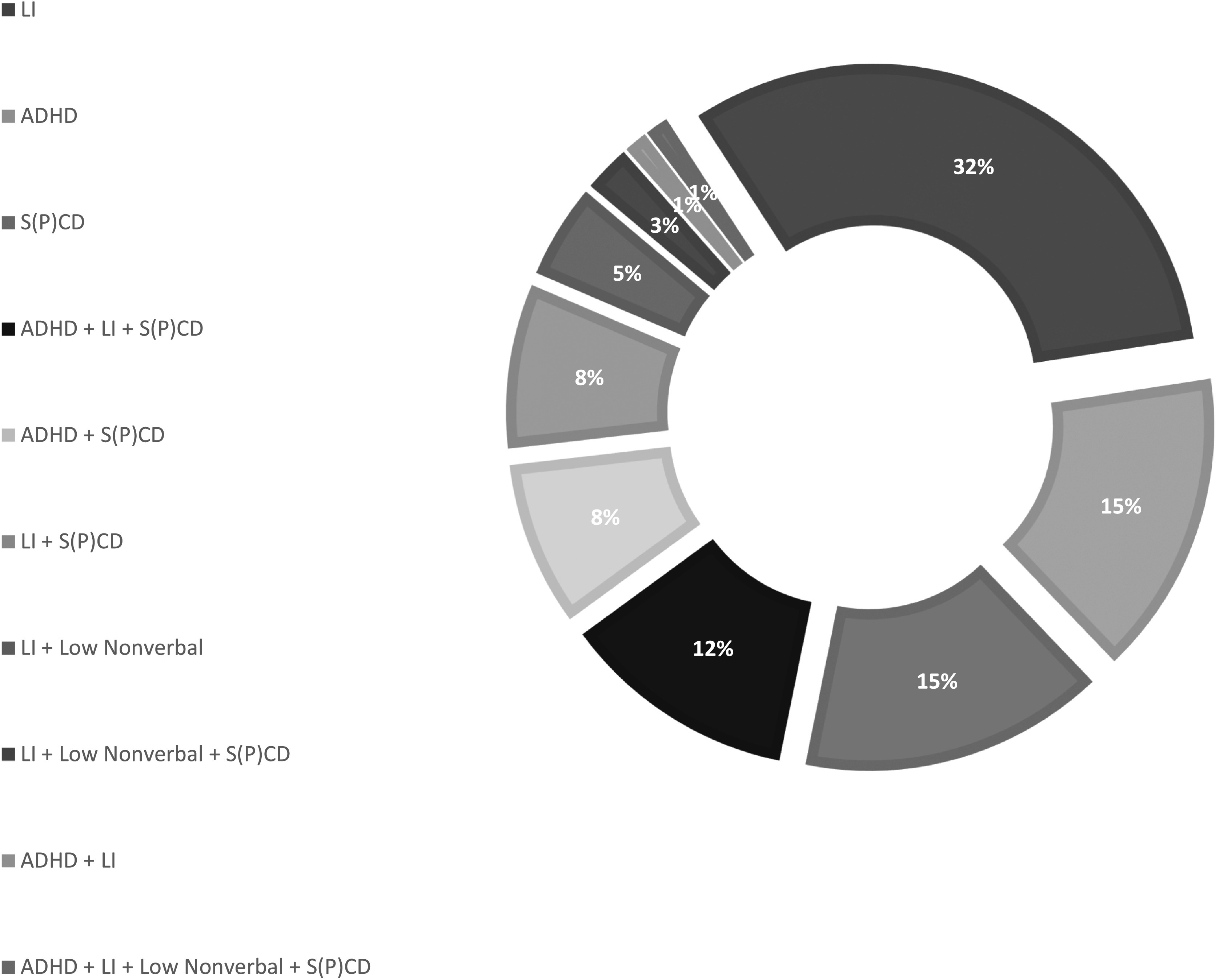
Purpose Estimates of the expected co-occurrence rates of idiopathic language disorder and attention-deficit/hyperactivity disorder (ADHD) provide a confusing and inconsistent picture. Potential sources for discrepancies considered so far include measurement and ascertainment biases (Redmond, 2016a, 2016b). In this research symposium forum article, the potential impact of applying different criteria to the observed co-occurrence rate is examined through an appraisal of the literature and an empirical demonstration. Method Eighty-five cases were selected from the Redmond, Ash, et al. (2019) study sample. Standard scores from clinical measures collected on K-3rd grade students were used to assign language impairment status, nonverbal impairment status, social (pragmatic) communication disorder status, and ADHD status. Criteria extrapolated from the specific language impairment (Stark & Tallal, 1981), developmental language disorder (Bishop et al., 2017), and language disorder (American Psychiatric Association, 2013) designations were applied. Results The language disorder designation and its separation of language disorder from the social (pragmatic) communication disorder designation provided the clearest segregation of idiopathic language deficits from elevated ADHD symptoms, showing only a 2% co-occurrence rate. In contrast, applying the broader developmental language disorder designation raised the observed co-occurrence rate to 22.3%. The specific language impairment designation yielded an intermediate value of 16.9%. Conclusions Co-occurrence rates varied as a function of designation adopted. The presence of pragmatic symptoms exerted a stronger influence on observed co-occurrence rates than low nonverbal abilities. Impacts on clinical management and research priorities are discussed. Presentation Video https://doi.org/10.23641/asha.13063751.
目的 对特发性语言障碍与注意力缺陷多动障碍(ADHD)预期共现率的估计呈现出令人困惑且不一致的情况。目前所考虑的差异潜在来源包括测量和确诊偏差(雷德蒙德,2016年a篇、2016年b篇)。在这篇研究研讨会论坛文章中,通过文献评估和实证论证,研究了应用不同标准对观察到的共现率的潜在影响。方法 从雷德蒙德、阿什等人(2019年)的研究样本中选取了85个案例。使用从对幼儿园至三年级学生收集的临床测量中得出的标准分数来确定语言障碍状态、非语言障碍状态、社交(语用)沟通障碍状态和ADHD状态。应用了从特定语言障碍(斯塔克和塔拉勒,1981年)、发育性语言障碍(毕晓普等人,2017年)以及语言障碍(美国精神病学协会,2013年)的定义中推断出的标准。结果 语言障碍的定义以及它将语言障碍与社交(语用)沟通障碍区分开来,使得特发性语言缺陷与ADHD症状增加之间的区分最为清晰,共现率仅为2%。相比之下,应用更宽泛的发育性语言障碍定义使观察到的共现率提高到了22.3%。特定语言障碍定义得出的中间值为16.9%。结论 共现率因所采用的定义而有所不同。语用症状的存在对观察到的共现率的影响比低非语言能力更强。文中讨论了对临床管理和研究重点的影响。展示视频 https://doi.org/10.23641/asha.13063751