Institute of Environmental Science and Research, Porirua, New Zealand.
School of Veterinary Science, Massey University, Palmerston North, New Zealand.
Lancet Public Health. 2020 Nov;5(11):e612-e623. doi: 10.1016/S2468-2667(20)30225-5. Epub 2020 Oct 14.
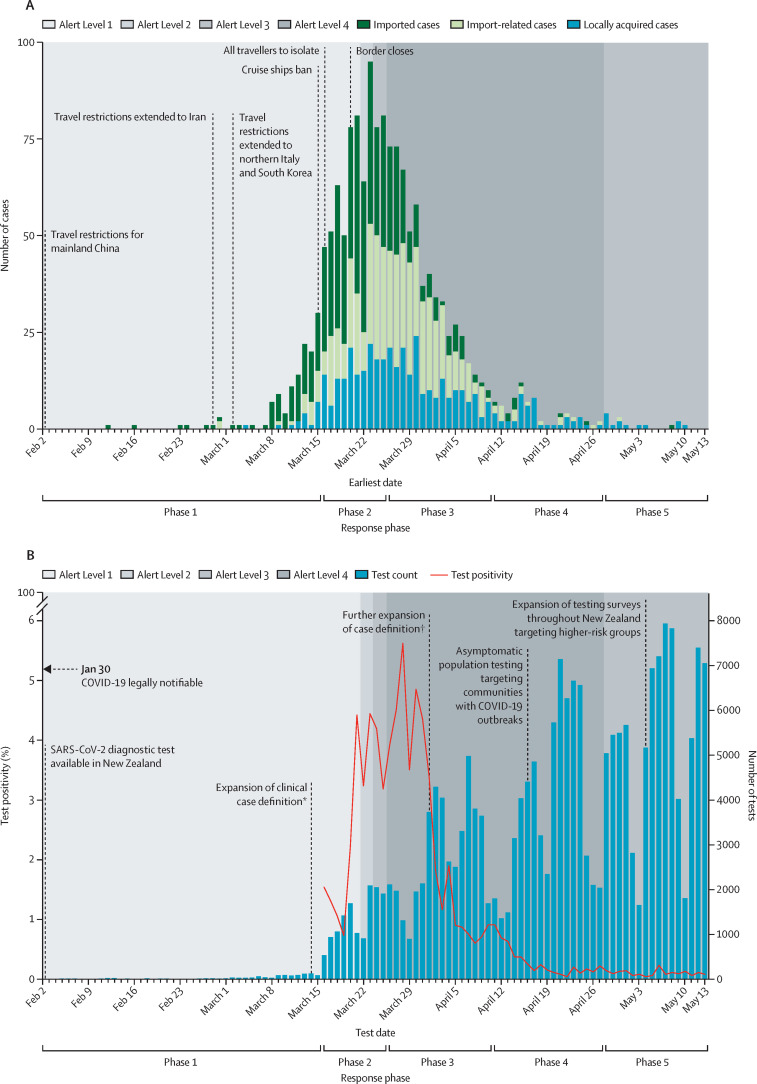
In early 2020, during the COVID-19 pandemic, New Zealand implemented graduated, risk-informed national COVID-19 suppression measures aimed at disease elimination. We investigated their impacts on the epidemiology of the first wave of COVID-19 in the country and response performance measures.
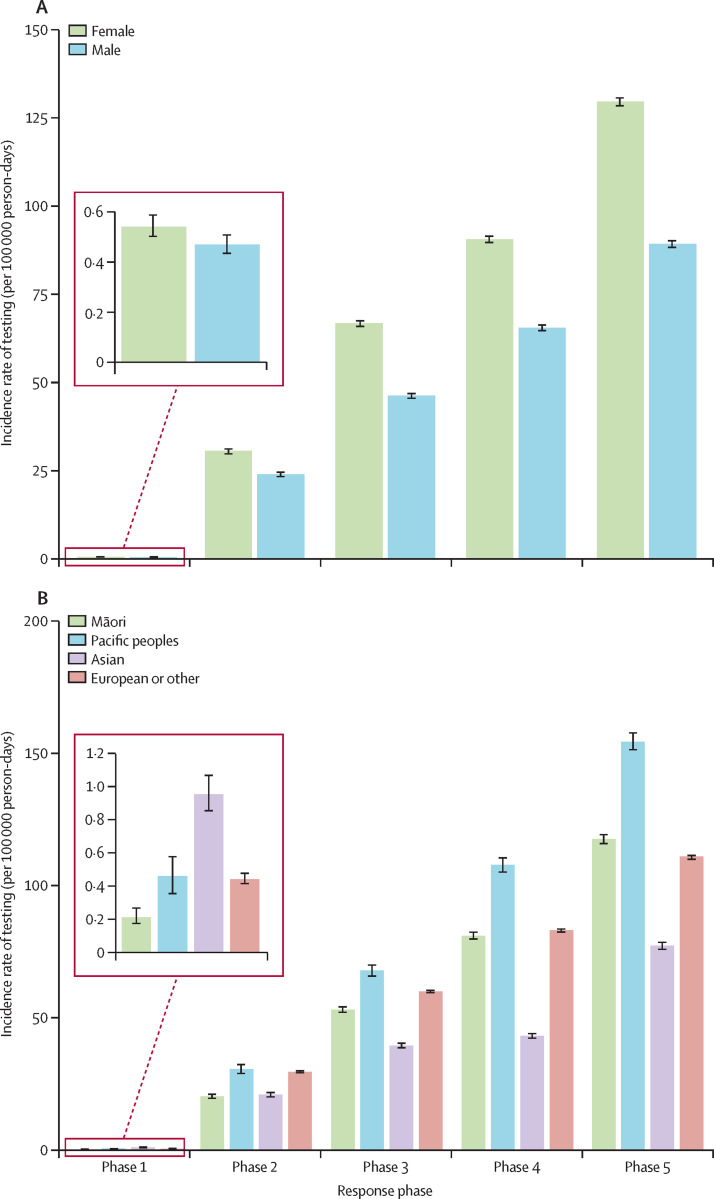
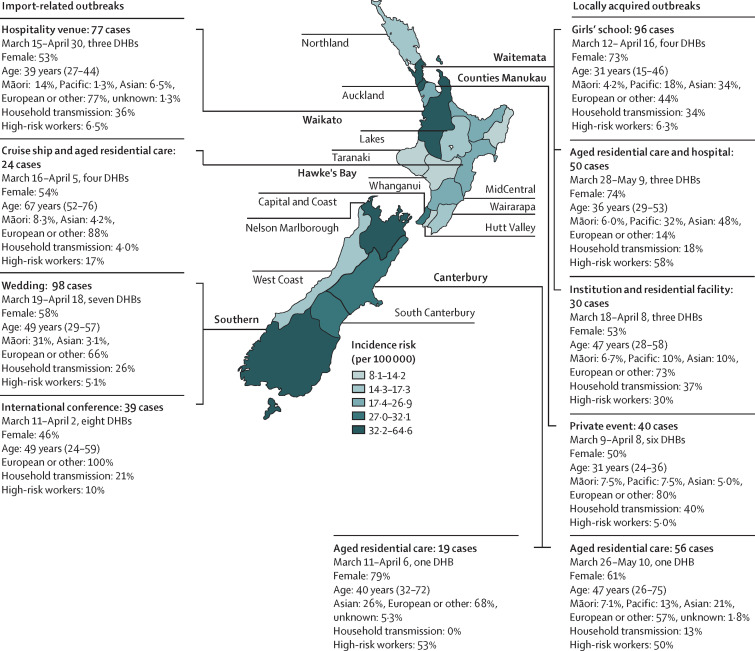
We did a descriptive epidemiological study of all laboratory-confirmed and probable cases of COVID-19 and all patients tested for severe acute respiratory syndrome coronavirus 2 (SARS-CoV-2) in New Zealand from Feb 2 to May 13, 2020, after which time community transmission ceased. We extracted data from the national notifiable diseases database and the national SARS-CoV-2 test results repository. Demographic features and disease outcomes, transmission patterns (source of infection, outbreaks, household transmission), time-to-event intervals, and testing coverage were described over five phases of the response, capturing different levels of non-pharmaceutical interventions. Risk factors for severe outcomes (hospitalisation or death) were examined with multivariable logistic regression and time-to-event intervals were analysed by fitting parametric distributions using maximum likelihood estimation.
1503 cases were detected over the study period, including 95 (6·3%) hospital admissions and 22 (1·5%) COVID-19 deaths. The estimated case infection rate per million people per day peaked at 8·5 (95% CI 7·6-9·4) during the 10-day period of rapid response escalation, declining to 3·2 (2·8-3·7) in the start of lockdown and progressively thereafter. 1034 (69%) cases were imported or import related, tending to be younger adults, of European ethnicity, and of higher socioeconomic status. 702 (47%) cases were linked to 34 outbreaks. Severe outcomes were associated with locally acquired infection (crude odds ratio [OR] 2·32 [95% CI 1·40-3·82] compared with imported), older age (adjusted OR ranging from 2·72 [1·40-5·30] for 50-64 year olds to 8·25 [2·59-26·31] for people aged ≥80 years compared with 20-34 year olds), aged residential care residency (adjusted OR 3·86 [1·59-9·35]), and Pacific peoples (adjusted OR 2·76 [1·14-6·68]) and Asian (2·15 [1·10-4·20]) ethnicities relative to European or other. Times from illness onset to notification and isolation progressively decreased and testing increased over the study period, with few disparities and increasing coverage of females, Māori, Pacific peoples, and lower socioeconomic groups.
New Zealand's response resulted in low relative burden of disease, low levels of population disease disparities, and the initial achievement of COVID-19 elimination.
Ministry of Business Innovation and Employment Strategic Scientific Investment Fund, and Ministry of Health, New Zealand.
2020 年初,在 COVID-19 大流行期间,新西兰实施了分级、风险知情的国家 COVID-19 抑制措施,旨在消除疾病。我们调查了这些措施对该国第一波 COVID-19 的流行病学和应对绩效措施的影响。
我们对 2020 年 2 月 2 日至 5 月 13 日期间在新西兰所有实验室确诊和可能的 COVID-19 病例以及所有接受严重急性呼吸系统综合征冠状病毒 2(SARS-CoV-2)检测的患者进行了描述性流行病学研究,此后社区传播停止。我们从国家法定传染病数据库和国家 SARS-CoV-2 检测结果存储库中提取数据。描述了五个应对阶段的人口统计学特征和疾病结局、传播模式(感染源、暴发、家庭传播)、时间到事件间隔和检测覆盖率,捕捉了不同水平的非药物干预措施。使用多变量逻辑回归检查严重结局(住院或死亡)的危险因素,并通过使用最大似然估计拟合参数分布来分析时间到事件间隔。
在研究期间共发现 1503 例病例,包括 95 例(6.3%)住院和 22 例(1.5%)COVID-19 死亡。估计的每百万人每日病例感染率在快速反应升级的 10 天内达到 8.5(95%CI 7.6-9.4),在封锁开始时下降至 3.2(2.8-3.7),此后逐渐下降。1034 例(69%)病例为输入或输入相关病例,倾向于年轻成年人,欧洲血统,社会经济地位较高。702 例(47%)病例与 34 起暴发有关。严重结局与本地获得性感染有关(与输入相比,粗比值比[OR]为 2.32[95%CI 1.40-3.82]),年龄较大(调整后的 OR 范围从 50-64 岁人群的 2.72[1.40-5.30]到 80 岁及以上人群的 8.25[2.59-26.31]与 20-34 岁人群相比)、居住在养老院(调整后的 OR 3.86[1.59-9.35])、太平洋民族(调整后的 OR 2.76[1.14-6.68])和亚洲(2.15[1.10-4.20])族裔与欧洲或其他族裔相比。从发病到通知和隔离的时间间隔逐渐缩短,检测量逐渐增加,女性、毛利人、太平洋民族和社会经济地位较低的群体的差异和覆盖面都有所增加。
新西兰的应对措施导致疾病负担相对较低,人群疾病差异程度较低,并初步实现了 COVID-19 的消除。
新西兰商业、创新和就业部战略科学投资基金和卫生部。