Faculty of Public Health, Medical Academy, Lithuanian University of Health Sciences, 44307 Kaunas, Lithuania.
Department of Nutrition and Food Science, Campus of Melilla, University of Granada, 52001 Melilla, Spain.
Nutrients. 2020 Oct 13;12(10):3119. doi: 10.3390/nu12103119.
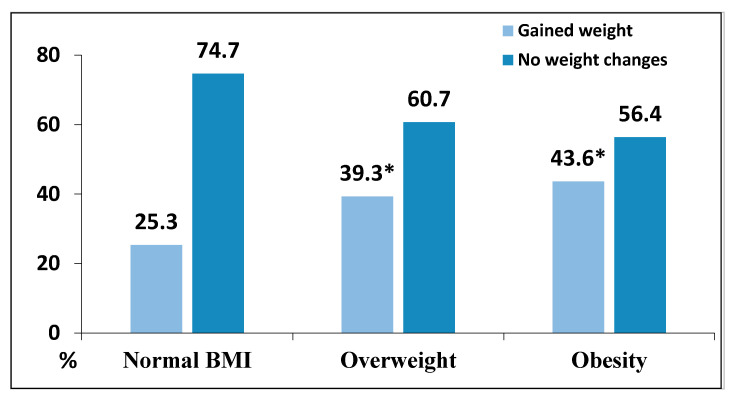
The COVID-19 quarantine has caused significant changes in everyday life. This study aimed to evaluate the effect of the quarantine on dietary, physical activity and alcohol consumption habits of Lithuanians and the association between health behaviours and weight changes. An online cross-sectional survey was carried out among individuals older than 18 years in April 2020. The self-administered questionnaire included health behaviour and weight change data. Altogether 2447 subjects participated in the survey. Almost half of the respondents (49.4%) ate more than usual, 45.1% increased snacking, and 62.1% cooked at home more often. Intake of carbonated or sugary drinks, fast food and commercial pastries decreased, while consumption of homemade pastries and fried food increased. A decrease in physical activity was reported by 60.6% of respondents. Every third (31.5%) respondent, more often those already with overweight, gained weight. Multivariate logistic regression analysis showed that the higher odds of weight gain were associated with females, older age, increased consumption of sugary drinks, homemade pastries and fried food, eating more than usual, increased snacking, decreased physical activity and increased alcohol consumption. Our data highlighted the need for dietary and physical activity guidelines to prevent weight gain during the period of self-isolation, especially targeting those with overweight and obesity.
新冠疫情隔离措施给人们的日常生活带来了重大变化。本研究旨在评估隔离措施对立陶宛居民饮食习惯、身体活动和饮酒习惯的影响,以及健康行为与体重变化之间的关系。2020 年 4 月,我们开展了一项针对 18 岁以上人群的在线横断面调查。自填式问卷包括健康行为和体重变化数据。共有 2447 名参与者完成了调查。近一半(49.4%)的受访者表示吃得比平时多,45.1%的人增加了零食摄入量,62.1%的人更频繁在家做饭。碳酸饮料或含糖饮料、快餐和商业糕点的摄入量减少,而自制糕点和油炸食品的摄入量增加。60.6%的受访者报告称身体活动减少。每三个(31.5%)受访者体重增加,超重者中更常见体重增加。多变量逻辑回归分析表明,女性、年龄较大、含糖饮料、自制糕点和油炸食品摄入量增加、吃得比平时多、零食摄入量增加、身体活动减少以及饮酒量增加与体重增加的几率较高相关。我们的数据强调了在自我隔离期间需要制定饮食和身体活动指南,以预防体重增加,尤其是针对超重和肥胖人群。