Department of Pharmacy, COMSATS University Islamabad, Abbottabad Campus, Khyber Pakhtunkhwa 22060, Pakistan.
Department of Pharmacology, University of Maryland School of Medicine, Baltimore, MD 21201, USA.
Molecules. 2020 Oct 14;25(20):4683. doi: 10.3390/molecules25204683.
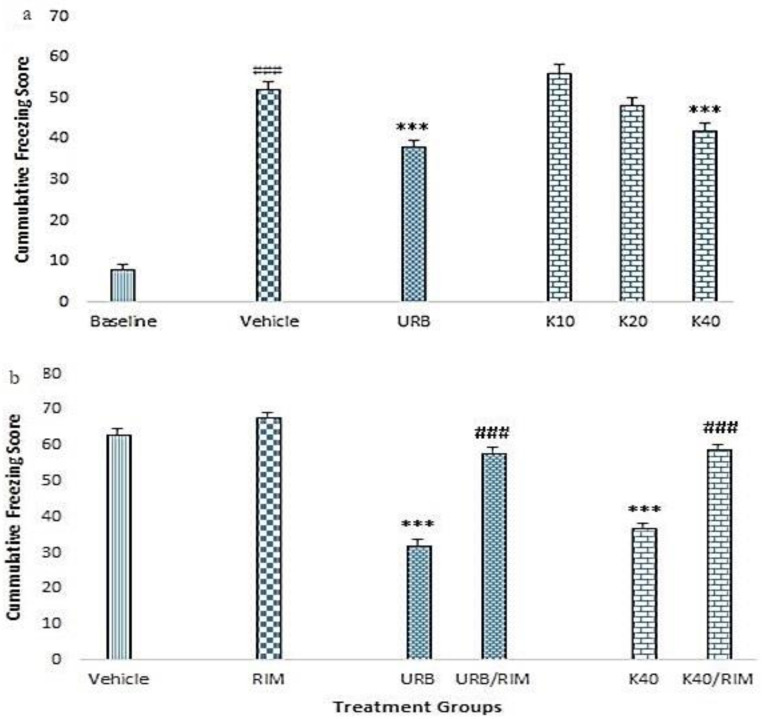
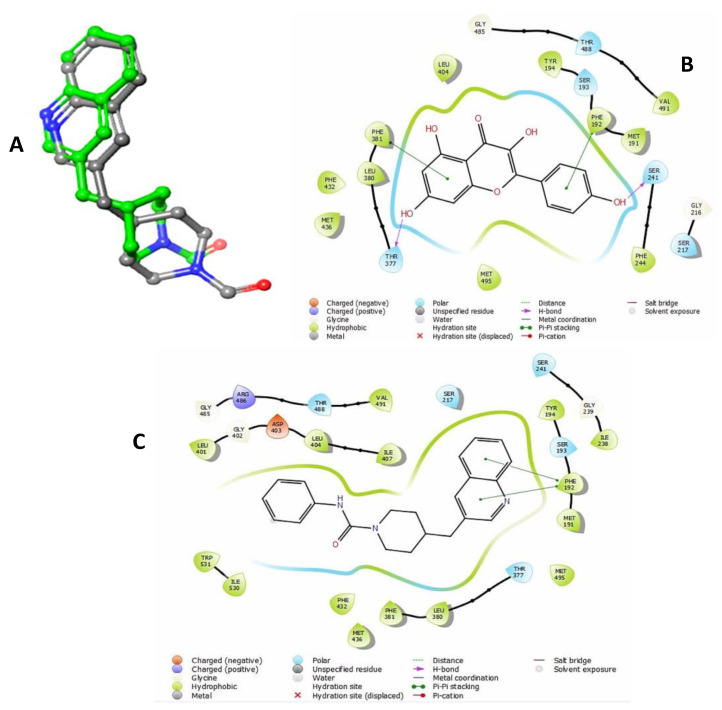
Fear, stress, and anxiety-like behaviors originate from traumatic events in life. Stress response is managed by endocannabinoids in the body by limiting the uncontrolled retrieval of aversive memories. Pharmacotherapy-modulating endocannabinoids, especially anandamide, presents a promising tool for treating anxiety disorders. Here, we investigated the effect of kaempferol, a flavonoid, in the extinction of fear related memories and associated anxiety-like behavior. The ability of kaempferol to inhibit fatty-acid amide hydrolase (FAAH, the enzyme that catabolizes anandamide) was assessed in vitro using an enzyme-linked immunosorbent assay (ELISA) kit. For animal studies (in vivo), the extinction learning was evaluated using contextual fear conditioning (CFC, a behavioral paradigm based on ability to learn and remember aversive stimuli). Furthermore, an elevated plus-maze (EPM) model was used for measuring anxiety-like behavior, while serum corticosterone served as a biochemical indicator of anxiety. Lastly, the interaction of kaempferol with FAAH enzyme was also assessed in silico (computational study). Our data showed that kaempferol inhibited the FAAH enzyme with an IC value of 1 µM. In CFC, it reduced freezing behavior in rats. EPM data demonstrated anxiolytic activity as exhibited by enhanced number of entries and time spent in the open arm. No change in blood corticosterone levels was noted. Our computational study showed that Kaempferol interacted with the catalytic amino acids (SER241, PHE192, PHE381, and THR377) of FAAH enzyme Our study demonstrate that kaempferol facilitated the extinction of aversive memories along with a reduction of anxiety. The effect is mediated through the augmentation of endocannabinoids via the inhibition of FAAH enzyme.
恐惧、压力和焦虑样行为源于生活中的创伤事件。内源性大麻素通过限制对厌恶记忆的失控检索来管理应激反应。调节内源性大麻素的药物治疗,特别是大麻素,为治疗焦虑症提供了一种有前途的工具。在这里,我们研究了黄酮类化合物山奈酚在消除与恐惧相关的记忆和相关焦虑样行为中的作用。通过酶联免疫吸附测定(ELISA)试剂盒评估山奈酚抑制脂肪酸酰胺水解酶(FAAH,代谢大麻素的酶)的体外能力。对于动物研究(体内),使用情境恐惧条件反射(CFC,一种基于学习和记忆厌恶刺激的行为范式)评估消除学习。此外,还使用高架十字迷宫(EPM)模型测量焦虑样行为,而血清皮质酮作为焦虑的生化指标。最后,还在计算机上评估了山奈酚与 FAAH 酶的相互作用(计算研究)。
我们的数据表明,山奈酚以 1µM 的 IC 值抑制 FAAH 酶。在 CFC 中,它减少了大鼠的冻结行为。EPM 数据显示出抗焦虑活性,表现为进入开放臂的次数和时间增加。血液皮质酮水平没有变化。我们的计算研究表明,山奈酚与 FAAH 酶的催化氨基酸(SER241、PHE192、PHE381 和 THR377)相互作用。
我们的研究表明,山奈酚通过抑制 FAAH 酶来促进厌恶记忆的消除,同时减轻焦虑。这种作用是通过增加内源性大麻素介导的,内源性大麻素通过抑制 FAAH 酶来增加。