Zhang Zhaohan, Ali Shahid, Zhang Tianxu, Wang Wanpeng, Xie Linan
College of Life Sciences, Northeast Forestry University, Harbin 150040, China.
Key Laboratory of Saline-Alkali Vegetative Ecology Restoration, Ministry of Education, College of Life Science, Northeast Forestry University, Harbin 150040, China.
Plants (Basel). 2020 Oct 14;9(10):1356. doi: 10.3390/plants9101356.
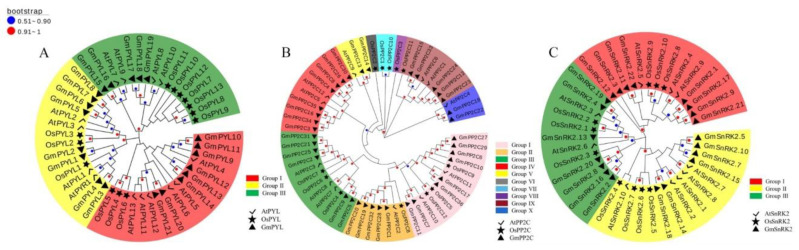
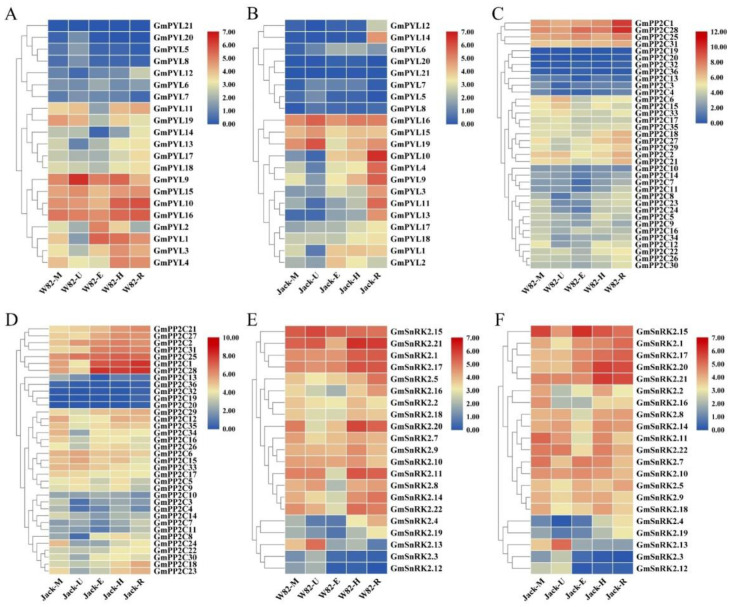
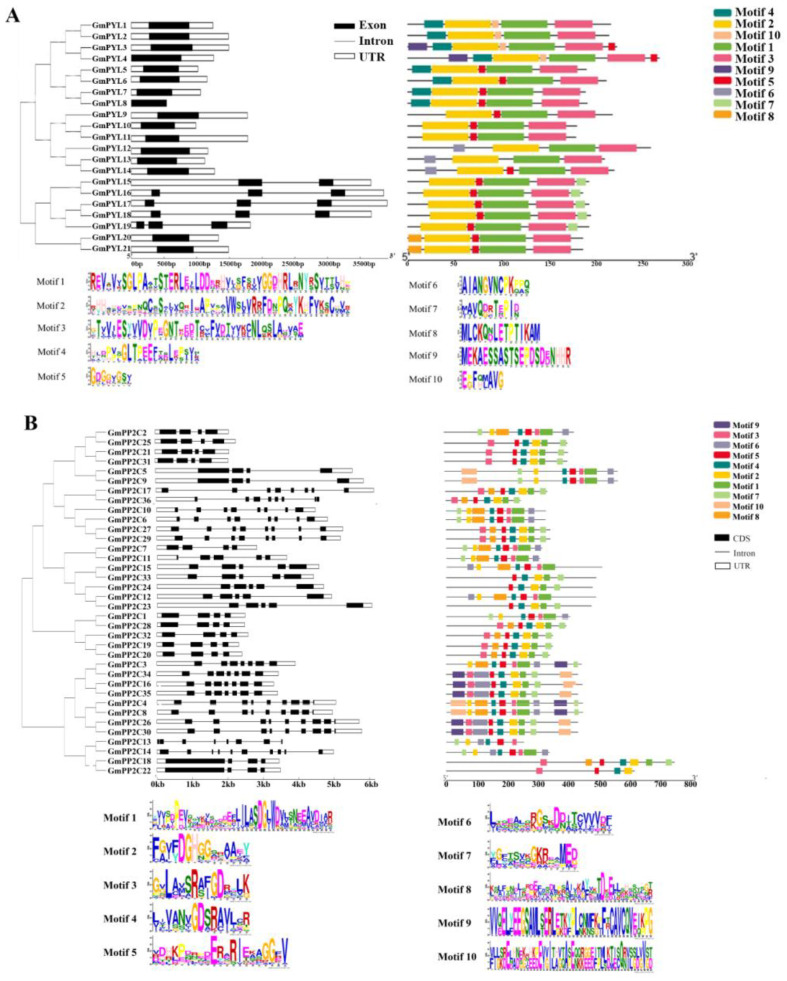
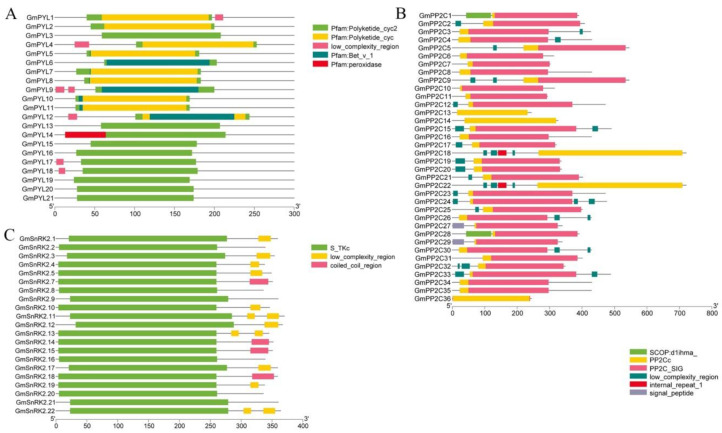
Abscisic acid (ABA) plays a crucial role in various aspects of plant growth and development, including fruit development and ripening, seed dormancy, and involvement in response to various environmental stresses. In almost all higher plants, ABA signal transduction requires three core components; namely, PYR/PYL/RCAR ABA receptors (PYLs), type 2C protein phosphatases (PP2Cs), and class III SNF-1-related protein kinase 2 (SnRK2s). The exploration of these three core components is not comprehensive in soybean. This study identified the gene family members by using the JGI Phytozome and NCBI database. The gene family composition, conservation, gene structure, evolutionary relationship, -acting elements of promoter regions, and its coding protein domains were analyzed. In the entire genome of the soybean, there are 21 , 36 , and 21 genes; further, by phylogenetic and conservation analysis, 21 genes are classified into 3 groups, 36 genes are classified into seven groups, and 21 genes are classified into 3 groups. The conserved motifs and domain analysis showed that all the gene family members contain START-like domains, the gene family contains PP2Cc domains, and the gene family contains S_TK domains, respectively. Furthermore, based on the high-throughput transcriptome sequencing data, the results showed differences in the expression patterns of gene families in different tissue parts of the same variety, and the same tissue part of different varieties. Our study provides a basis for further elucidation of the identification of gene family members and analysis of their evolution and expression patterns, which helps to understand the molecular mechanism of soybean response to abiotic stress. In addition, this provides a conceptual basis for future studies of the soybean ABA core signal pathway.
脱落酸(ABA)在植物生长发育的各个方面都起着至关重要的作用,包括果实发育与成熟、种子休眠以及参与对各种环境胁迫的响应。在几乎所有高等植物中,ABA信号转导需要三个核心组分;即PYR/PYL/RCAR ABA受体(PYLs)、2C型蛋白磷酸酶(PP2Cs)和III类SNF-1相关蛋白激酶2(SnRK2s)。在大豆中,对这三个核心组分的探索并不全面。本研究利用JGI植物基因组数据库和NCBI数据库鉴定了该基因家族成员。分析了该基因家族的组成、保守性、基因结构、进化关系、启动子区域的顺式作用元件及其编码蛋白结构域。在大豆的整个基因组中,分别有21个、36个和21个基因;此外,通过系统发育和保守性分析,21个基因被分为3组,36个基因被分为7组,21个基因被分为3组。保守基序和结构域分析表明,所有该基因家族成员均分别含有类START结构域、该基因家族含有PP2Cc结构域、该基因家族含有S_TK结构域。此外,基于高通量转录组测序数据的结果表明,该基因家族在同一品种的不同组织部位以及不同品种的相同组织部位的表达模式存在差异。我们的研究为进一步阐明该基因家族成员的鉴定及其进化和表达模式分析提供了依据,有助于了解大豆对非生物胁迫响应的分子机制。此外,这为大豆ABA核心信号通路的未来研究提供了概念基础。