Plant Biotechnology Program, Federal University of Lavras (UFLA), Lavras, MG, 37200-000, Brazil.
Genetics and Biotechnology Laboratory, Embrapa Agroenergy (CNPAE), Brasilia, DF, 70770-901, Brazil.
Sci Rep. 2019 Mar 11;9(1):4028. doi: 10.1038/s41598-019-40623-5.
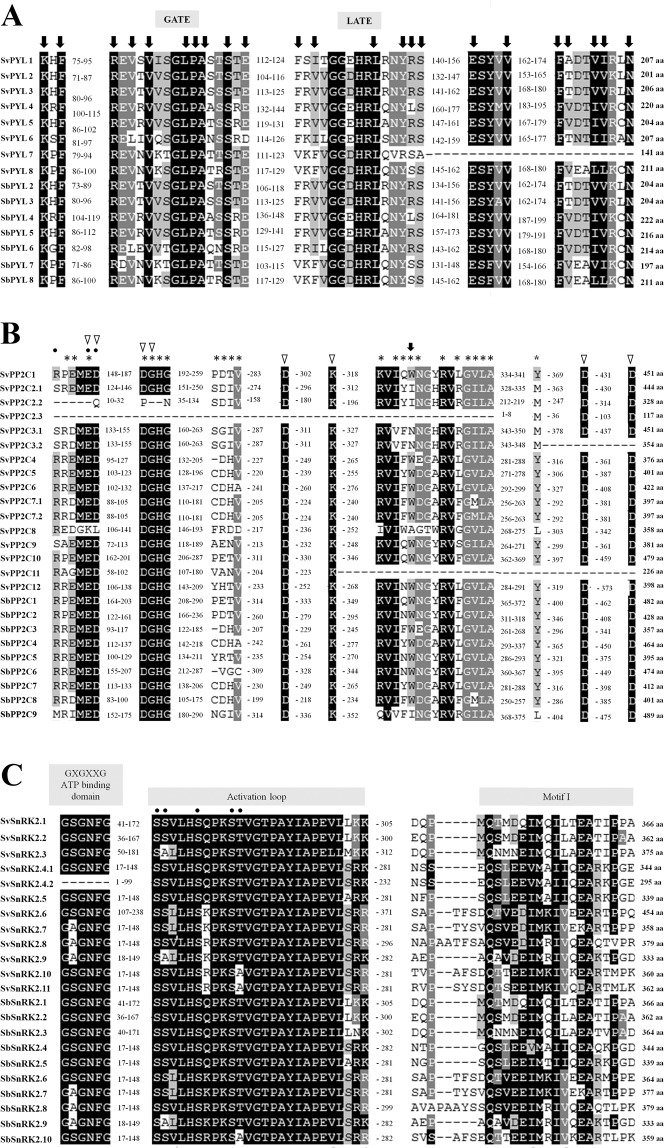
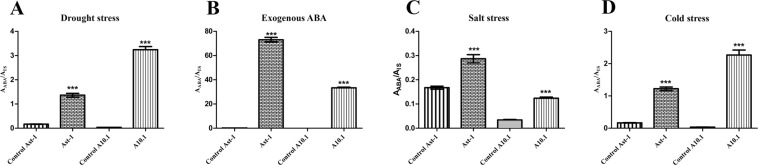
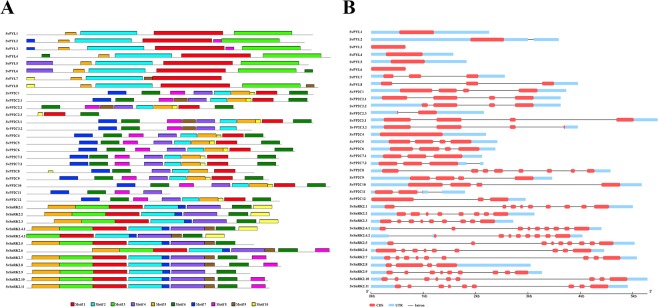
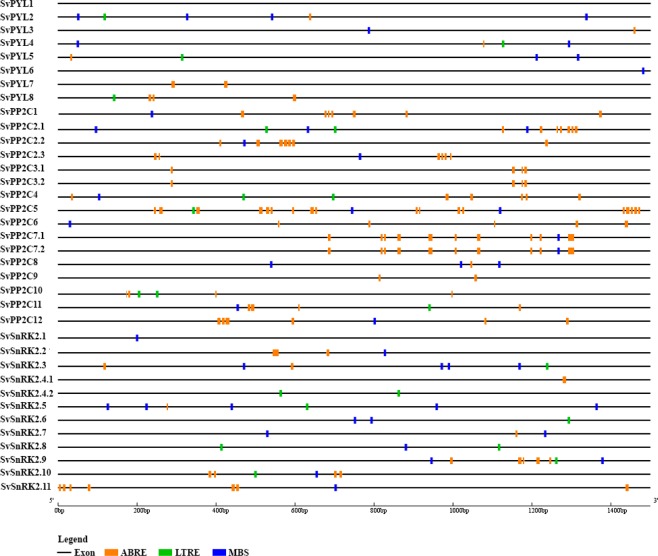
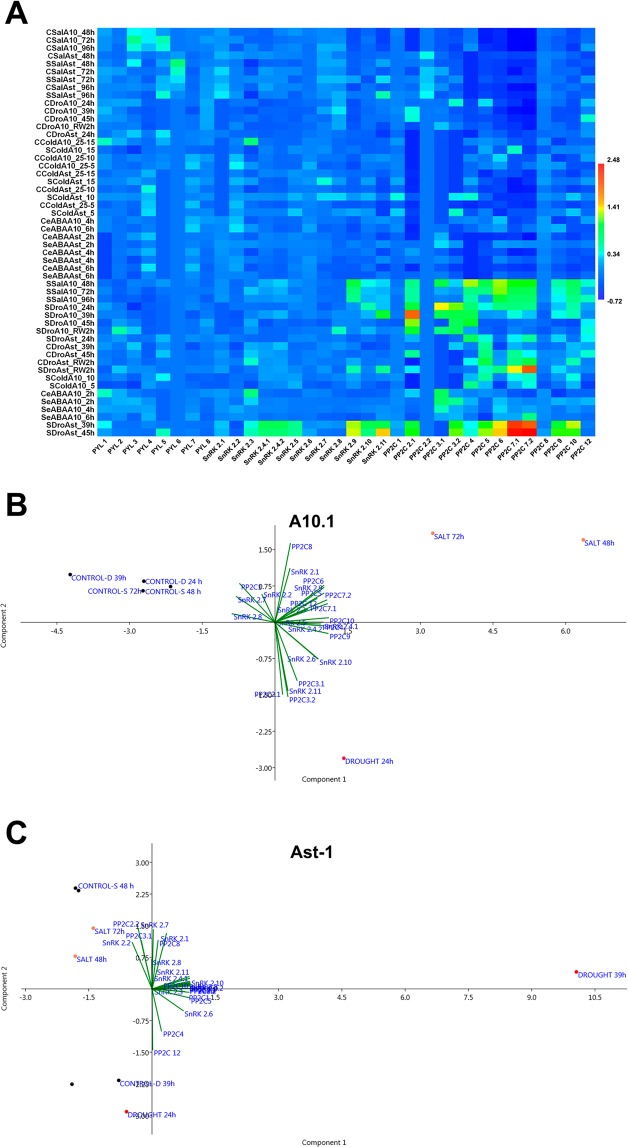
Abscisic acid (ABA) is an essential phytohormone that regulates growth, development and adaptation of plants to environmental stresses. In Arabidopsis and other higher plants, ABA signal transduction involves three core components namely PYR/PYL/RCAR ABA receptors (PYLs), type 2C protein phosphatases (PP2Cs) and class III SNF-1-related protein kinase 2 (SnRK2s). In the present study, we reported the identification and characterization of the core ABA signaling components in Setaria viridis, an emerging model plant for cereals and feedstock crops presenting C4 metabolism, leading to the identification of eight PYL (SvPYL1 to 8), twelve PP2C (SvPP2C1 to 12) and eleven SnRK2 (SvSnRK2.1 through SvSnRK2.11) genes. In order to study the expression profiles of these genes, two different S. viridis accessions (A10.1 and Ast-1) were submitted to drought, salinity and cold stresses, in addition to application of exogenous ABA. Differential gene expression profiles were observed in each treatment and plant genotype, demonstrating variations of ABA stress responses within the same species. These differential responses to stresses were also assessed by physiological measurements such as photosynthesis, stomatal conductance and transpiration rate. This study allows a detailed analysis of gene expression of the core ABA signaling components in Setaria viridis submitted to different treatments and provides suitable targets for genetic engineering of C4 plants aiming tolerance to abiotic stresses.
脱落酸(ABA)是一种重要的植物激素,调节植物的生长、发育和对环境胁迫的适应。在拟南芥和其他高等植物中,ABA 信号转导涉及三个核心成分,即 PYR/PYL/RCAR ABA 受体(PYLs)、类型 2C 蛋白磷酸酶(PP2Cs)和第三类 SNF-1 相关蛋白激酶 2(SnRK2s)。本研究报告了在谷子和饲料作物的新兴模式植物柳枝稷中核心 ABA 信号成分的鉴定和特征,该植物具有 C4 代谢,导致鉴定出 8 个 PYL(SvPYL1 到 8)、12 个 PP2C(SvPP2C1 到 12)和 11 个 SnRK2(SvSnRK2.1 到 SvSnRK2.11)基因。为了研究这些基因的表达谱,两个不同的柳枝稷品种(A10.1 和 Ast-1)分别进行了干旱、盐和冷胁迫处理,以及外源 ABA 的应用。在每种处理和植物基因型中都观察到了基因表达谱的差异,表明在同一物种中 ABA 应激反应的变化。这些对胁迫的差异反应也通过生理测量如光合作用、气孔导度和蒸腾速率进行评估。本研究允许对不同处理下的柳枝稷核心 ABA 信号成分的基因表达进行详细分析,并为 C4 植物的遗传工程提供了对非生物胁迫耐受的合适靶标。