Department of Cardiology, Chinese PLA General Hospital, Beijing, China; Liverpool Centre for Cardiovascular Sciences, University of Liverpool, Liverpool, United Kingdom; and Aalborg Thrombosis Research Unit, Department of Clinical Medicine, Aalborg University, Aalborg, Denmark.
Department of Cardiology, Chinese PLA General Hospital, Beijing, China.
Eur J Intern Med. 2020 Dec;82:105-111. doi: 10.1016/j.ejim.2020.09.024. Epub 2020 Oct 13.
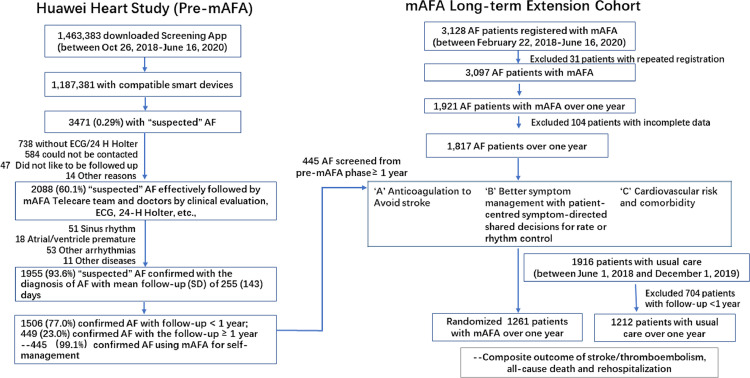
In the mobile Atrial Fibrillation App (mAFA)-II trial, the use of mobile health (mHealth) technology, incorporating AF screening and integrated management strategy, was associated with improved short-term clinical outcomes. The aim of this study was to report adherence/persistence and long term (≥1 year) clinical outcomes of the mAFA-II trial, with mHealth-supported optimised stroke prevention, symptom control and comorbidity management.
We studied an adult population screened for AF, where identified patients could enter a structured program of holistic and integrated care based on the ABC (Atrial fibrillation Better Care) pathway using mHealth with a mAFA intervention. In this cluster randomised trial, comparing mHeath intervention to usual care, the primary composite outcome was 'stroke/thromboembolism, all-cause death and rehospitalization'.
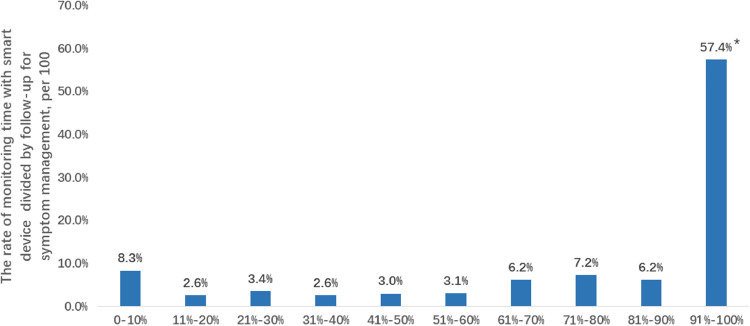
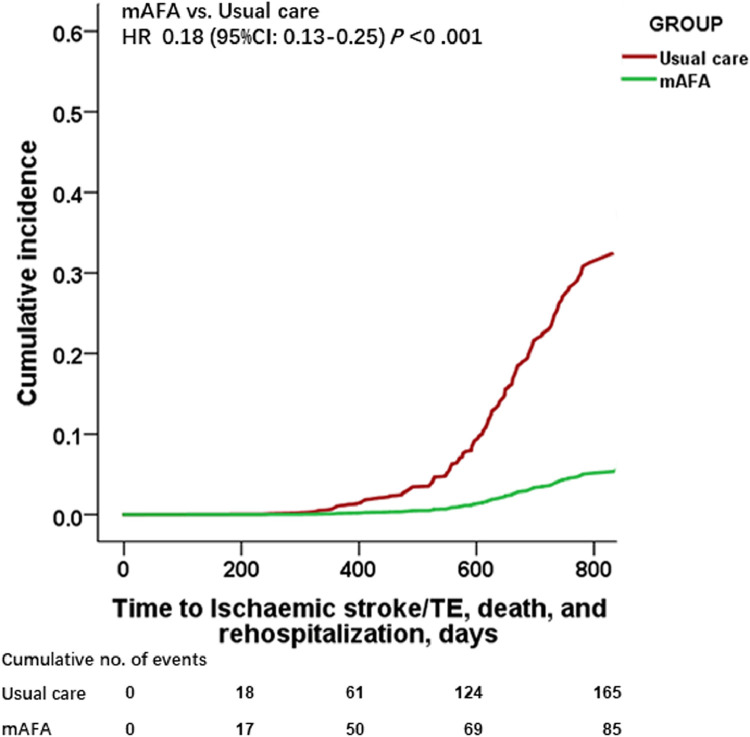
The 1261 subjects (mean age 67.0 years, 38.0% female) who were followed up over one year (mean follow-up 687 (standard deviation, SD 191) days) in the intervention arm, had a lower risk of the composite outcome of 'ischaemic stroke/systemic thromboembolism, death, and rehospitalization' (hazard ratio, HR 0.18, 95% confidence interval, CI: 0.13-0.25, P < 0.001), compared to usual care (1212 subjects, mean age 70.1 years, 42.1% female). Of 842 patients using their smart devices for 'Better symptom management', 70.8% had good management adherence (monitoring time/follow-up since initial monitoring ≥ 70%), with the persistence of use of 91.7%.
Amongst AF patients with long term use (≥1 year) of mHealth technology for optimising stroke prevention, symptom control and comorbidity management, adherence/persistence was good and associated with a reduction in adverse clinical outcomes.
在移动心房颤动应用(mAFA)-II 试验中,使用移动健康(mHealth)技术,结合房颤筛查和综合管理策略,与改善短期临床结果相关。本研究的目的是报告 mAFA-II 试验的依从性/持久性和长期(≥1 年)临床结果,采用 mHealth 支持的优化卒中预防、症状控制和合并症管理。
我们研究了筛查出的房颤患者人群,确定的患者可以根据 ABC(心房颤动更好的护理)路径,使用 mHealth 进入整体和综合护理的结构化程序,mAFA 干预。在这项比较 mHealth 干预与常规护理的集群随机试验中,主要复合结局是“卒中/血栓栓塞、全因死亡和再住院”。
在干预组中,1261 例(平均年龄 67.0 岁,38.0%女性)患者在随访 1 年后(平均随访 687[标准差,SD]191 天),缺血性卒中/系统性血栓栓塞、死亡和再住院的复合结局风险较低(风险比,HR 0.18,95%置信区间,CI:0.13-0.25,P<0.001),与常规护理(1212 例,平均年龄 70.1 岁,42.1%女性)相比。在 842 例使用智能设备进行“更好症状管理”的患者中,70.8%的患者管理依从性良好(监测时间/自初始监测以来的随访时间≥70%),使用率的持久性为 91.7%。
在长期(≥1 年)使用 mHealth 技术优化卒中预防、症状控制和合并症管理的房颤患者中,依从性/持久性良好,与不良临床结局减少相关。