Department of Biological Sciences, The University of Texas at Dallas, 800 west Campbell Rd, Richardson, TX, 75080, USA.
Higuchi Biosciences Center, The University of Kansas, Lawrence, KS, 66045, USA.
Sci Rep. 2020 Oct 16;10(1):17589. doi: 10.1038/s41598-020-74613-9.
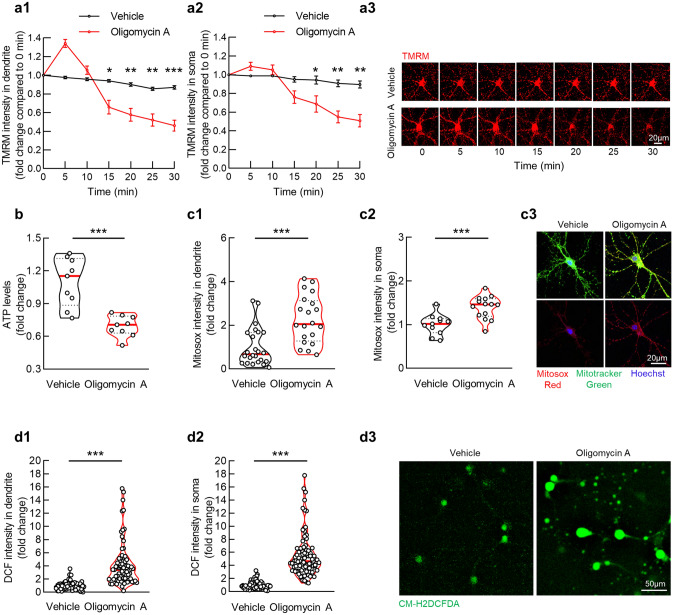
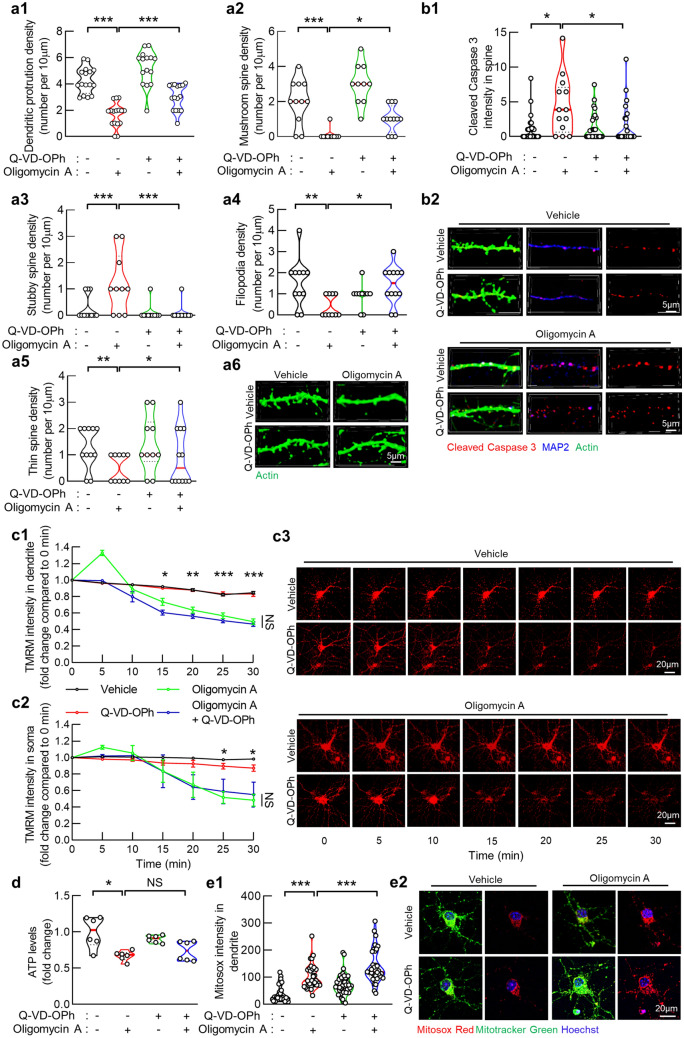
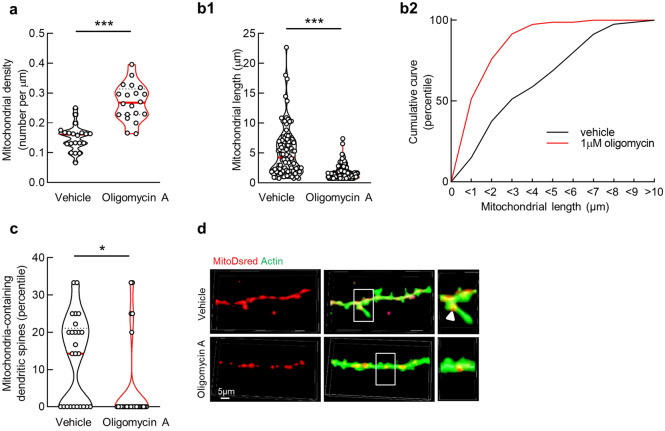
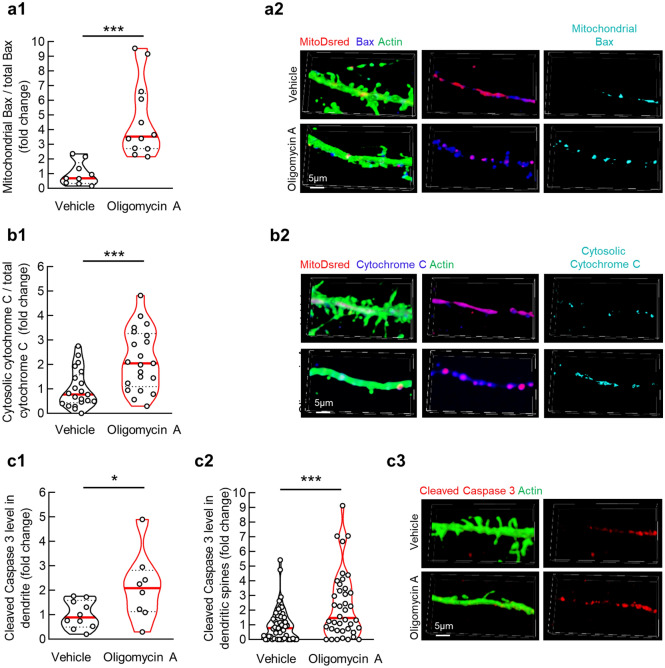
Dendritic spine injury underlies synaptic failure in many neurological disorders. Mounting evidence suggests a mitochondrial pathway of local nonapoptotic caspase signaling in mediating spine pruning. However, it remains unclear whether this caspase signaling plays a key role in spine loss when severe mitochondrial functional defects are present. The answer to this question is critical especially for some pathological states, in which mitochondrial deficits are prominent and difficult to fix. F1Fo ATP synthase is a pivotal mitochondrial enzyme and the dysfunction of this enzyme involves in diseases with spinopathy. Here, we inhibited F1Fo ATP synthase function in primary cultured hippocampal neurons by using non-lethal oligomycin A treatment. Oligomycin A induced mitochondrial defects including collapsed mitochondrial membrane potential, dissipated ATP production, and elevated reactive oxygen species (ROS) production. In addition, dendritic mitochondria underwent increased fragmentation and reduced positioning to dendritic spines along with increased caspase 3 cleavage in dendritic shaft and spines in response to oligomycin A. Concurring with these dendritic mitochondrial changes, oligomycin A-insulted neurons displayed spine loss and altered spine architecture. Such oligomycin A-mediated changes in dendritic spines were substantially prevented by the inhibition of caspase activation by using a pan-caspase inhibitor, quinolyl-valyl-O-methylaspartyl-[-2,6-difluorophenoxy]-methyl ketone (Q-VD-OPh). Of note, the administration of Q-VD-OPh showed no protective effect on oligomycin A-induced mitochondrial dysfunction. Our findings suggest a pivotal role of caspase 3 signaling in mediating spine injury and the modulation of caspase 3 activation may benefit neurons from spine loss in diseases, at least, in those with F1Fo ATP synthase defects.
树突棘损伤是许多神经紊乱中突触功能丧失的基础。越来越多的证据表明,局部非凋亡半胱天冬酶信号转导的线粒体途径在介导棘突修剪中起作用。然而,当存在严重的线粒体功能缺陷时,这种半胱天冬酶信号转导是否在棘突损失中起关键作用仍不清楚。这个问题的答案至关重要,尤其是对于一些病理状态,其中线粒体缺陷明显且难以修复。F1FoATP 合酶是一种关键的线粒体酶,这种酶的功能障碍与伴有棘突病的疾病有关。在这里,我们通过使用非致死性寡霉素 A 处理原代培养的海马神经元来抑制 F1FoATP 合酶的功能。寡霉素 A 诱导的线粒体缺陷包括线粒体膜电位崩溃、ATP 产生耗散和活性氧 (ROS) 产生增加。此外,树突状线粒体发生碎片化增加,定位减少到树突棘,同时伴随着 caspase 3 在树突干和棘突中的切割增加。与这些树突状线粒体变化一致,寡霉素 A 损伤的神经元显示出棘突损失和棘突结构改变。使用泛半胱天冬酶抑制剂,喹啉基-缬氨酰-O-甲基天冬氨酸-[-2,6-二氟苯氧基]-甲基酮 (Q-VD-OPh) 抑制半胱天冬酶激活,可显著防止寡霉素 A 介导的树突棘变化。值得注意的是,Q-VD-OPh 的给药对寡霉素 A 诱导的线粒体功能障碍没有保护作用。我们的研究结果表明,caspase3 信号在介导棘突损伤中起关键作用,调节 caspase3 激活可能有益于疾病中神经元的棘突损失,至少在那些具有 F1FoATP 合酶缺陷的疾病中是如此。