Wang Pengrui, Berry David B, Song Zhaoqiang, Kiratitanaporn Wisarut, Schimelman Jacob, Moran Amy, He Frank, Xi Brian, Cai Shengqiang, Chen Shaochen
Materials Science and Engineering Program, University of California San Diego, La Jolla, CA 92093.
Department of NanoEngineering, University of California San Diego, La Jolla, CA 92093.
Adv Funct Mater. 2020 Apr 3;30(14). doi: 10.1002/adfm.201910391. Epub 2020 Feb 19.
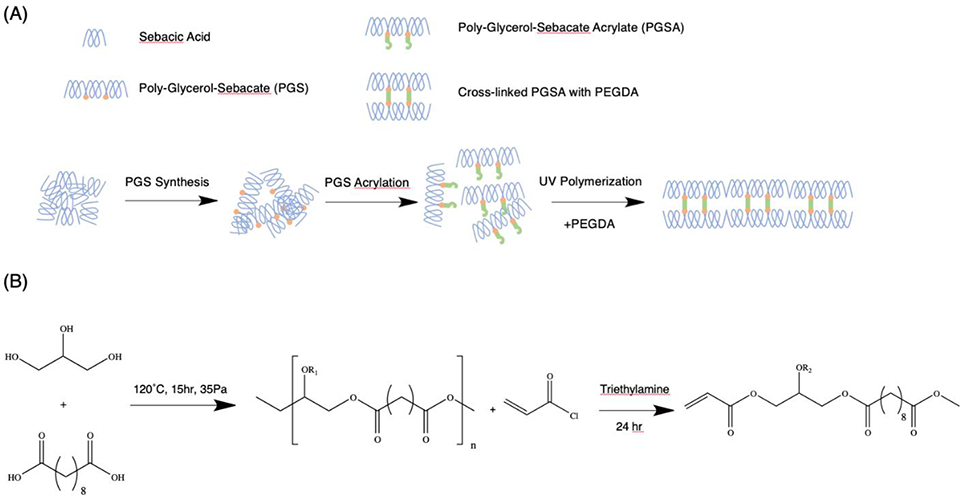
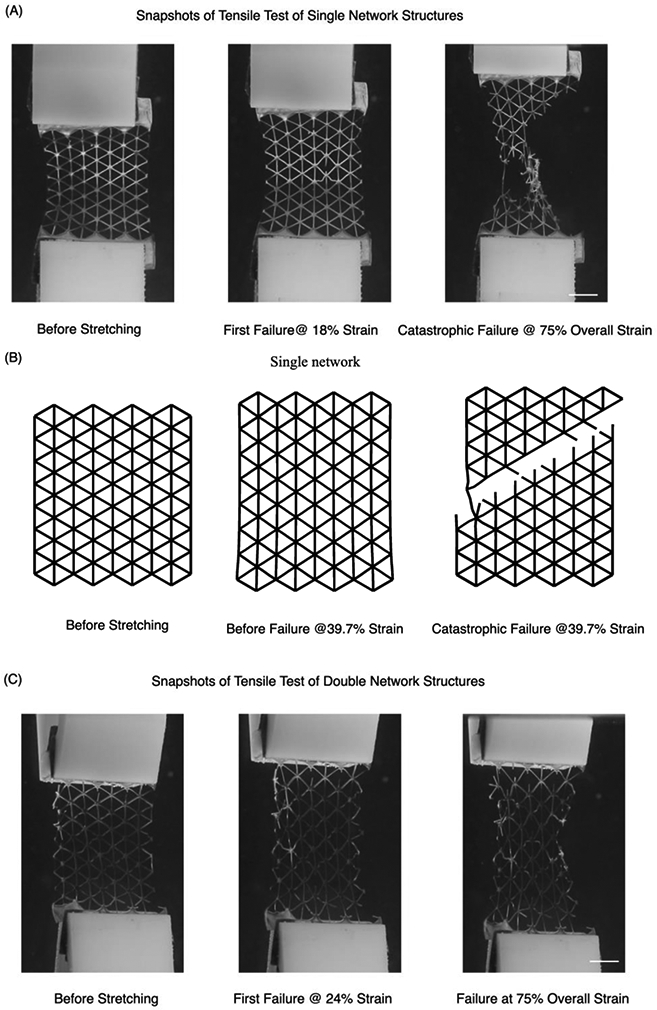
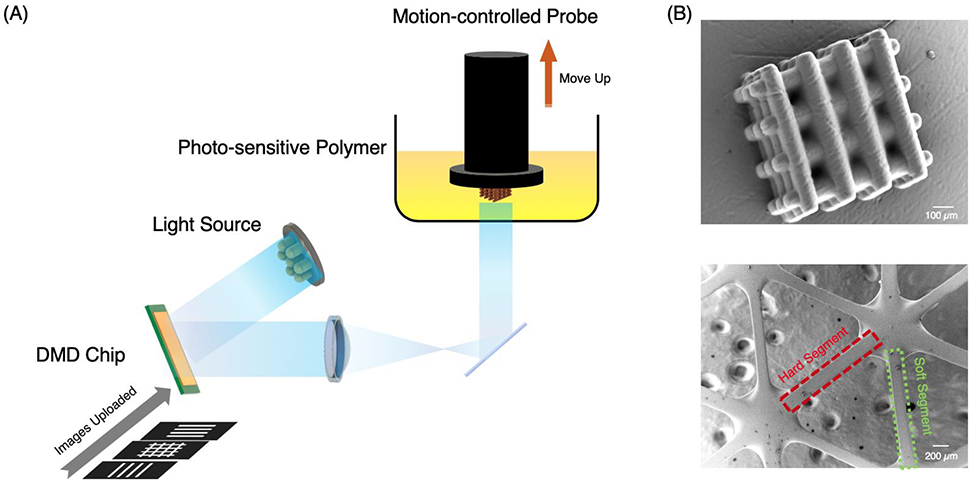
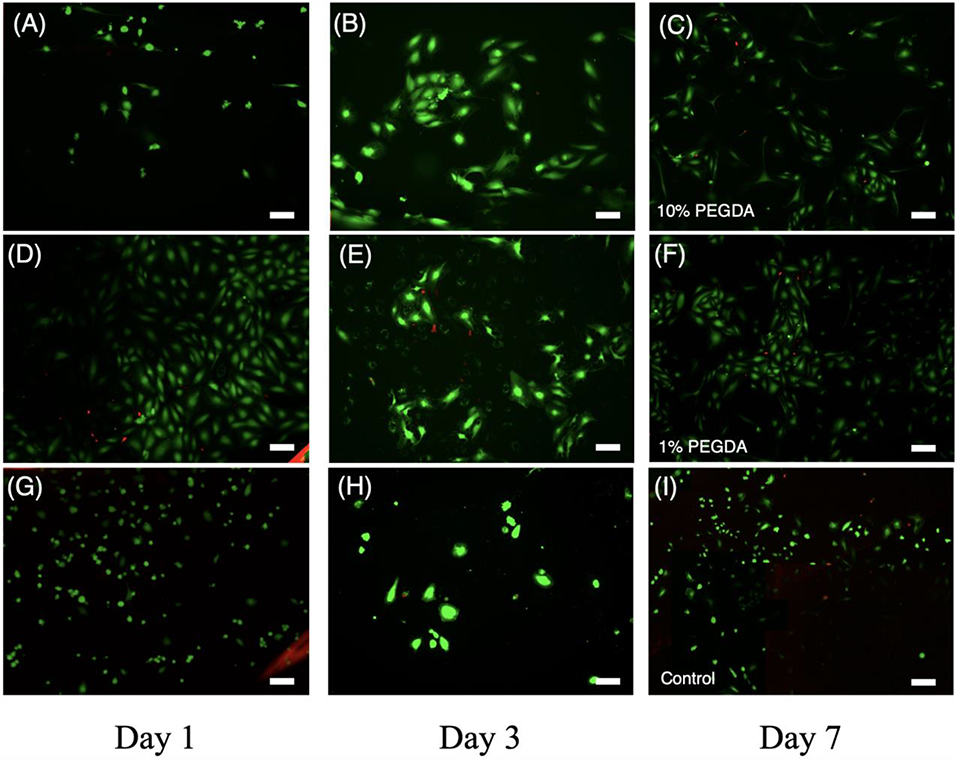
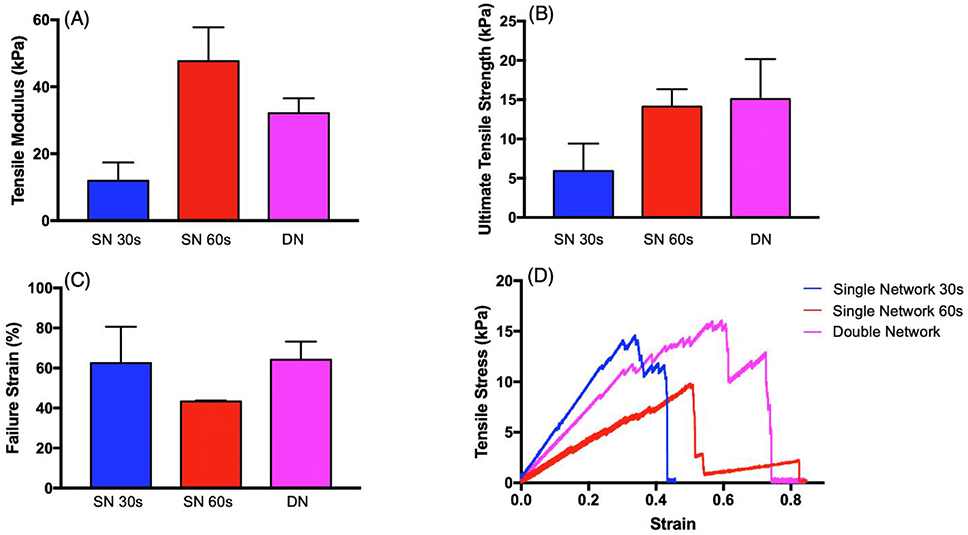
The majority of 3D-printed biodegradable biomaterials are brittle, limiting their potential application to compliant tissues. Poly (glycerol sebacate) acrylate (PGSA) is a synthetic biodegradable and biocompatible elastomer, compatible with light-based 3D printing. In this work we employed digital-light-processing (DLP)-based 3D printing to create a complex PGSA network structure. Nature-inspired double network (DN) structures with two geometrically interconnected segments with different mechanical properties were printed from the same material in a single shot. Such capability has not been demonstrated by any other fabrication technique. The biocompatibility of PGSA after 3D printing was confirmed via cell-viability analysis. We used a finite element analysis (FEA) model to predict the failure of the DN structure under uniaxial tension. FEA confirmed the soft segments act as sacrificial elements while the hard segments retain structural integrity. The simulation demonstrated that the DN design absorbs 100% more energy before rupture than the network structure made by single exposure condition (SN), doubling the toughness of the overall structure. Using the FEA-informed design, a new DN structure was printed and the FEA predicted tensile test results agreed with tensile testing of the printed structure. This work demonstrated how geometrically-optimized material design can be easily and rapidly achieved by using DLP-based 3D printing, where well-defined patterns of different stiffnesses can be simultaneously formed using the same elastic biomaterial, and overall mechanical properties can be specifically optimized for different biomedical applications.
大多数3D打印的可生物降解生物材料都很脆,这限制了它们在顺应性组织中的潜在应用。聚(癸二酸甘油酯)丙烯酸酯(PGSA)是一种合成的可生物降解且具有生物相容性的弹性体,适用于基于光的3D打印。在这项工作中,我们采用基于数字光处理(DLP)的3D打印技术来创建复杂的PGSA网络结构。从同一材料中一次性打印出具有两种不同机械性能的几何互连段的仿生双网络(DN)结构。这种能力尚未被任何其他制造技术所证明。通过细胞活力分析证实了3D打印后PGSA的生物相容性。我们使用有限元分析(FEA)模型来预测DN结构在单轴拉伸下的失效情况。有限元分析证实软段起到牺牲元件的作用,而硬段保持结构完整性。模拟表明,与单曝光条件(SN)制成的网络结构相比,DN设计在破裂前吸收的能量多100%,使整体结构的韧性提高了一倍。利用有限元分析指导的设计,打印出一种新的DN结构,有限元分析预测的拉伸试验结果与打印结构的拉伸试验结果一致。这项工作展示了如何通过使用基于DLP的3D打印轻松快速地实现几何优化的材料设计,即使用相同的弹性生物材料可以同时形成具有不同刚度的明确定义的图案,并且可以针对不同的生物医学应用专门优化整体机械性能。