Zhang Yuanyuan, Ding Hongwei
Speech-Language-Hearing Center, School of Foreign Languages, Shanghai Jiao Tong University, Shanghai, China.
MARCS Institute, University of Western Sydney, Penrith, NSW, Australia.
Front Psychol. 2020 Sep 18;11:573520. doi: 10.3389/fpsyg.2020.573520. eCollection 2020.
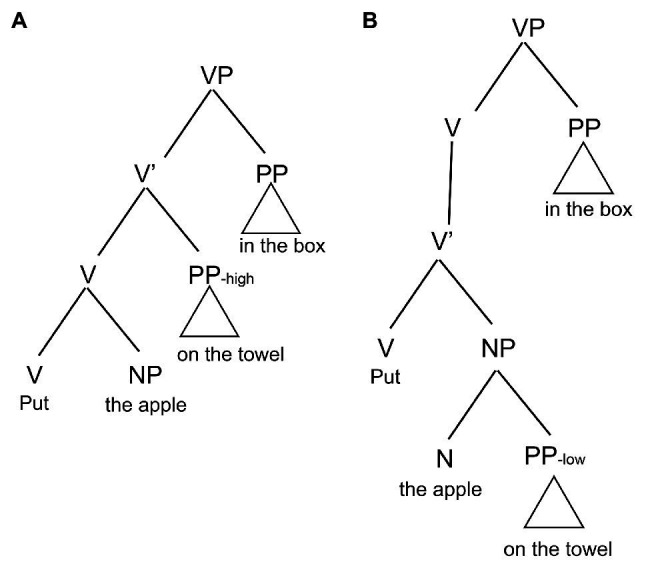
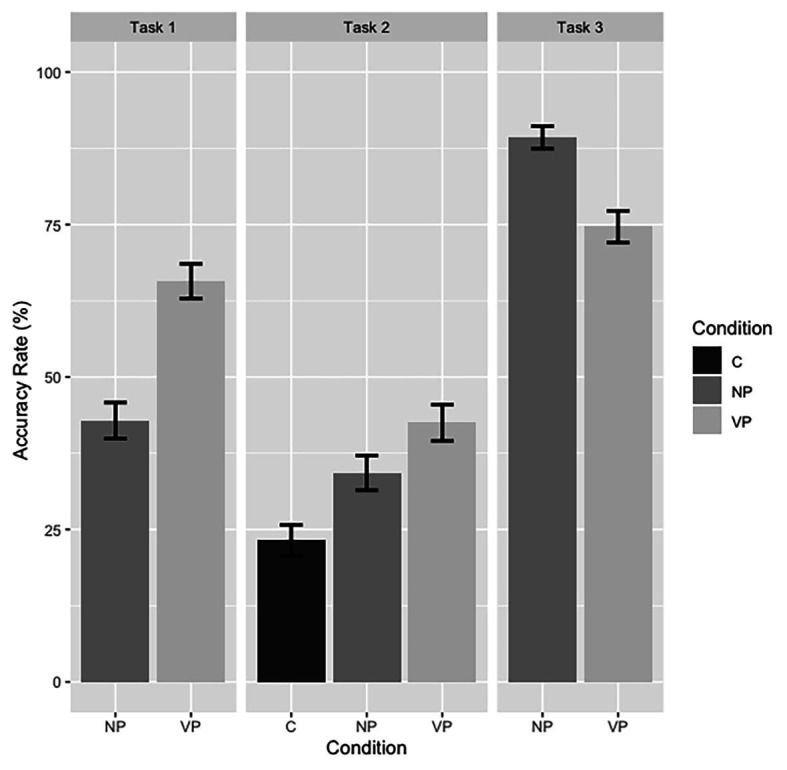
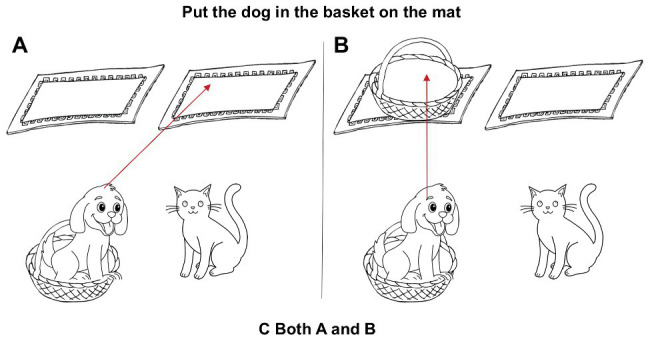
Three tasks were reported to examine the effect of ambiguity awareness on Chinese-speaking English learners' use of prosody in resolving prepositional-phrase attachment ambiguity. In the first (Task 1) and second (Task 2) tasks, listeners were not informed of the syntactic ambiguity. In the third task (Task 3), listeners were given the specific information about syntactic ambiguity. The analysis of the overall accuracy rate showed that before receiving specific information about syntactic ambiguity, learners did not detect the ambiguity within the structure and tended to interpret the sentence in a "good-enough" heuristic to reduce the computational burden. After being aware of the syntactic ambiguity, they could use prosodic cues to resolve the ambiguity. However, the finding that the learners reversed their parsing bias from verb phrase attachment (VP-attachment) toward noun phrase attachment (NP-attachment) indicated their difficulty in integrating prosodic information to syntactic structure efficiently. The analysis of individual accuracy rate demonstrated learners' individual variations in using prosodic cues. The result suggests that learners' failure to use prosodic cues may be attributed to a lack of ambiguity awareness and difficulty in information integration, rather than their low sensitivity to prosodic cues.
据报道,有三项任务用于检验歧义意识对说中文的英语学习者在解决介词短语附加歧义时韵律运用的影响。在第一项任务(任务1)和第二项任务(任务2)中,听众未被告知句法歧义。在第三项任务(任务3)中,听众得到了关于句法歧义的具体信息。对总体准确率的分析表明,在收到关于句法歧义的具体信息之前,学习者没有察觉到结构中的歧义,倾向于以“足够好”的启发式方式来解释句子,以减轻计算负担。在意识到句法歧义后,他们能够利用韵律线索来解决歧义。然而,学习者将其解析偏向从动词短语附加(VP附加)转向名词短语附加(NP附加)这一发现表明,他们在有效地将韵律信息整合到句法结构方面存在困难。对个体准确率的分析表明了学习者在使用韵律线索方面的个体差异。结果表明,学习者未能使用韵律线索可能归因于缺乏歧义意识和信息整合困难,而非他们对韵律线索的低敏感性。