Department of Sport Science and Sport, Friedrich-Alexander-Universität Erlangen-Nuremberg, Erlangen, Germany.
Institute of Sports Science, Eberhard-Karls-Universität Tübingen, Tübingen, Germany.
Front Public Health. 2020 Sep 24;8:571413. doi: 10.3389/fpubh.2020.571413. eCollection 2020.
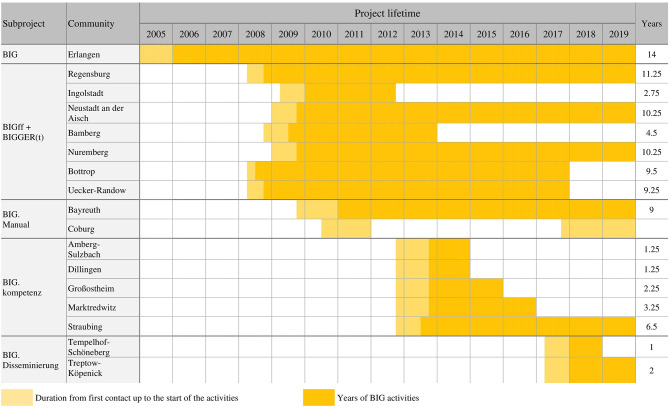
Community-based participatory research (CBPR) is an effective approach to health promotion, especially in relation to socially disadvantaged groups. However, the long-term implementation of CPBR-based projects on a broad scale is often challenging, and research regarding the sustainable transfer of participatory research is lacking. This limits the scaling-up and public health impact of CBPR. Therefore, this study examines the mechanisms utilized to transfer and sustain the BIG project, a multifaceted CBPR project aimed at promoting physical activity among women in difficult life situations. Borrowing from the RE-AIM framework, we analyzed project documentation and conducted a reflection workshop to investigate methods of transferring BIG to new sites as well as strategies from researchers to support project implementation and the maintenance of program activities at those sites. Moreover, we analyzed the reasons for discontinuing program activities at some former BIG sites and the costs involved in transferring BIG. Since its establishment in 2005, BIG was transferred to and implemented at 17 sites. As of the winter of 2019, the program activities were maintained at eight sites. The average duration of sites that continue to offer program activities was more than 9 years. Discontinued sites maintained project activities for an average of 4 years. According to the study findings, the extent of scientific support, the provision of seed funding, and the local project coordinator, the person managing the project at the site, all have a significant impact on the sustainability of the transfer. A patchwork of funding agencies was needed to finance scientific support and seed funding in BIG. The transfer of BIG projects accrued annual costs of approximately EUR20,000 per site; however, long-term project implementation resulted in a decline in the annual transfer costs of BIG. The sustainable transfer of CBPR is challenging but possible, and increased support of research and seed funding can facilitate long-term transfer. Nevertheless, other factors in the implementation setting are beyond scientific control. With scarce financial resources, researchers need to carefully balance the efforts of the sustainability and transfer of CBPR projects. To address this issue, there is a need for further research into the interrelationship of the sustainability and transfer of CBPR projects as well as increased long-term funding.
基于社区的参与式研究(CBPR)是促进健康的有效方法,特别是对于社会弱势群体。然而,广泛实施基于 CPBR 的项目的长期实施通常具有挑战性,并且缺乏关于参与式研究可持续转移的研究。这限制了 CBPR 的扩大规模和对公共卫生的影响。因此,本研究探讨了用于转移和维持 BIG 项目的机制,BIG 项目是一个多方面的 CBPR 项目,旨在促进困难生活情况下的妇女进行身体活动。借鉴 RE-AIM 框架,我们分析了项目文件并进行了反思研讨会,以调查将 BIG 转移到新地点的方法以及研究人员支持项目实施和维持这些地点的计划活动的策略。此外,我们分析了一些前 BIG 地点停止计划活动的原因以及转移 BIG 的相关成本。自 2005 年成立以来,BIG 已转移到 17 个地点并实施。截至 2019 年冬季,该计划活动在 8 个地点得到维持。继续提供计划活动的地点的平均持续时间超过 9 年。停止活动的地点平均维持项目活动 4 年。根据研究结果,科学支持的程度、种子资金的提供以及当地项目协调员(即负责该地点项目的人员)都对转移的可持续性产生重大影响。需要拼凑各种资金来源来为 BIG 的科学支持和种子资金提供资金。BIG 项目的转移产生了每个地点每年约 20,000 欧元的年度成本;然而,长期的项目实施导致 BIG 的年度转移成本下降。CBPR 的可持续转移具有挑战性但却是可行的,增加对研究和种子资金的支持可以促进长期转移。然而,实施环境中的其他因素超出了科学控制范围。由于资金有限,研究人员需要仔细平衡 CBPR 项目的可持续性和转移的努力。为了解决这个问题,需要进一步研究 CBPR 项目的可持续性和转移的相互关系,并增加长期资金。