International Diabetes Federation (IDF), 166 Chaussée de La Hulpe B-1170 Brussels, Belgium; ADJ Diabetes Brasil (ADJ). Rua Padre Antônio Tomás, 213, Zip code, 05003-010, Água Branca, São Paulo, SP, Brazil; Fórum Intersetorial para Combate às DCNTs no Brasil (ForumDCNTs), Rua Padre Antônio Tomás, 213, 05003-010, Água Branca, São Paulo, SP, Brazil; Sociedade Brasileira de Diabetes (SBD), Rua Afonso Braz 579, Salas 72/74, Vila Nova, Conceição, 04511-011, São Paulo SP, Brazil.
Universidade de São Paulo (USP), Instituto de Matemática e Estatística, Departamento de Estatística. Rua do Matão 1010, Cidade Universitária, 05508-090, São Paulo, SP, Brazil.
Diabetes Metab Syndr. 2020 Nov-Dec;14(6):1973-1978. doi: 10.1016/j.dsx.2020.10.005. Epub 2020 Oct 7.
COVID-19 severity and mortality are elevated in individuals with diabetes. During the pandemic, interventions recommended globally for people with diabetes were to keep blood glucose on target whilst staying at home to curb the spread of the virus. In Brazil, similar measures were proposed. The aim of our observational study was to assess whether these measures achieved their objectives.
An anonymous and untraceable survey was shared from April 22nd to May 4th. States with more than 30 respondents were included in the analysis and Fisher's exact test was performed to identify associations, with p < 0.05 considered significant.
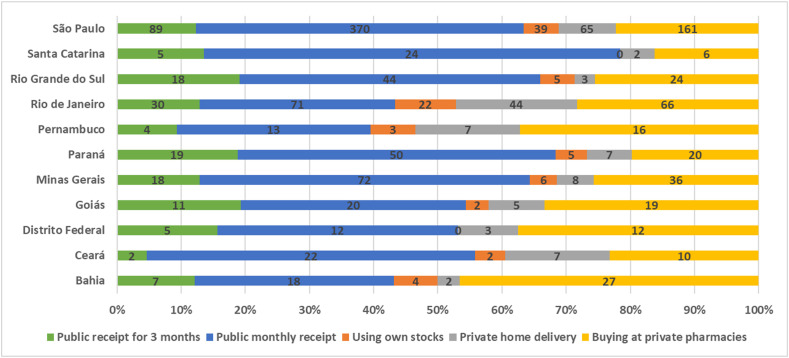
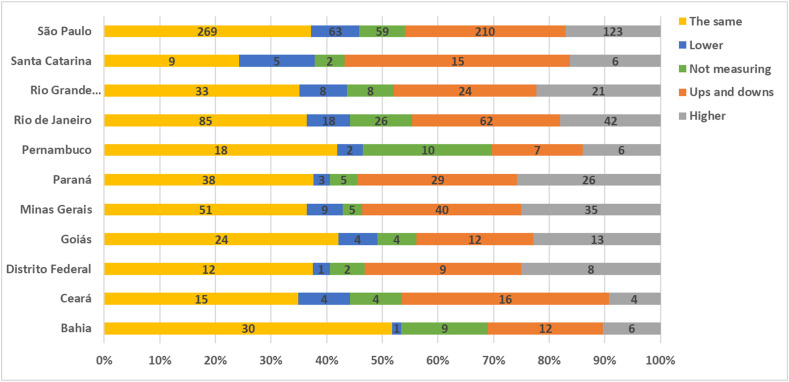
Type 1 diabetes and female participants were prevalent, 60.76% and 76.12% respectively. 10 out of 26 states were included, in addition to the Federal District (1562 responses). Only in three states (Bahia, Goiás and Pernambuco) less than 50% of the respondents experienced higher glycemia or higher variability during the pandemic. Goiás state, where almost half of the respondents (49.12%) have private insurance, presented the highest percentage of individuals receiving medicines for three months (35.48%) and one of the lowest percentages of blood glucose deterioration (47.17%). In the large states of Minas Gerais, Rio de Janeiro and São Paulo, consultations and/or lab exams were postponed by 37.14%, 34.33% and 40.88%, respectively.
The decentralized measures implemented by states in Brazil left most people with diabetes unprotected. Many were forced to venture outside to collect or to purchase their medical supplies monthly and reported increased glycemic levels and/or variability.
COVID-19 在糖尿病患者中的严重程度和死亡率较高。在大流行期间,全球建议糖尿病患者采取的干预措施是保持血糖达标,同时待在家中以遏制病毒传播。在巴西,也提出了类似的措施。我们的观察性研究旨在评估这些措施是否达到了目标。
从 4 月 22 日至 5 月 4 日,我们共享了一份匿名且无法追踪的调查。纳入分析的州必须有 30 名以上的受访者,使用 Fisher 精确检验来识别关联,p 值<0.05 被认为有统计学意义。
1 型糖尿病和女性参与者居多,分别占 60.76%和 76.12%。纳入了 26 个州中的 10 个州以及联邦区(1562 份回复)。只有在三个州(巴伊亚州、戈亚斯州和伯南布哥州)中,不到 50%的受访者在大流行期间经历了更高的血糖或更高的变异性。戈亚斯州几乎一半的受访者(49.12%)拥有私人保险,报告了接受三个月药物治疗的个体比例最高(35.48%),血糖恶化的比例最低(47.17%)之一。在米纳斯吉拉斯州、里约热内卢州和圣保罗州这三个大州,咨询和/或实验室检查分别被推迟了 37.14%、34.33%和 40.88%。
巴西各州实施的分散措施使大多数糖尿病患者没有得到保护。许多人被迫冒险外出每月采集或购买医疗用品,报告血糖水平升高和/或变异性增加。