Department of Biochemistry and Medical Chemistry, Pomeranian Medical University in Szczecin, Powstańców Wielkopolskich 72 Av., 70-111 Szczecin, Poland.
Department of Medical Chemistry, Pomeranian Medical University in Szczecin, Powstańców Wlkp. 72 Av., 70-111 Szczecin, Poland.
Int J Mol Sci. 2020 Oct 15;21(20):7619. doi: 10.3390/ijms21207619.
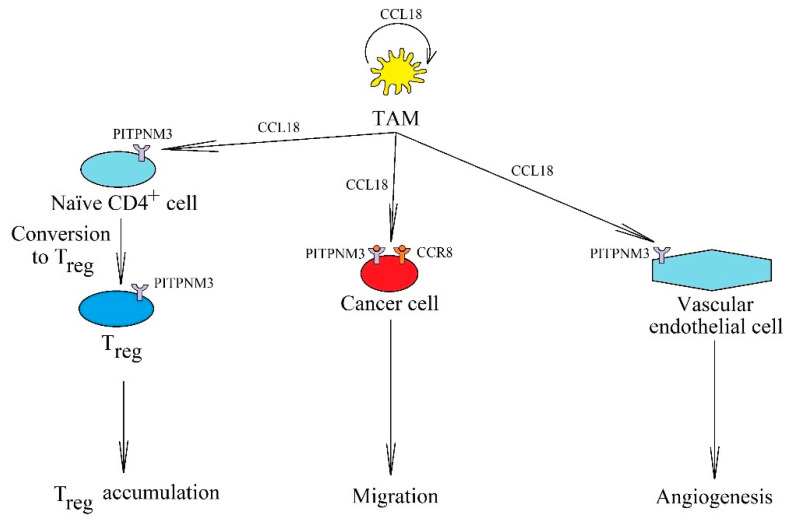
CC chemokines (or β-chemokines) are 28 chemotactic cytokines with an N-terminal CC domain that play an important role in immune system cells, such as CD4 and CD8 lymphocytes, dendritic cells, eosinophils, macrophages, monocytes, and NK cells, as well in neoplasia. In this review, we discuss human CC motif chemokine ligands: CCL1, CCL3, CCL4, CCL5, CCL18, CCL19, CCL20, CCL21, CCL25, CCL27, and CCL28 (CC motif chemokine receptor CCR5, CCR6, CCR7, CCR8, CCR9, and CCR10 ligands). We present their functioning in human physiology and in neoplasia, including their role in the proliferation, apoptosis resistance, drug resistance, migration, and invasion of cancer cells. We discuss the significance of chemokine receptors in organ-specific metastasis, as well as the influence of each chemokine on the recruitment of various cells to the tumor niche, such as cancer-associated fibroblasts (CAF), Kupffer cells, myeloid-derived suppressor cells (MDSC), osteoclasts, tumor-associated macrophages (TAM), tumor-infiltrating lymphocytes (TIL), and regulatory T cells (T). Finally, we show how the effect of the chemokines on vascular endothelial cells and lymphatic endothelial cells leads to angiogenesis and lymphangiogenesis.
CC 趋化因子(或β-趋化因子)是 28 种具有 N 端 CC 结构域的趋化细胞因子,在免疫系统细胞(如 CD4 和 CD8 淋巴细胞、树突状细胞、嗜酸性粒细胞、巨噬细胞、单核细胞和 NK 细胞)以及肿瘤中发挥重要作用。在这篇综述中,我们讨论了人类 CC 基序趋化因子配体:CCL1、CCL3、CCL4、CCL5、CCL18、CCL19、CCL20、CCL21、CCL25、CCL27 和 CCL28(CC 基序趋化因子受体 CCR5、CCR6、CCR7、CCR8、CCR9 和 CCR10 的配体)。我们介绍了它们在人体生理学和肿瘤中的功能,包括它们在癌细胞增殖、抗凋亡、耐药性、迁移和侵袭中的作用。我们讨论了趋化因子受体在器官特异性转移中的意义,以及每种趋化因子对各种细胞向肿瘤微环境募集的影响,如肿瘤相关成纤维细胞(CAF)、枯否细胞、髓源性抑制细胞(MDSC)、破骨细胞、肿瘤相关巨噬细胞(TAM)、肿瘤浸润淋巴细胞(TIL)和调节性 T 细胞(T)。最后,我们展示了趋化因子对血管内皮细胞和淋巴管内皮细胞的影响如何导致血管生成和淋巴管生成。