Department of Prosthodontics, Semmelweis University, Szentkiralyi Street 47, 1088, Budapest, Hungary.
BMC Oral Health. 2020 Oct 19;20(1):287. doi: 10.1186/s12903-020-01278-1.
The spread of digital technology in dentistry poses new challenges and sets new goals for dentists. The aim of the present in vivo study was to determine the learning curve of intraoral scanning described by (1) scanning time and (2) image number (count of images created by intraoral scanner during the scanning process).
Ten dental students of Semmelweis University took part in the study. Dental students took digital study impressions using a 3Shape Trios 3® (3Shape, Copenhagen, Denmark) intraoral scanning device. Each student took 10 digital impressions on volunteers. Volunteer inclusion criteria included full dentition (except for missing third molars) and no prosthetic/restorative treatment. Digital impression taking was preceded by tuition consisting of both theoretical education and practical training. Digital impressions were taken of the upper and lower arches, and the bite was recorded according to the manufacturer's instructions. Total scanning times and image numbers were recorded.
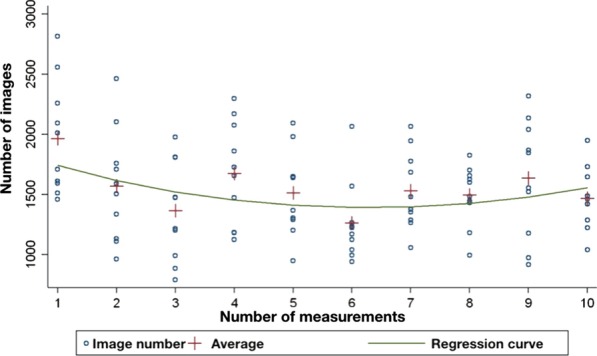
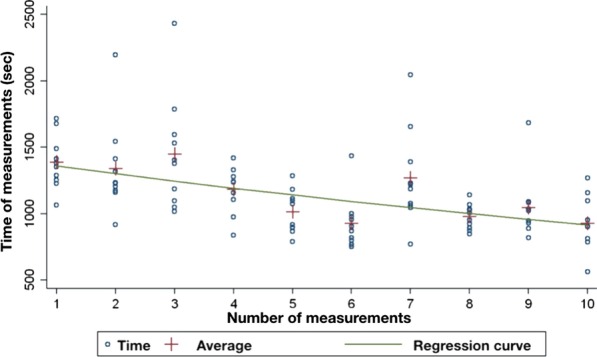
The difference in scanning time between the first and the tenth digital impressions was significant (p = 0.007). The average scanning time for the first impressions was 23 min 9 s; for the tenth impressions, it was 15 min 28 s. The difference between the scanning times of the first and the tenth procedures was 7 min 41 s. The average image count for the first impressions was 1964.5; for the tenth impressions, it was 1468.6. The image count difference between the first and the tenth procedures was 495.9. The image count versus sequential number of measurement curve shows an initial decreasing tendency followed by a trough around the sixth measurement and a final increasing phase.
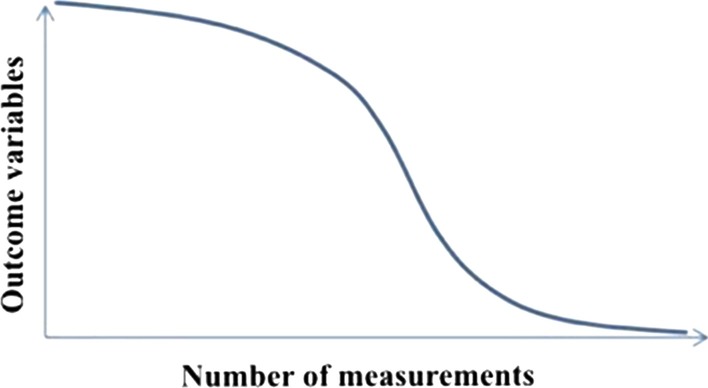
Our results indicate an association between the sequential number of measurements and the outcome variables. The drop in scanning time is probably explained by a practice effect of repeated use, i.e. the students learned to move the scanning tip faster. The image count first showed a decreasing tendency, and after the sixth measurement, it increased; there was no consistent decline in mean scan count. Shorter scanning times are associated with poorer coverage quality, with the operator needing to make corrections by adding extra images; this manifests as the time function of image counts taking an increase after the sixth measurement.
数字技术在牙科中的传播为牙医带来了新的挑战和目标。本体内研究的目的是通过(1)扫描时间和(2)图像数量(口腔内扫描仪在扫描过程中创建的图像数量)来确定口腔内扫描的学习曲线。
十名赛梅维什大学的牙科学生参加了这项研究。牙科学生使用 3Shape Trios 3®(3Shape,哥本哈根,丹麦)口腔内扫描仪进行数字化研究印模。每位学生对志愿者进行了 10 次数字化印模。志愿者纳入标准包括全牙列(除第三磨牙缺失外)和无修复/治疗。按照制造商的说明,在进行数字化印模之前,先进行理论教育和实践培训。对上下牙弓进行了数字化印模,根据制造商的说明记录咬合。记录总扫描时间和图像数量。
第一和第十次数字印象之间的扫描时间差异具有统计学意义(p=0.007)。第一次印象的平均扫描时间为 23 分 9 秒;第十次印象的平均扫描时间为 15 分 28 秒。第一次和第十次扫描之间的扫描时间差为 7 分 41 秒。第一次印象的平均图像数为 1964.5;第十次印象的平均图像数为 1468.6。第一次和第十次扫描之间的图像数差异为 495.9。图像数量与顺序测量数量的曲线显示出初始下降趋势,随后在第六次测量时出现低谷,最后出现上升阶段。
我们的结果表明,顺序测量数量与结果变量之间存在关联。扫描时间的下降可能是由于重复使用的练习效应所致,即学生学会了更快地移动扫描探头。图像数量最初呈下降趋势,在第六次测量后增加;平均扫描数量没有一致的下降。较短的扫描时间与较差的覆盖质量相关,操作员需要通过添加额外的图像进行更正;这表现为第六次测量后图像数量的时间函数增加。