Woods Institute for the Environment, Stanford University, Stanford, California 94305, United States.
Department of Forestry and Environmental Resources, North Carolina State University, Raleigh, North Carolina 27695, United States.
Environ Sci Technol. 2020 Nov 3;54(21):13828-13838. doi: 10.1021/acs.est.0c02606. Epub 2020 Oct 20.
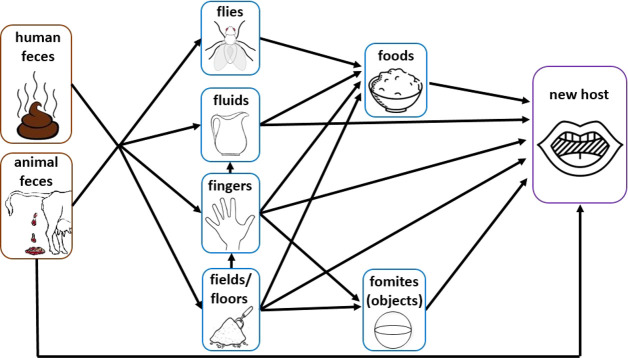
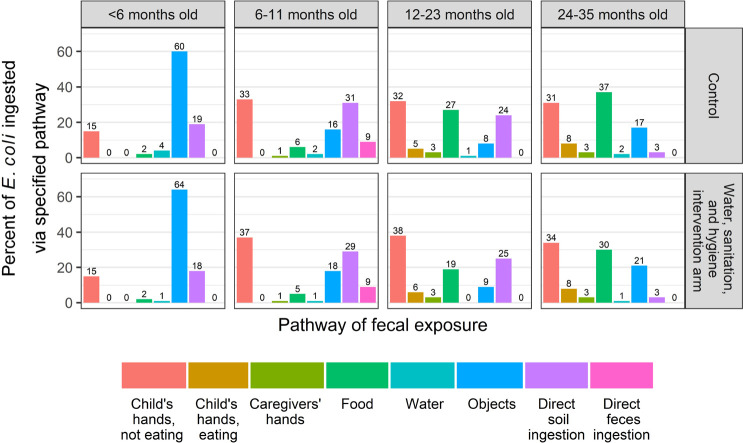
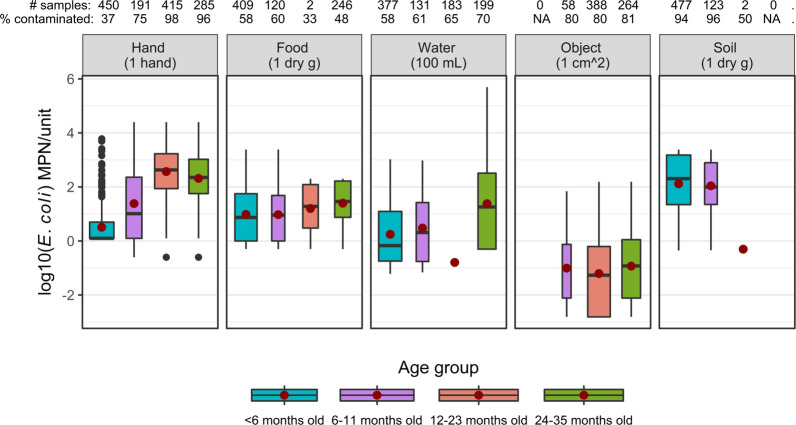
Quantifying the contribution of individual exposure pathways to a child's total ingestion of fecal matter could help prioritize interventions to reduce environmental enteropathy and diarrhea. This study used data on fecal contamination of drinking water, food, soil, hands, and objects and second-by-second data on children's contacts with these environmental reservoirs in rural Bangladesh to assess the relative contribution of different pathways to children's ingestion of fecal indicator bacteria and if ingestion decreased with the water, sanitation, and hygiene interventions implemented in the WASH Benefits Trial. Our model estimated that rural Bangladeshi children <36 months old consume 3.6-4.9 log most probable number /day. Among children <6 months, placing objects in the mouth accounted for 60% of ingested. For children 6-35 months old, mouthing their own hands, direct soil ingestion, and ingestion of contaminated food were the primary pathways of ingestion. The amount of ingested by children and the predominant pathways of ingestion were unchanged by the water, sanitation, and hygiene interventions. These results highlight contaminated soil, children's hands, food, and objects as primary pathways of ingestion and emphasize the value of intervening along these pathways.
量化儿童通过各种暴露途径摄入粪便的总量,可以帮助确定优先干预措施,以减少环境肠道病和腹泻。本研究利用孟加拉国农村地区饮用水、食物、土壤、手和物体粪便污染数据以及儿童与这些环境接触的逐秒数据,评估了不同途径对儿童摄入粪便指示菌的相对贡献,以及摄入是否随 WASH 效益试验中实施的水、环境卫生和个人卫生干预措施而减少。我们的模型估计,孟加拉国农村地区 <36 个月的儿童每天摄入 3.6-4.9 对数最可能数。在 <6 个月的儿童中,将物体放入口中占摄入的 60%。对于 6-35 个月的儿童,口含自己的手、直接摄入土壤和摄入受污染的食物是摄入的主要途径。水、环境卫生和个人卫生干预措施并未改变儿童摄入的量和主要摄入途径。这些结果突出了污染土壤、儿童的手、食物和物体是摄入的主要途径,并强调了沿着这些途径进行干预的重要性。