Department of Evidence-Based Medicine, Southwest Medical University, Luzhou, China.
Department of Rheumatology and Immunology, Minda Hospital of Hubei Minzu University, Enshi, China.
J Cell Mol Med. 2020 Nov;24(21):12379-12389. doi: 10.1111/jcmm.15737. Epub 2020 Oct 20.
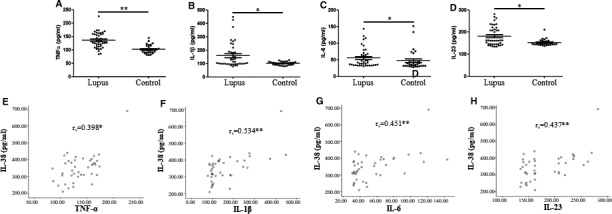
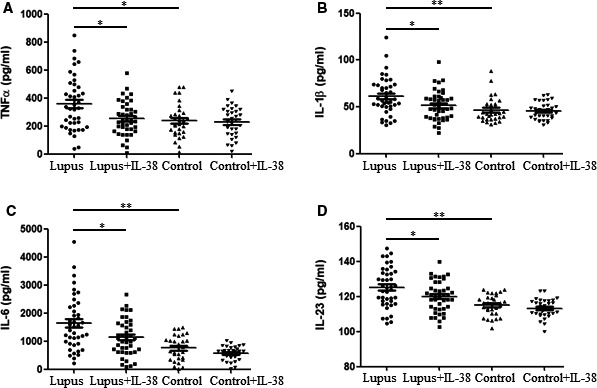
IL-38 is a newly identified cytokine that belongs to the IL-1 family. In our previous study, we found elevated plasma levels of IL-38 in patients with systemic lupus erythematosus (SLE). However, the clear relationship of IL-38 expression in plasma, peripheral blood mononuclear cells (PBMCs) and clinical and laboratory features needs elucidation. Additionally, we evaluated the possible role of IL-38 in regulating production of inflammatory cytokines in PBMCs in vitro. A pristane-induced murine lupus model was used to further demonstrate the effects of IL-38 on cytokines in vivo and discuss the significance of IL-38 in lupus development. The results showed that mRNA expression of IL-38 in PBMCs of patients with SLE was elevated compared with volunteers, and expression of IL-38 in both plasma and PBMCs was strongly related to clinical features, such as haematuria and proteinuria, and correlated with a SLEDAI score. Plasma levels of TNF-α, IL-1β, IL-6 and IL-23 were elevated in patients with SLE and were related to plasma levels of IL-38. In vitro, PBMCs of patients with SLE stimulated with IL-38 showed a decreased expression of the four inflammatory cytokines compared with PBMCs of patients without treatment. Interestingly, IL-38 administration in lupus mice significantly reduced the development of lupus, such as reduced proteinuria, improved histological examinations of the kidneys and down-regulated inflammatory cytokines. In conclusion, IL-38 may suppress synthesis of pro-inflammatory cytokines and therefore regulate lupus pathogenesis.
白细胞介素 38(IL-38)是一种新发现的细胞因子,属于白细胞介素 1 家族。在我们之前的研究中,发现系统性红斑狼疮(SLE)患者的血浆中白细胞介素 38(IL-38)水平升高。然而,IL-38 在血浆、外周血单个核细胞(PBMC)中的表达与临床和实验室特征之间的明确关系尚需阐明。此外,我们评估了 IL-38 在体外调节 PBMC 中炎症细胞因子产生的可能作用。采用角鲨烷诱导的狼疮小鼠模型进一步证明了 IL-38 对体内细胞因子的影响,并探讨了 IL-38 在狼疮发病机制中的意义。结果显示,与志愿者相比,SLE 患者 PBMC 中的 IL-38mRNA 表达升高,且血浆和 PBMC 中的 IL-38 表达与血尿和蛋白尿等临床特征密切相关,与 SLEDAI 评分相关。SLE 患者的 TNF-α、IL-1β、IL-6 和 IL-23 血浆水平升高,且与 IL-38 血浆水平相关。体外,与未经治疗的患者相比,SLE 患者的 PBMC 经 IL-38 刺激后,四种炎症细胞因子的表达降低。有趣的是,狼疮小鼠给予 IL-38 治疗可显著减轻狼疮的发生,如蛋白尿减少、肾脏组织学检查改善以及炎症细胞因子下调。总之,IL-38 可能抑制促炎细胞因子的合成,从而调节狼疮的发病机制。