Sakkas Hercules, Kittas Christos, Kapnisi Georgia, Priavali Efthalia, Kallinteri Amalia, Bassukas Ioannis D, Gartzonika Konstantina
Microbiology Department, Faculty of Medicine, School of Health Sciences, University of Ioannina, 45110 Ioannina, Greece.
Department of Microbiology, University Hospital of Ioannina, 45110 Ioannina, Greece.
Pathogens. 2020 Oct 17;9(10):851. doi: 10.3390/pathogens9100851.
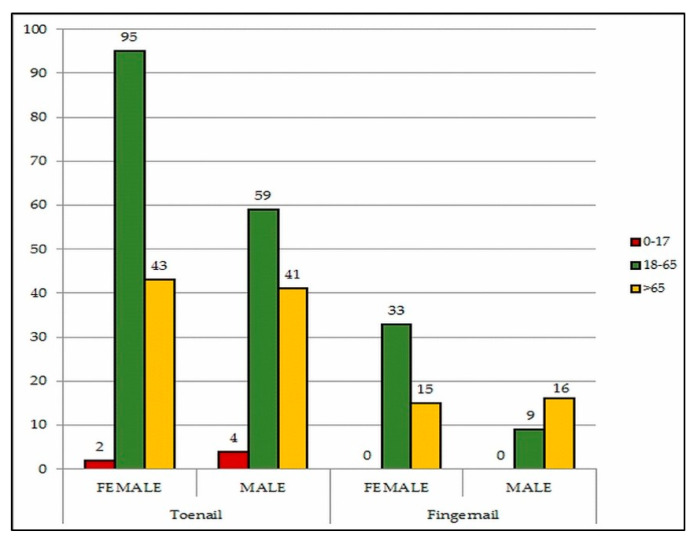
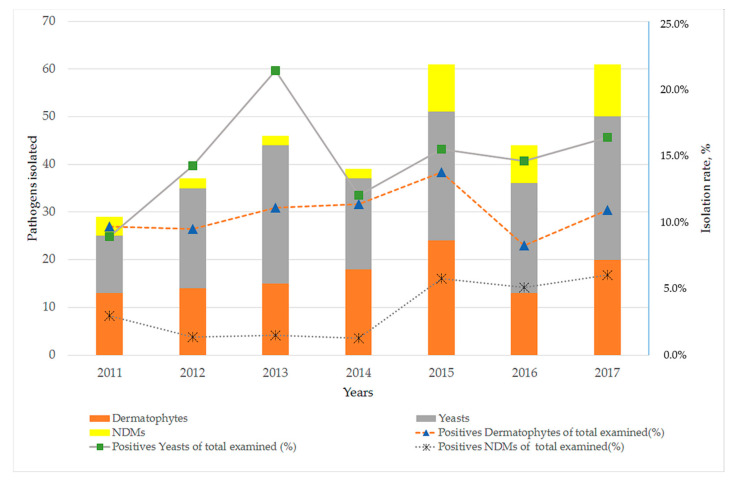
Onychomycosis is considered as one of the major public health problems with a global distribution associated with geographic, demographic and environmental factors, underlying comorbidities and immunodeficiency disorders. This study was conducted to investigate the etiological agents of onychomycosis, in Northwestern Greece during a 7-year period. The study population included 1095 outpatients with clinically suspected onychomycosis that presented to the University Hospital of Ioannina, NW Greece (2011-2017). Samples were examined for causative fungi, and mycological identification was established using standard mycological methods. Demographic data of each patient, comorbidities, localization of infection and history of previous fungal infection were collected. Onychomycosis was diagnosed in 317 of the 1095 suspected cases (28.9%) and the most frequently isolated pathogens were yeasts (50.8%) followed by dermatophytes (36.9%) and non-dermatophyte molds (NDMs) (12.3%). Dermatophytes were mostly involved in toenail onychomycosis (90.6%) and more commonly affected males than females (57.3% vs. 42.7%), while the predominantly isolated pathogen was (74.4%) followed by (21.4%). was the most prevalent isolated yeast (82%), whereas among the cases with onychomycosis due to NDMs, spp. were isolated as the principal species (59%). Continuous monitoring should be performed in order to identify possible trends and shifts in species isolation rates and to evaluate the impact of onychomycosis among the general population and high-risk groups.
甲癣被认为是一个主要的公共卫生问题,其全球分布与地理、人口统计学和环境因素、潜在的合并症及免疫缺陷疾病有关。本研究旨在调查希腊西北部7年间甲癣的病原体。研究人群包括1095名临床疑似甲癣的门诊患者,这些患者就诊于希腊西北部约阿尼纳大学医院(2011 - 2017年)。对样本进行致病真菌检测,并采用标准真菌学方法进行真菌鉴定。收集了每位患者的人口统计学数据、合并症、感染部位及既往真菌感染史。在1095例疑似病例中,确诊甲癣317例(28.9%),最常分离出的病原体是酵母菌(50.8%),其次是皮肤癣菌(36.9%)和非皮肤癣菌霉菌(NDMs)(12.3%)。皮肤癣菌主要累及趾甲甲癣(90.6%),男性比女性更易受累(57.3%对42.7%),而最常分离出的病原体是 (74.4%),其次是 (21.4%)。 是最常见的分离酵母菌(82%),而在由NDMs引起的甲癣病例中, spp. 是主要分离菌种(59%)。应持续进行监测,以确定菌种分离率可能的趋势和变化,并评估甲癣在普通人群和高危人群中的影响。