Watanabe Yumi, Hirao Yoshitoshi, Kasuga Kensaku, Tokutake Takayoshi, Kitamura Kaori, Niida Shumpei, Ikeuchi Takeshi, Nakamura Kazutoshi, Yamamoto Tadashi
aDivision of Preventive Medicine, Niigata University Graduate School of Medical and Dental Sciences, Niigata, Japan.
bBiofluid Biomarker Center, Niigata University Graduate School of Medical and Dental Sciences, Niigata, Japan.
Dement Geriatr Cogn Dis Extra. 2020 Sep 11;10(3):94-104. doi: 10.1159/000509561. eCollection 2020 Sep-Dec.
Biomarkers of Alzheimer's disease (AD) that can easily be measured in routine health checkups are desirable. Urine is a source of biomarkers that can be collected easily and noninvasively. We previously reported on the comprehensive profile of the urinary proteome of AD patients and identified proteins estimated to be significantly increased or decreased in AD patients by a label-free quantification method. The present study aimed to validate urinary levels of proteins that significantly differed between AD and control samples from our proteomics study (i.e., apolipoprotein C3 [ApoC3], insulin-like growth factor-binding protein 3 [Igfbp3], and apolipoprotein D [ApoD]).
Enzyme-linked immunosorbent assays (ELISAs) were performed using urine samples from the same patient and control groups analyzed in the previous proteomics study (18 AD and 18 controls, set 1) and urine samples from an independent group of AD patients and controls (13 AD, 5 mild cognitive impairment [MCI], and 32 controls) from the National Center for Geriatrics and Gerontology Biobank (set 2).
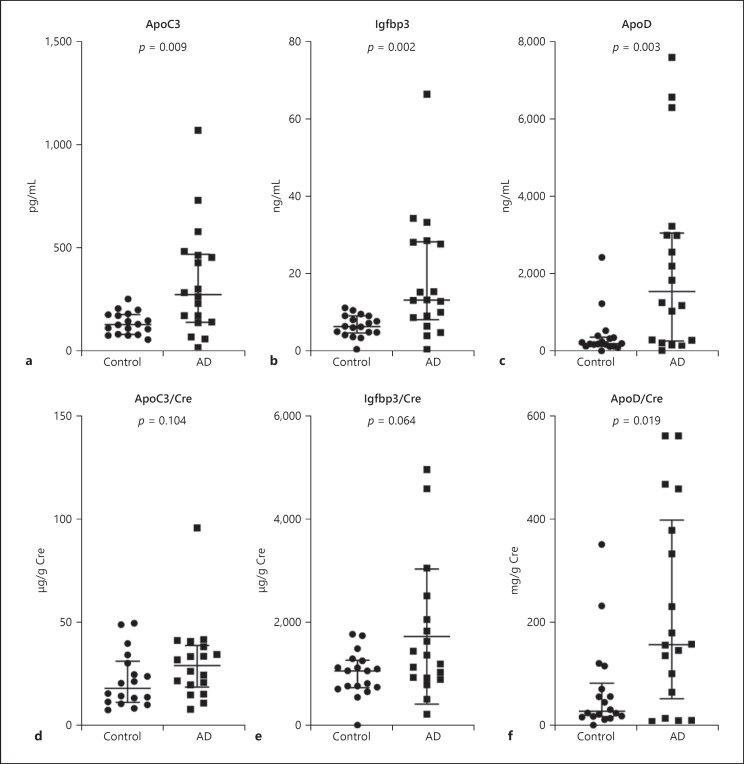
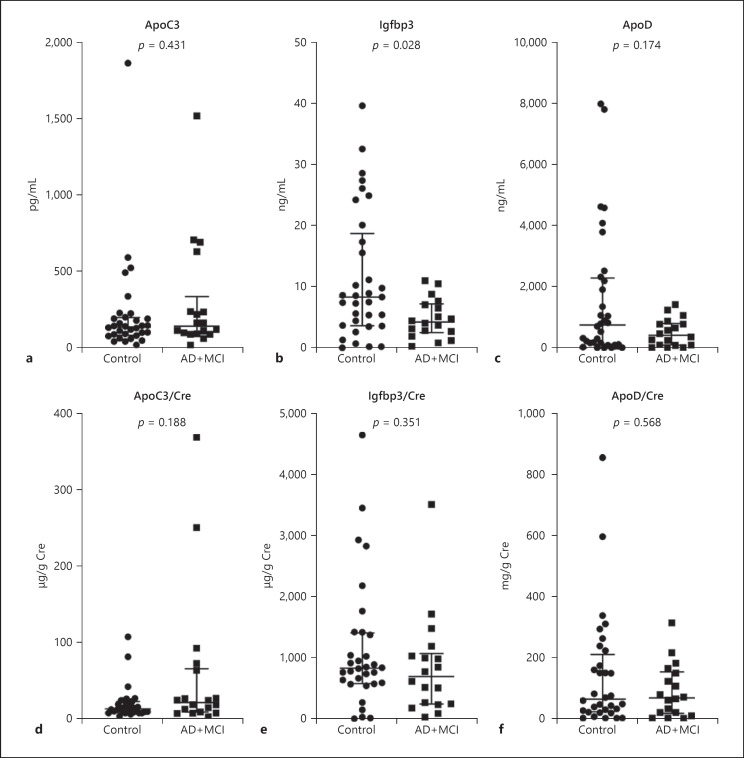
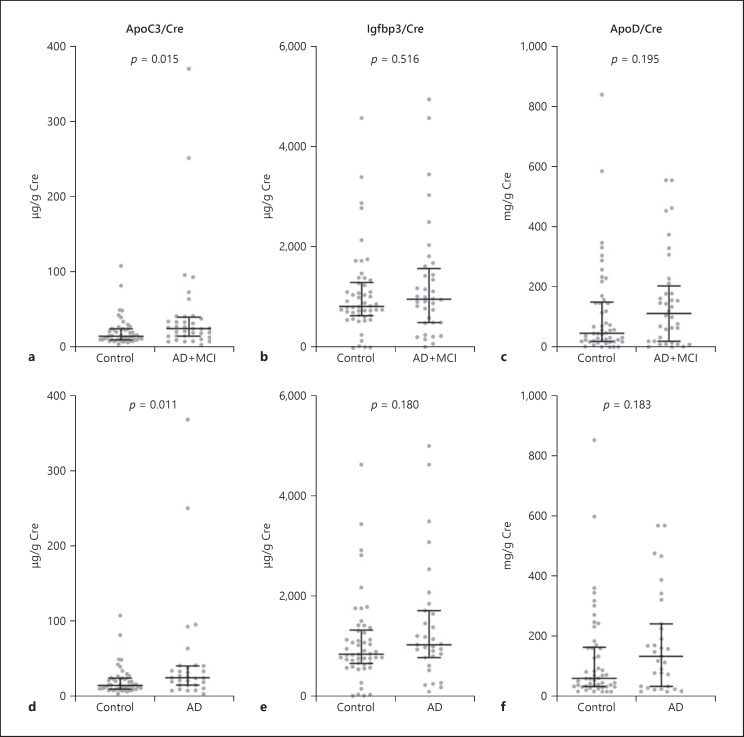
In set 1, the crude urinary levels of ApoD, Igfbp3, and creatinine-adjusted ApoD were significantly higher in the AD group relative to the control group ( = 0.003, = 0.002, and = 0.019, respectively), consistent with our previous proteomics results. In set 2, however, the crude urinary levels of Igfbp3 were significantly lower in the AD+MCI group than in the control group ( = 0.028), and the levels of ApoD and ApoC3 did not differ significantly compared to the control group. Combined analysis of all samples revealed creatinine-adjusted ApoC3 levels to be significantly higher in the AD+MCI group ( = 0.015) and the AD-only group ( = 0.011) relative to the control group.
ApoC3 may be a potential biomarker for AD, as validated by ELISA. Further analysis of ApoC3 as a urinary biomarker for AD is warranted.
理想的阿尔茨海默病(AD)生物标志物应能在常规健康检查中轻松检测。尿液是生物标志物的一个来源,可轻松且无创地收集。我们之前报道了AD患者尿液蛋白质组的全面概况,并通过无标记定量方法鉴定出估计在AD患者中显著增加或减少的蛋白质。本研究旨在验证我们蛋白质组学研究中AD样本与对照样本之间存在显著差异的蛋白质的尿液水平(即载脂蛋白C3 [ApoC3]、胰岛素样生长因子结合蛋白3 [Igfbp3]和载脂蛋白D [ApoD])。
使用来自先前蛋白质组学研究中相同患者和对照组的尿液样本(18例AD患者和18例对照,第1组)以及来自国立老年医学和老年学中心生物样本库的一组独立AD患者和对照的尿液样本(13例AD患者、5例轻度认知障碍[MCI]患者和32例对照,第2组)进行酶联免疫吸附测定(ELISA)。
在第1组中,AD组的ApoD、Igfbp3粗尿液水平以及肌酐校正后的ApoD水平相对于对照组显著更高(分别为 = 0.003、 = 0.002和 = 0.019),与我们之前的蛋白质组学结果一致。然而,在第2组中,AD + MCI组的Igfbp3粗尿液水平显著低于对照组( = 0.028),并且与对照组相比,ApoD和ApoC3水平无显著差异。对所有样本的综合分析显示,相对于对照组,AD + MCI组( = 0.015)和仅AD组( = 0.011)的肌酐校正后的ApoC3水平显著更高。
经ELISA验证,ApoC3可能是AD的潜在生物标志物。有必要进一步分析ApoC3作为AD尿液生物标志物的情况。