Patel Darpan I, Gallegos Amber M, Sheikh Bilal, Vardeman Sarah, Liss Michael A
School of Nursing, University of Texas Health at San Antonio, San Antonio, TX, 78229, USA.
Mays Cancer Center at UT Health San Antonio, University of Texas Health at San Antonio, San Antonio, TX, 78229, USA.
Contemp Clin Trials Commun. 2020 Oct 2;20:100659. doi: 10.1016/j.conctc.2020.100659. eCollection 2020 Dec.
Herein, we propose a novel RCT study to collect preliminary data on the impact of a 24-week home-based exercise program that can improve prognosis, physical function, and quality of life (QoL) in men with prostate cancer (PCa). This study will provide data on the feasibility of conducting a home-based exercise study and pilot data on the impact of exercise on circulating concentrations of biomarkers reported in the literature to be beneficial for the prognostication of PCa.
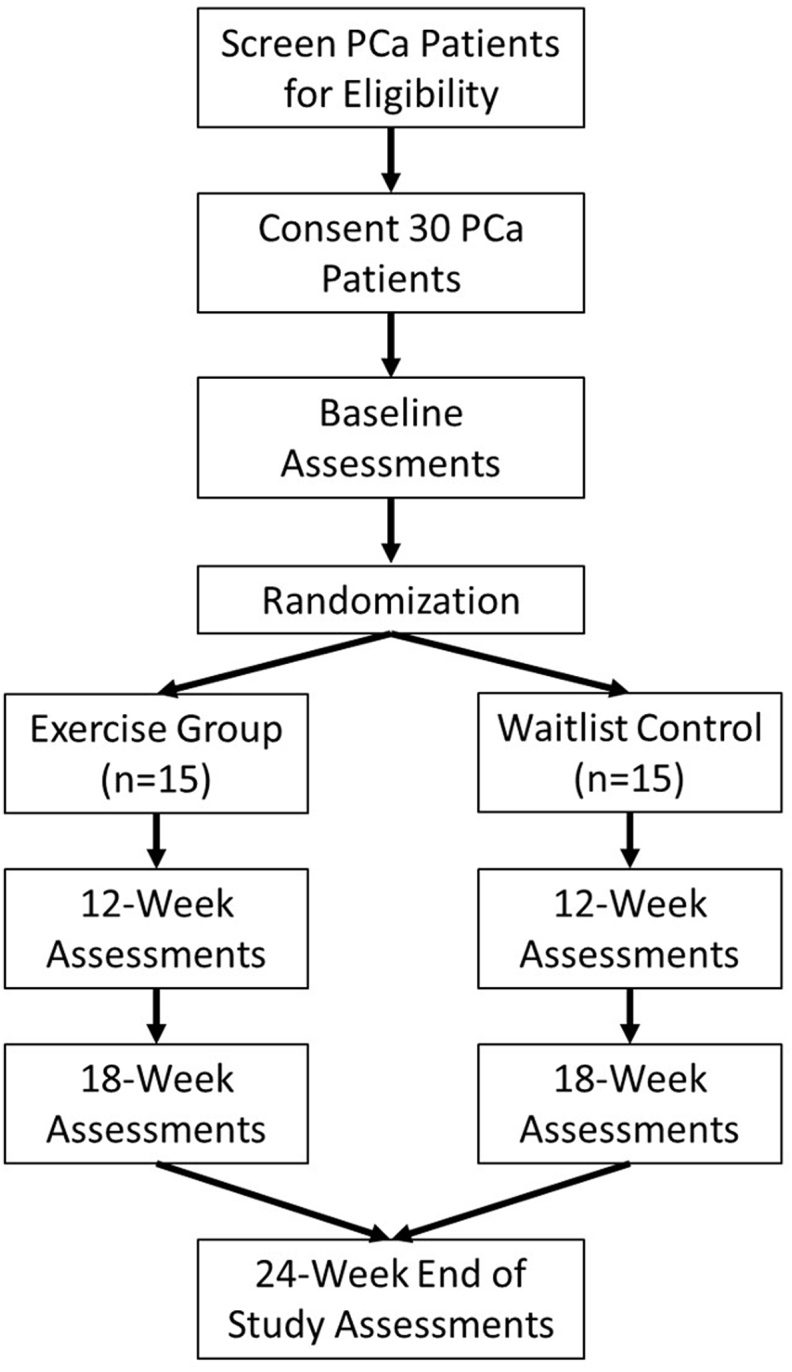
METHODS/DESIGN: Thirty male patients, clinically-diagnosed with prostate cancer under active surveillance, will be recruited to participate in a 2-arm, 24-week home-based program Random allocation to each arm - intervention, and control - will be performed in a 1:1 ratio. Participants assigned to the intervention group will perform 30 min of light-to-moderate intensity walking five days a week (40-60% heart rate reserve) and three sets of 15 repetitions of light callisthenic exercises (bodyweight squats, incline push-ups, and hip thrusts) 3 days a week. Participants randomized to the control group will maintain normal activity throughout the 24 weeks. Four visits occurring at baseline, 12-, 18-, and 24-weeks will be used to assess QoL, body composition, prognostic biomarker concentrations, and overall physical function. Primary endpoints include significant changes in prognostic biomarkers. Secondary endpoints include changes in quality of life, physical function and body composition.
This study should demonstrate preliminary evidence that a home-based exercise intervention can impact biomarkers of progression while improving quality of life, physical function and body composition. Results from this study have the potential to promote health and wellness while minimizing cancer progression in men with PCa.
在此,我们提出一项新颖的随机对照试验(RCT)研究,以收集关于一项为期24周的居家锻炼计划影响的数据,该计划可改善前列腺癌(PCa)男性患者的预后、身体功能和生活质量(QoL)。本研究将提供关于开展居家锻炼研究可行性的数据,以及关于锻炼对文献报道的对PCa预后有益的生物标志物循环浓度影响的初步数据。
方法/设计:将招募30名临床诊断为处于积极监测期的前列腺癌男性患者,参与一项为期24周的双臂居家计划。将以1:1的比例随机分配至每个组——干预组和对照组。分配到干预组的参与者将每周五天进行30分钟的轻度至中度强度步行(心率储备的40 - 60%),每周三天进行三组,每组15次的轻度健身操练习(自重深蹲、斜卧推和臀部后推)。随机分配到对照组的参与者将在24周内保持正常活动。在基线、第12周、第18周和第24周进行四次访视,以评估生活质量、身体成分、预后生物标志物浓度和整体身体功能。主要终点包括预后生物标志物的显著变化。次要终点包括生活质量、身体功能和身体成分的变化。
本研究应能证明初步证据,即居家锻炼干预可影响疾病进展的生物标志物,同时改善生活质量、身体功能和身体成分。本研究结果有可能促进健康,同时将PCa男性患者的癌症进展降至最低。