Institute of Basic Medicine, College of Medicine, National Cheng Kung University, Tainan, 701, Taiwan.
Department of Histology, Embryology and Pathology, University of Medicine and Pharmacy at Ho Chi Minh City, Ho Chi Minh City, Vietnam.
BMC Med Genomics. 2020 Oct 22;13(Suppl 10):149. doi: 10.1186/s12920-020-00776-z.
Colorectal carcinoma (CRC) is the third most common cancer in the world and also the third leading cause of cancer-related mortality in Taiwan. CRC tumorigenesis is a multistep process, starting from mutations causing loss of function of tumor suppressor genes, canonically demonstrated in adenomatous polyposis coli pathogenesis. Although many genes or chromosomal alterations have been shown to be involved in this process, there are still unrecognized molecular events within CRC tumorigenesis. Elucidating these mechanisms may help improve the management and treatment.
In this study, we aimed to identify copy number alteration of the smallest chromosomal regions that is significantly associated with sporadic CRC tumorigenesis using high-resolution array-based Comparative Genomic Hybridization (aCGH) and quantitative Polymerase chain reaction (qPCR). In addition, microsatellite instability assay and sequencing-based mutation assay were performed to illustrate the initiation event of CRC tumorigenesis.
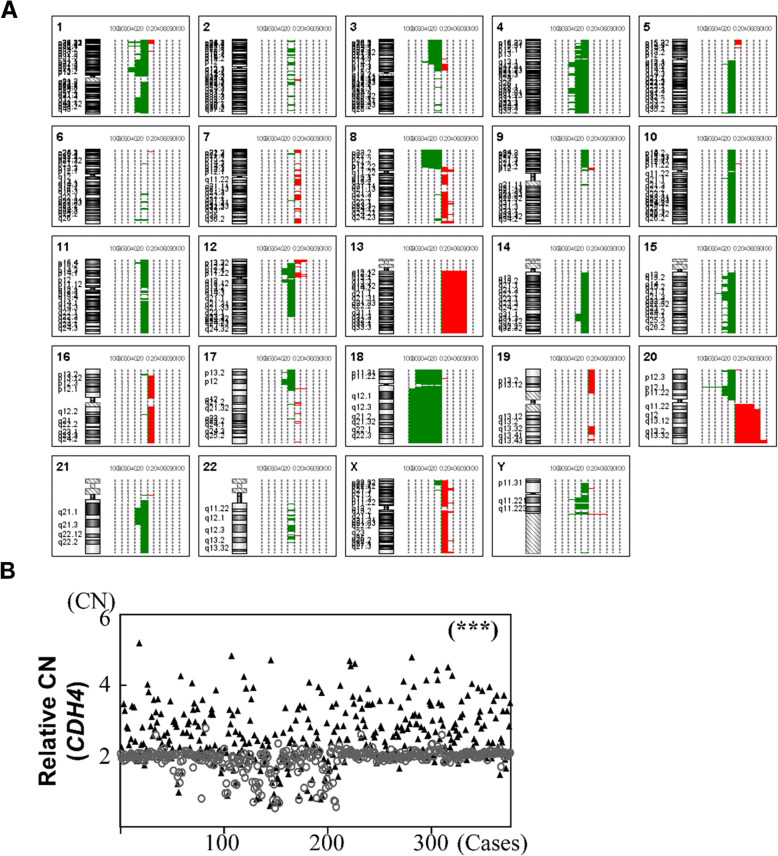
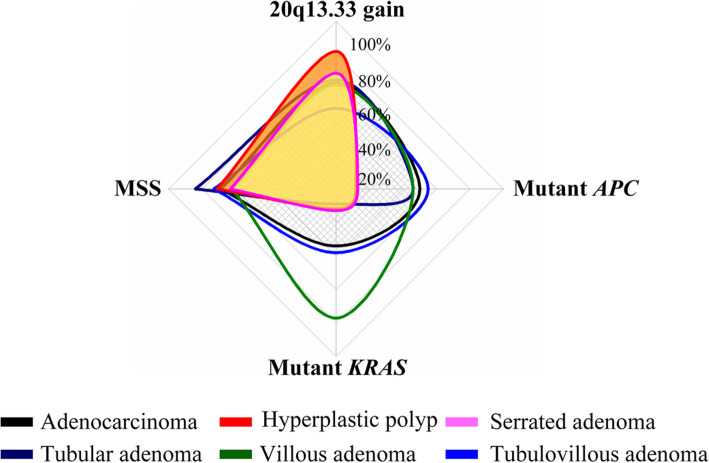
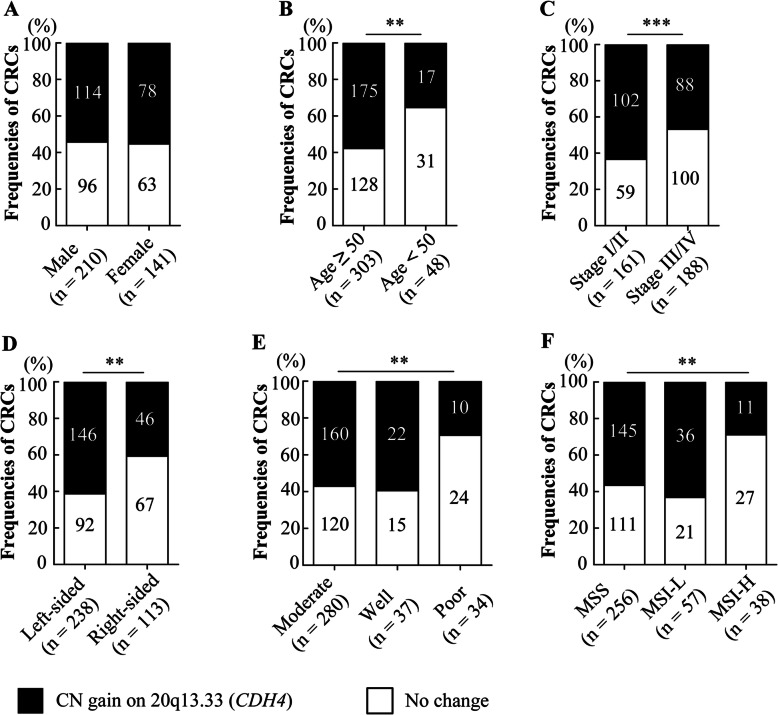
A total of 571 CRC patients were recruited and 377 paired CRC tissues from sporadic CRC cases were used to define the smallest regions with chromosome copy number changes. In addition, 198 colorectal polyps from 160 patients were also used to study the role of 20q13.33 gain in CRC tumorigenesis. We found that gain in 20q13.33 is the main chromosomal abnormalities in this patient population and counts 50.9 and 62.8% in CRC and colon polyps, respectively. Furthermore, APC and KRAS gene mutations were profiled simultaneously and co-analyzed with microsatellite instability and 20q13.33 gain in CRC patients. Our study showed that the frequency of 20q13.33 copy number gain was highest among all reported CRC mutations.
As APC or KRAS mutations are currently identified as the most important targets for CRC therapy, this study proposes that 20q13.33 copy number gain and the associated chromosomal genes function as promising biomarkers for both early stage detection and targeted therapy of sporadic CRCs in the future.
结直肠癌(CRC)是世界上第三常见的癌症,也是台湾癌症相关死亡的第三大主要原因。CRC 肿瘤发生是一个多步骤的过程,从导致肿瘤抑制基因功能丧失的突变开始,这在腺瘤性结肠息肉病发病机制中得到了明确的证明。尽管已经显示许多基因或染色体改变参与了这一过程,但 CRC 肿瘤发生中仍存在未被识别的分子事件。阐明这些机制可能有助于改善管理和治疗。
在这项研究中,我们旨在使用高分辨率基于阵列的比较基因组杂交(aCGH)和定量聚合酶链反应(qPCR)来鉴定与散发性 CRC 肿瘤发生显著相关的最小染色体区域的拷贝数改变。此外,还进行了微卫星不稳定性测定和基于测序的突变测定,以说明 CRC 肿瘤发生的起始事件。
共招募了 571 名 CRC 患者,377 对来自散发性 CRC 病例的配对 CRC 组织用于定义染色体拷贝数变化的最小区域。此外,还使用了来自 160 名患者的 198 个结肠息肉来研究 20q13.33 增益在 CRC 肿瘤发生中的作用。我们发现,20q13.33 增益是该患者群体中的主要染色体异常,在 CRC 和结肠息肉中分别占 50.9%和 62.8%。此外,同时对 APC 和 KRAS 基因突变进行了分析,并与 CRC 患者的微卫星不稳定性和 20q13.33 增益进行了共分析。我们的研究表明,在所有报道的 CRC 突变中,20q13.33 拷贝数增益的频率最高。
由于 APC 或 KRAS 突变目前被确定为 CRC 治疗的最重要靶点,因此本研究提出,20q13.33 拷贝数增益和相关染色体基因作为有希望的生物标志物,可用于未来散发性 CRC 的早期检测和靶向治疗。