Narayanan Divya, Rodriguez John, Wallstrom Garrick, Welch Donna, Chapin Matthew, Arrigg Paul, Abelson Mark
Ora, Inc, 300 Brickstone Square, Andover, MA, 01810, USA.
Statistics and Data Corporation, Tempe, AZ, USA.
BMC Ophthalmol. 2020 Oct 22;20(1):424. doi: 10.1186/s12886-020-01683-8.
To prevent irreversible vision loss in age-related macular degeneration (AMD), it is critical to detect retinal dysfunction before permanent structural loss occurs. In the current study we evaluated a series of visual function tests to identify potential endpoints to detect visual dysfunction in non-advanced AMD.
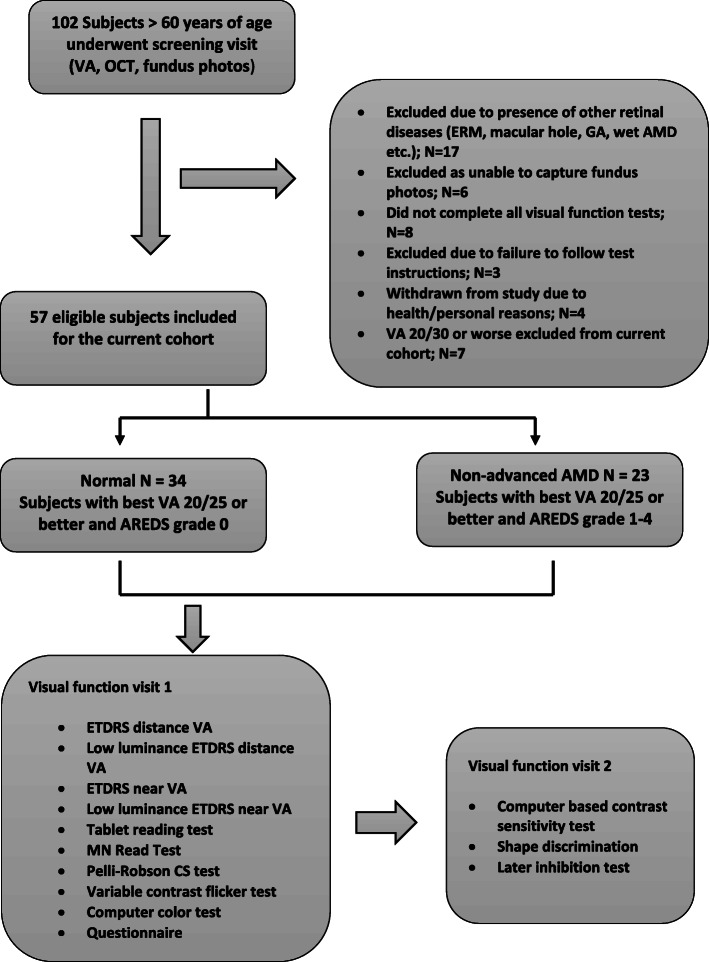
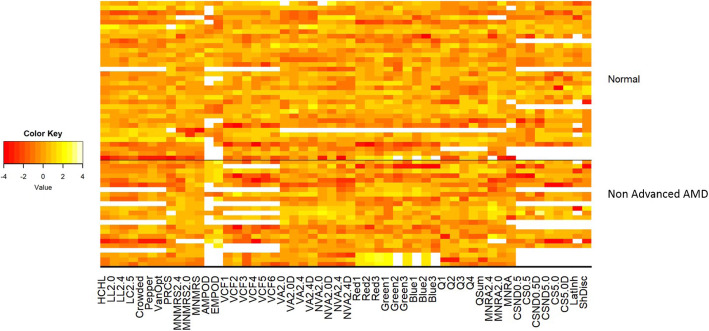
A series of visual function tests were performed on 23 non-advanced AMD subjects (AREDS grade 1-4 on simplified scale) and 34 age-matched normals (AREDS grade 0). Tests included some commonly used endpoints such as ETDRS visual acuity (VA), low luminance (LL) 2.0ND ETDRS VA, MNREAD as well as newly developed tests such as the Ora-VCF™ test, Ora-tablet reading test, color sensitivity etc. Differences between the two groups were compared for each test. Test-retest repeatability and reproducibility was assessed on a subset of subjects and percent agreement was calculated.
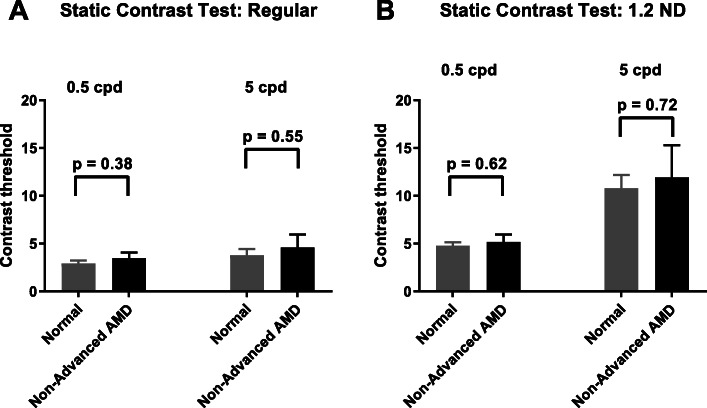
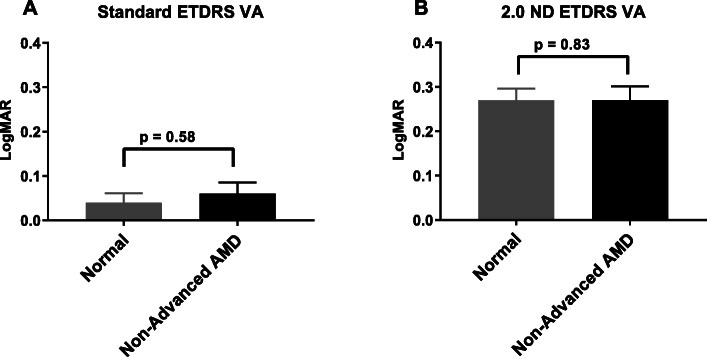
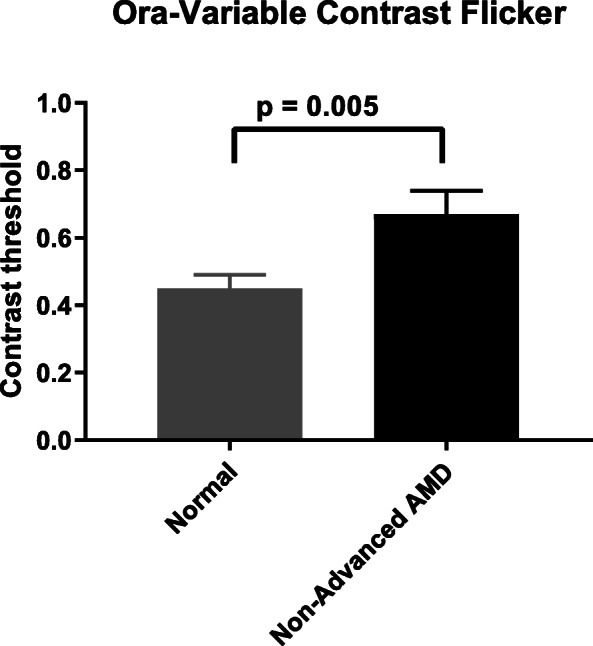
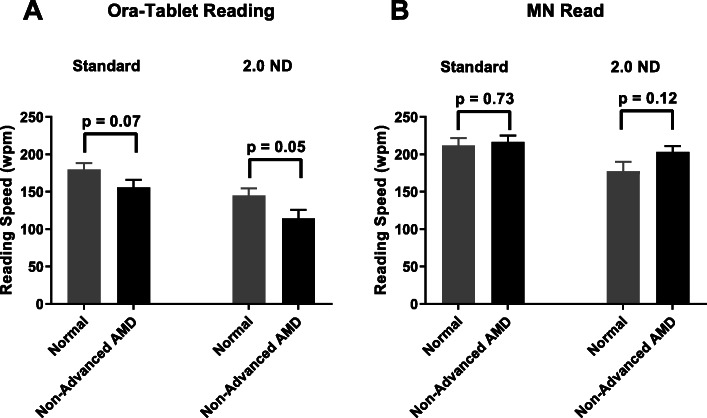
There was no difference in standard ETDRS VA between non-advanced AMD (0.06 ± 0.02 logMAR) and normal groups (0.04 ± 0.02 logMAR) (p = 0.57). LL 2.0 ETDRS VA and MNREAD showed no difference between the groups (p > 0.05). Ora-VCF™ test was significantly worse in the non-advanced AMD group compared to normals (0.67 ± 0.07 in AMD; 0.45 ± 0.04 in normals, p = 0.005). Non-advanced AMD subjects also had significantly worse reading performance using the Ora-tablet with LL 2.0ND (114.55 ± 11.22 wpm in AMD; 145.17 ± 9.55 wpm in normals p = 0.049). No significant difference between the groups was noted using other tests. Repeatability was 82% for Ora-VCF™ test and 92% for Ora-tablet LL 2.0ND reading. Reproducibility was 89% for both Ora-VCF™ test and Ora-tablet LL 2.0ND reading.
While there was no significant difference between non-advanced AMD and normal groups using some current common endpoints such as ETDRS VA, LL 2.0 ETDRS VA or MNREAD, Ora-VCF™ test and Ora-tablet LL 2.0ND reading tests were able to identify significant visual dysfunction in non-advanced AMD subjects. These tests show promise as endpoints for AMD studies.
为预防年龄相关性黄斑变性(AMD)导致不可逆的视力丧失,在永久性结构损伤发生之前检测视网膜功能障碍至关重要。在本研究中,我们评估了一系列视觉功能测试,以确定在非晚期AMD中检测视觉功能障碍的潜在终点指标。
对23名非晚期AMD受试者(简化分级为AREDS 1 - 4级)和34名年龄匹配的正常受试者(AREDS 0级)进行了一系列视觉功能测试。测试包括一些常用的终点指标,如ETDRS视力(VA)、低亮度(LL)2.0ND ETDRS VA、MNREAD,以及新开发的测试,如Ora-VCF™测试、Ora片剂阅读测试、颜色敏感度等。对每组测试比较两组之间的差异。在一部分受试者中评估了测试 - 再测试的重复性和再现性,并计算了一致性百分比。
非晚期AMD组(0.06±0.02 logMAR)和正常组(0.04±0.02 logMAR)之间的标准ETDRS VA无差异(p = 0.57)。两组之间LL 2.0 ETDRS VA和MNREAD无差异(p>0.05)。与正常组相比,非晚期AMD组的Ora-VCF™测试明显更差(AMD组为0.67±0.07;正常组为0.45±0.04,p = 0.005)。非晚期AMD受试者在使用LL 2.0ND的Ora片剂时阅读表现也明显更差(AMD组为114.55±11.22词/分钟;正常组为145.17±9.55词/分钟,p = 0.049)。使用其他测试未发现两组之间有显著差异。Ora-VCF™测试的重复性为82%,Ora片剂LL 2.0ND阅读的重复性为92%。Ora-VCF™测试和Ora片剂LL 2.0ND阅读的再现性均为89%。
虽然使用一些当前常用的终点指标,如ETDRS VA、LL 2.0 ETDRS VA或MNREAD时,非晚期AMD组和正常组之间没有显著差异,但Ora-VCF™测试和Ora片剂LL 2.0ND阅读测试能够识别非晚期AMD受试者中的显著视觉功能障碍。这些测试有望作为AMD研究的终点指标。