Center for Stem Cell and Translational Medicine, School of Life Sciences, Anhui University, Hefei 230601, China.
Department of Molecular and Medical Pharmacology, Crump Institute for Molecular Imaging (CIMI), California NanoSystems Institute (CNSI), University of California, Los Angeles, Los Angeles, CA 90095, USA.
Sci Adv. 2020 Oct 23;6(43). doi: 10.1126/sciadv.abb7107. Print 2020 Oct.
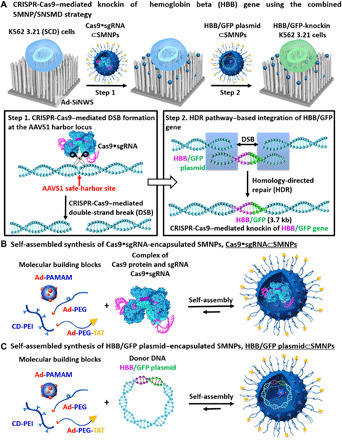
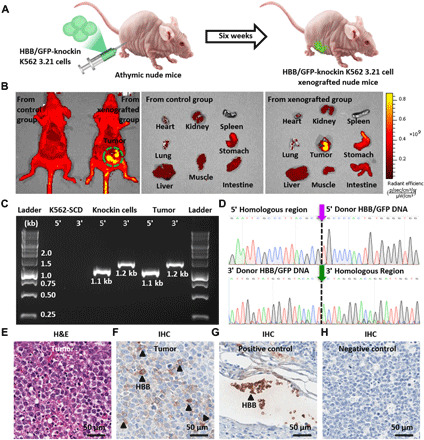
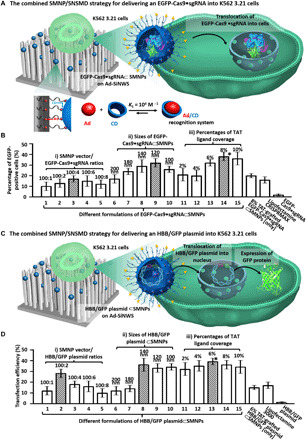
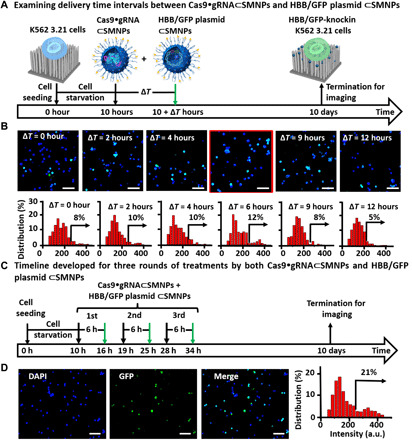
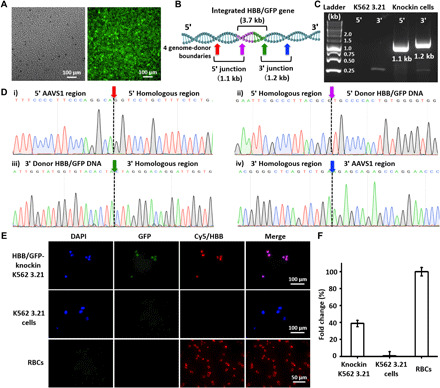
Leveraging the endogenous homology-directed repair (HDR) pathway, the CRISPR-Cas9 gene-editing system can be applied to knock in a therapeutic gene at a designated site in the genome, offering a general therapeutic solution for treating genetic diseases such as hemoglobinopathies. Here, a combined supramolecular nanoparticle (SMNP)/supramolecular nanosubstrate-mediated delivery (SNSMD) strategy is used to facilitate CRISPR-Cas9 knockin of the hemoglobin beta (HBB) gene into the adeno-associated virus integration site 1 (AAVS1) safe-harbor site of an engineered K562 3.21 cell line harboring the sickle cell disease mutation. Through stepwise treatments of the two SMNP vectors encapsulating a Cas9•single-guide RNA (sgRNA) complex and an HBB/green fluorescent protein (GFP)-encoding plasmid, CRISPR-Cas9 knockin was successfully achieved via HDR. Last, the HBB/GFP-knockin K562 3.21 cells were introduced into mice via intraperitoneal injection to show their in vivo proliferative potential. This proof-of-concept demonstration paves the way for general gene therapeutic solutions for treating hemoglobinopathies.
利用内源性同源定向修复(HDR)途径,CRISPR-Cas9 基因编辑系统可用于在基因组的指定位置敲入治疗基因,为治疗血红蛋白病等遗传疾病提供通用的治疗方案。在这里,采用了一种联合的超分子纳米颗粒(SMNP)/超分子纳米底物介导的递送(SNSMD)策略,以促进血红蛋白β(HBB)基因在携带镰状细胞病突变的工程化 K562 3.21 细胞系的腺相关病毒整合位点 1(AAVS1)安全港位点的 CRISPR-Cas9 基因敲入。通过两步处理两个封装 Cas9•单链引导 RNA(sgRNA)复合物和 HBB/绿色荧光蛋白(GFP)编码质粒的 SMNP 载体,成功地通过 HDR 实现了 CRISPR-Cas9 基因敲入。最后,通过腹腔注射将 HBB/GFP 敲入 K562 3.21 细胞引入小鼠体内,以显示其体内增殖潜力。这一概念验证为治疗血红蛋白病的通用基因治疗方案铺平了道路。